07/10/1944 — 04/17/2020
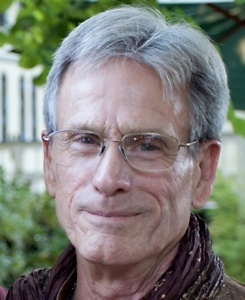
by Omprakash Rider and Indradevi Powers
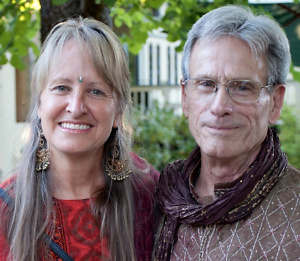
Brian Powers, later given the spiritual name of Bajrang by Swami Kriyananda, was born in Sausalito, and raised in Walnut Creek, in the east San Francisco Bay Area. His parents had Yogananda’s Autobiography of a Yogi on a shelf in the house where he grew up – he took it with him when he moved out on his own at the age of 17, but only because he thought it looked cool. He did not read it for several more years. In 1977, Brian and Lisa met while on a film crew at San Jose State, producing a public service television series about preventative health, in the days of motion picture camera’s and hot glue splicing.
Lisa and Brian became friends, and by 1980 they were living together in San Jose. Lisa had read the AY in 1973 and visited the Meditation Retreat in 1980. Shortly after, Brian also visited, and then they both became involved with Ananda in the Bay Area.
In 1982 they were married on a beach at sunset, in west Maui.
Brian (aka Bajrang) had been collecting various kinds of antiques, and was now running a small business in Los Gatos called “Toys for Big Boys”. This retail store sold antique armor, weapons, ship models, globes, and some Japanese and Asian items. Many of the objects he handled were from the Renaissance era, but there were also some much older items from ancient Greece and Rome. He had a gift for buying, selling, researching, and conserving old antiquities, and researching their backgrounds.
In 1981 Bajrang started selling objects in his unique specialty at California antique shows, showcasing them as art in the general antique market, with Lisa’s help. He was noticed by producers of high-end antiques shows, and in January of 1984 they shipped their inventory east to sell at Manhattan’s New York Winter Antique Show, one of the most prestigious shows in the world. Toy’s For Big Boys now became Brian Michael Powers, Inc, to match the gravitas of the venue. This show opened the door to more top-of-the-line shows, and an international clientele, which skyrocketed their business.
Bajrang and Lisa attended their first major antique show, a large gathering in New York City focused on arms and armor. This led to connections and sources, and Bajrang began making buying trips to London – the center of the arms and armor world. Lisa now quit her hospital job to join him, assisting in his growing business to support the shows which were now bringing in more income than the retail store. In 1986 the business grossed more than one million dollars. They could hardly believe their success.
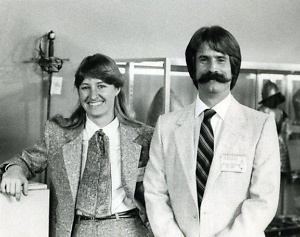
Bajrang gained a reputation for being an honest dealer with integrity. He began to be recommended by other antique dealers to collectors and museums to authenticate and value collections. The curator of the arms and armor collection at the Metropolitan Museum of Art in NYC, one of the most respected curators in the world, recommended him to a wealthy collector in Reno, because of his integrity. Bajrang worked for this man for nearly 20 years, providing an income for their early years at Ananda Village.
In the 1980’s, Bajrang and Lisa got more involved with Ananda. For a while they hosted a small Ananda meditation group in the shop in Los Gatos. During this time Prahlad, Jerry Haslam, Govinda, and other Ananda ministers came to help lead the group.
They had a large box truck, used in transporting the large number of both display items and fixtures to numerous Antique shows around the country. Bajrang and Lisa used this truck to move Bharat and Anandi back to the Village from the Menlo Park ashram, and to move David and Asha Praver from the Village to Palo Alto. They both became Kriyabans during this time, and then in 1989 they were among the first Ananda members to move into the newly purchased Ananda Community in Mountain View.
In 1986 Bajrang and Lisa had bought 5 acres off Maidu ridge from Mike Hebel, a San Francisco policeman who was a friend of Swami’s. They sold this to Dave Bingham and purchased the land abutting the hermitage chapel, and traded it to Ananda for Parcel C, connected to the Hebel land. In 1990 they moved a trailer onto parcel C and in 1992 hired the Ananda Builders Guild to build a house for them. Thanksgiving weekend of 1992 saw them moved in to their new house at Ananda. (Dave Bingham soon also built a house on the adjoining Hebel parcel.)
By this time Bajrang had sold his retail operation and was working solely for the wealthy collector in Reno, buying for and curating his extensive collection. Doing this had freed him to move to the Village. Now he became involved with helping in several areas of the Ananda community and with Swami Kriyananda.
For several years, in the mid-1990’s, Bajrang coached the 9 – 14 year old junior high school girl’s and their Little League team, called the Ananda Angels.
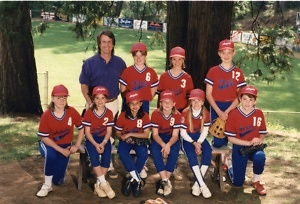
Unlike many of the other coaches in the league, who focused on winning, he wanted the girls to have fun. He wrote a song called “What do I do with the white thing?”,(to the tune of Take Me out to the Ball Game). The girls all cheered the opposing team’s good plays, and they often took them out for pizza after the games. At the Village he learned to operate a tractor, assisting with work at the Village. But he also used the tractor in helping the girls pick blackberries by putting them in the foam pad-lined bucket and extending it out over the bushes so they could access the best berries at the top.
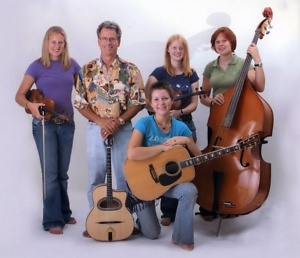
Bajrang also became a teacher in the junior high school. Among other things he taught the students to sell things on eBay, which was at that time a very new concept. They used their earnings to finance a school trip to England & Paris. Then there was the Fiddlesticks Band. This after-school project gave a number of girls the opportunity to become better musicians in a folk/bluegrass/soft rock band. Bajrang had Rick Toles, who was Tim Kretzmann’s partner in the Joyfull Strings duo, give lessons to the band to improve their playing.
Yet another project that Bajrang organized for his students was restoring old cars, something he had done since he was 12. Their first car was a classic 1957 Bugeye Sprite. This car came in boxes, including the body, from a friend. Bajrang obtained the parts via a website about the project, from around the world. He and the students, mostly girls, assembled the car, including grinding and welding parts. Each girl put in $500 to cover expenses, and each ended up receiving $2000 when they sold the finished car at auction.
Although he was basically a shy person, Bajrang’s dedication to the Ananda School led him to be the MC and auctioneer in many school fundraising auctions. He and Lisa travelled to the Ananda colonies to gather donated items to auction off, and Bajrang wore the tuxedo and black tie he used to wear at the antique shows’ opening Galas.
Back in 1986 Bajrang and Lisa had heard an inspiring presentation about the first India Pilgrimage. They went on the second pilgrimage in 1987. Deeply moved, they went again and again, with David and Asha Praver and Vidura and Durga Smallen, on these initial Pilgrimages, called “In the Footsteps of the Masters.” On these trips they met Master’s relatives: Harekrishna and Anjali Ghosh and Devi and Hassi Mukherjee. Bajrang especially bonded with the Ghoshes. He had the rare ability to make Harekrishna laugh. Increasingly through the years, Master’s Indian family gave him numerous family relics to take to Ananda Village.
Swami Kriyananda wanted Ananda Village to have a “museum” of items that had belonged to our gurus, along with a boutique. In 1993, at the Ananda Village Centennial Celebration of Master’s birth, the Ghoshes and Mukherjees brought many additional items that had belonged to our gurus. Bajrang and Lisa set up a temporary museum display in the Sun Room of the Crystal Hermitage, using some of their display cases and fixtures.
The Shrine of the Masters
From Swami Kriyananda’s wish to have a Museum, the idea emerged to build a permanent home for these sacred relics. Design and construction began on one of the upper terraces of the Hermitage Gardens, and the Shrine was built in 1993 and 1994. The display cabinets were built by Dave Bingham and the boutique displays and relic stands by Tim Kretzmann. Lisa set up the Shrine gift shop. Bajrang and Lisa put in many hours over the years, redesigning the display cases as new items were added. The Museum and gift shop opened on August 20, 1994, Lisa’s birthday. The Museum was renamed the Shrine of the Masters in the 2000’s, right around the time Swami gave Brian the name Bajrang.
In 2010 Bajrang and Lisa (who was given the spiritual name Indradevi in 2021) moved to a new house on Almora Road. Bajrang built a detached garage to house his various projects. In 2015 he was diagnosed with what turned out to be an incurable lung disease. He passed away in 2020, one month into the Covid lockdown.