Part 1 of this series covered the mechanics of playing the harmonium. With those skills in hand, you can explore different playing styles:
- Single-note melody
- Melody with drone
- Chords
- Melody with chord-appropriate drones
- Melody with chord-appropriate rhythm accidentals
Different players prefer different styles, and each style has its own characteristics. Different styles, too, may work better for different chants, and for different venues. For example, playing a chant that is intended to awaken devotion in a large group often employs drones and chords to make the sound fuller. At Ananda, we often use guitars and other instruments to make the sound fuller at the beginning of a devotional kirtan during which we sing multiple chants. In contrast, a chant played right before a period of silent meditation is usually one that’s quieter and more inward by nature, which lends well to the styles that emphasize melody without too much added sound. In a kirtan, we’ll play those kinds of chants farther into the program.
Some of the styles are also more demanding where playing skill is concerned. The list above is more or less ranked from the simpler to the more complex styles, so as you begin playing the instrument, give yourself time to develop skills with the simpler styles before attempting the more complex ones.
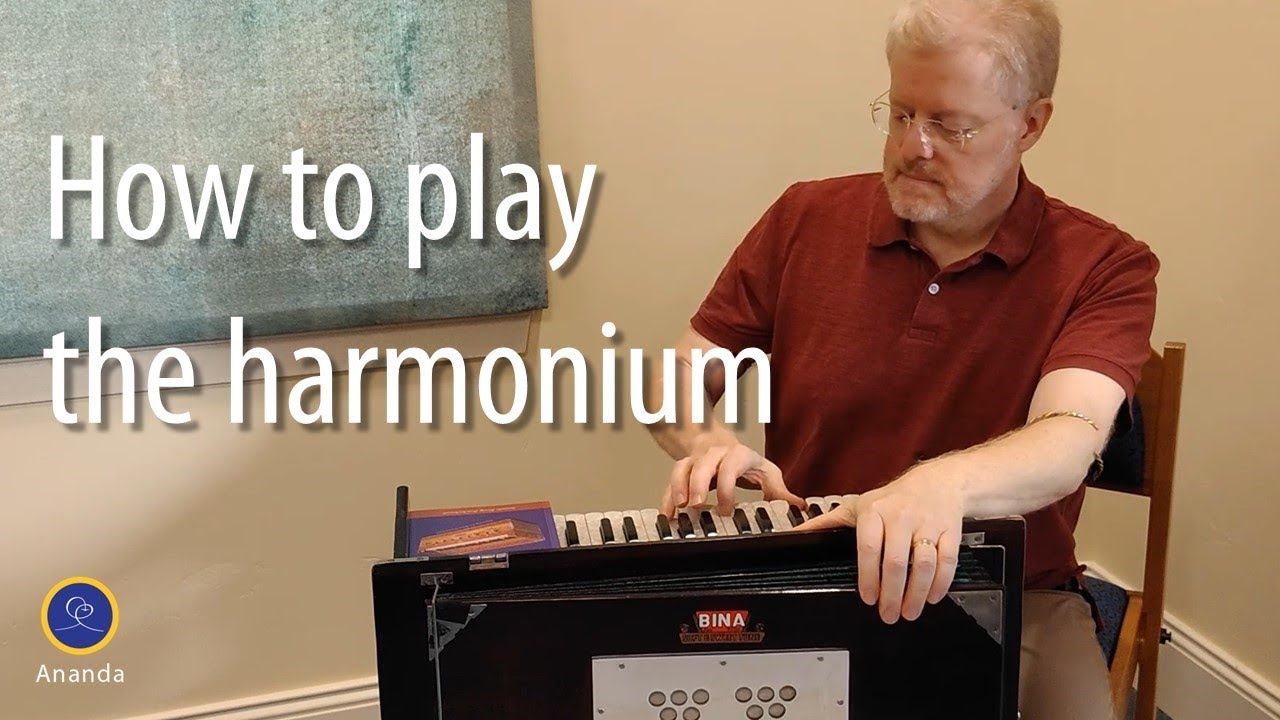
All of these styles are demonstrated in the video, How to Play the Harmonium, and the sections below link to specific segments of that video for visual demonstrations.
About tempo and volume variations
The tempo or speed at which you play a chant greatly affects how well the chant focuses the mind for meditation, which is a primary reason to chant in the first place. But bear this in mind: focus is not the same thing as speed or volume. Speed and volume can help or hinder focus depending on how they’re used. Some chants naturally want to be sung more slowly to emphasize the depth of devotion; singing them too fast scatters that energy. Other chants naturally want to be sung at a faster tempo, as their purpose is more to awaken energy, and singing them too slowly makes them drag.
To find a natural and suitable tempo, first sing the chant with voice only and no accompanying instruments. Try singing it slower and faster, honing in on the tempo where you feel that the chant has the most power. Once you’ve found that tempo, play the accompaniment on the harmonium (or another instrument) to match. Occasionally stop playing the instrument and check whether you’ve maintained the natural singing tempo.
I suggest this practice because accompanying instruments, and their playing styles, impose something of their own opinion where tempo is concerned. If you play a chant in a way that’s perhaps more natural to the instrument but then took the accompaniment away and continued with voice only, you might notice the mismatch in tempo. For example, there are tempos at which one can play a very lovely rendition of a chant on a solo guitar, but singing the chant at that speed without the guitar might sound like a dirge.
Put another way, the lead instrument in chanting is always the one that’s singing to God: the voice. Other instruments support the voice.
It’s possible, of course, to vary the tempo during the course of a single chant. Increasing the tempo can help to focus people’s attention, though it can also draw people more outward if it gets too frenetic. For that reason, devotional chanting more typically holds a steady tempo throughout most of the chant, perhaps getting more quiet and then slowing down just a bit before the end, which draws people’s energy inward for meditation to a degree.
That little slowing at the end, called a ritardando, is very common in music and signals the end of the piece. For devotional chanting, however, what we ideally want is to continue to sing the song mentally so that it helps keep our minds focused.
For this reason, Paramhansa Yogananda gave a specific five-stage technique that accomplishes this inward focus on much deeper levels and doesn’t really “end” the chant:
- Start a chant at a loud volume to “whip up the feelings in the heart,” as he put it.
- After a time, repeat the chant more at a normal singing level, letting it penetrate the conscious mind.
- Sing the volume more softly, then, down to a whisper, which brings the energy more inward.
- Sing the chant silently (while softly playing accompanying instruments), focusing at the medulla oblongata (the base of the brain). He called this “silent subconscious chanting.”
- Finally, continue to sing the chant silently but with greater intensity, focusing at the spiritual eye (the point between the eyebrows). He called this “silent superconscious chanting.” An accompanying instrument can still be played at this point, perhaps become louder at this point to signal the change in intensity and the focus at the spiritual eye, even though you’re still singing silently. You can then keep singing silently even after the accompaniment stops.
I demonstrate this technique toward the end of the companion video.
Whether a chant is naturally slow or fast, and regardless of whether its lyrics are naturally more inward or outward, this five-stage technique works with any playing style to awaken energy then pull it into and upwards in the spine to focus it at the spiritual eye, essentially implanting it in your consciousness. Try it out even on your own! You may find that a chant will keep cycling in your mind long after it’s complete.
Single-note melody
Video segment: Single-note melody style
The melody of a song, and especially the melody of a devotional chant, is the most important part of the piece because it carries and communicates the song’s aspirations. If you learn no other style, learn to play the melody of a chant by itself. In fact, the most complex style covered in this article is a return to the melody with the addition of short rhythm accidentals. If you listen to Swami Kriyananda chanting on the albums Music for Meditation and Kriyananda Chants Yogananda, you’ll notice that he focuses primarily on melody. Two examples are provided below.
A helpful aspect of single-note melody is that it doesn’t require much pumping of the bellows because of all the styles it makes the smallest demand on air flow. The most important skill, then, is learning to play the melody with a smooth legato touch so that there’s a continuity of sound. Legato means that you more or less start depressing key for the next note in the melody as you’re letting up the key for the previous note. It’s one reason why “floating fingers” as described in Part 1 are important rather than striking the keys like you would on a piano. And, fortunately, it doesn’t take much practice to play smoothly like this.
For chants that use a wider range of notes in the melody, you may need to practice cross-over fingering. For example, if most of the melody (in the key of C, say), are C, D, E, F, and G, but there’s a low G below middle C, you play that low G by crossing the index finger of the right hand over and below the thumb that’s positioned on the C, then shift the hand up for the remaining part of the melody.
If you can read music, then you can easily look at the music notation in the Ananda Chant Book to find the notes. If you can’t read music easily, however, you can label the keys appropriately and refer to them by letter instead. The Ananda Chant Book, in fact, labels every note in the musical notation with the note letter for this very reason. Because chants are so short and simple, it’s easy to memorize the rhythm so you can concern yourself with only the notes. And with a little practice you’ll soon memorize the notes as well.
One refinement with playing the melody is that when the same note is used for multiple syllables in the lyrics, it’s not necessary to lift and depress the key for each one: you can just hold the key down for that note until a change is necessary.
Melody with drone
Video segment: Melody with drone style
An aid to maintaining a continuous sound when playing a melody is to hold down one key throughout the chant as a drone (as in something that keeps talking without pause, droning on and on). Sometimes you also change the drone note in different sections of the chant, but such changes are only once or twice in the whole piece.
Many players prefer using a drone because the style is only incrementally more difficult and provides a fuller sound than playing the melody by itself. The drone also fills in any gaps in the sound so you don’t have to be quite so smooth when playing the melody notes. If this style works for you, then it can serve you well for many years.
The Ananda Chant Book indicates appropriate drones notes for each chant. Keep in mind that these are suggested drones: you can vary them if you want. Note also that it’s not necessary for the drone to be the lowest note you’re playing: sometimes it works to use drone note that’s higher than the melody. For example, when I play Swami Kriyananda’s chant “Hare Hare Krishna,” I like to play it in the key of B. For the first segment I use an F# note for the drone and play the melody on the A#, B, C#, and D# notes below it. Using the F# drone helps the melody to stand out more in my mind. For the second part of the chant, which goes higher, I switch the drone to the low B instead.
There is one caveat with using a drone: because you’re playing it simultaneously with another note, you’re creating chords, which is to say, harmonies. In many cases the chord is suitable and pleasant, or the combination happens too quickly to cause much notice. In some chants, however, some melody notes that are held longer, such as at the end of a phrase, is discordant with the drone. The result can be grating to the ears. In such cases you can either let up on the drone for that moment, or switch to a more harmonious drone note for a short time. But for the latter, you need to understand something about chords.
Chords
Video segment: Chords style
Using chords to accompany a chant means playing multiple notes together that harmonize with a given phrase in the melody. Many devotees who chant using a guitar rely primarily on chords.
On the harmonium, new players sometimes prefer using chords because chords don’t change as often as melody notes and thus pose less demands on your manual dexterity. The Ananda Chant Book indicates chords for many chants, and even a quick glance tells you that they change less frequently than the melody notes. Yogananda’s chant “Listen, Listen, Listen” (“I Will Never Forget Thee”), for example, uses two and only two chords, with the change happening only once per measure. (In this chant, too, the chord change can be made by with only the index and middle fingers while the thumb and pinky finger remain on the same keys the whole time. For this reason, “Listen, Listen, Listen” is the simplest starter chant for new players to learn.)
Most chants, though, use three or more different chords and switching between them demands a different skill than playing a melody (with or without a drone), especially when the chords in question don’t have any notes in common. In some cases, such as playing Swami Kriyananda’s fully-chorded arrangement of “Door of My Heart,” where the chords change with almost every melody note, you have to often change which finger is holding down a certain note so that you can move your fingers to other notes. As noted in Part 1 of this article, I demonstrate these movements in the video.
To help smooth these transitions, know that there are three ways to play any given chord, called inversions. It’s generally easier to switch between different inversions than it is to switch between what are called the root forms of the chords. Inversions, however, are a more involved subject, so refer to the Harmonium Handbook for details, which includes an appendix that shows all the inversions for the major and minor chords.
It’s also worth noting that Swami Kriyananda discouraged too much dependency on using chords with chanting. The reason is subtle. Melody is the relationship between consecutive notes and expresses the consciousness of the chant. Harmony, on the other hand, is the relationship between simultaneous notes and serve to deepen the feelings in the heart.
Offhand, deepening the heart’s feelings sounds like a good thing where devotion is concerned, and it can be especially helpful both at the beginning of a chant and at the beginning of a series of chants (as in a kirtan). However, the purpose of chanting is to help focus attention for meditation at the spiritual eye, not the heart. An over-reliance on chords, then, prevents the heart’s energy from rising to the spiritual eye.
If you learn to play chords, then, learn also to leave them behind, even during the course of a chant, which can be done with the styles discussed in the next two sections.
Melody with chord-appropriate drones
Video segment: Melody with chord-appropriate drones style
Earlier we saw that playing with a drone can sometimes produce discords between the drone and a melody note. The longer you use the same drone note in any given chant, the higher the likelihood of creating a discordant combination.
If you want to avoid those discords without losing the richness of the harmonies, you can change the drone more frequently as you play the melody. Specifically, use a note in the chord for that segment of the chant, meaning that you might be changing drones as often as you change chords (often once per measure or even more). It also means that sometimes you just abandon the drone altogether for a note or two until it’s suitable to bring a drone back in.
Clearly, this is a more complicated playing style than just using one or two drone notes. The reward for learning it, however, is the ability to use the richness of using chords in such a way that you can gradually let the chords go during the course of a chant and focus more on the melody. In this way you can begin a chant with more depth in the heart but then thin out the chords bring energy up to the spiritual eye. As you thin out the accompaniment, too, it’s easier to play more softly to accommodate the whispering and silent-subconscious stages of Yogananda’s chanting technique.
Learning this style also leads to the ability to play the final stylistic variation.
Melody with rhythm accidentals
Video segment: Melody with rhythm accidentals style
If you listen carefully to a few of the chants on Music for Meditation, such as “Polestar of My Life” and “Who Is in My Temple” (included below), you’ll notice that Kriyananda sometimes plays a little more than just the melody, and yet isn’t playing chords or using a drone. Those extra sounds, called “accidentals,” are produced by brief taps on a few keys other than the melody.
Those other keys used for accidentals are typically appropriate for the chord that would harmonize with the melody at that point, which demonstrates why learning chord-appropriate drones leads into this style. Once you learn those chord drones, you simply play them in little taps rather than holding them down. As such, they become more rhythm elements rather than harmony elements yet retain the harmony of the chords.
The result is an accompaniment that provides some of the richness of chords without being too heavy on them, while simultaneously providing a little bit of rhythmic grounding.
This rhythm becomes especially helpful in the silent-subconscious and silent-superconscious segment of Yogananda’s chanting progression. In those segments, you continue to mentally sing the lyrics in time with the accompaniment and these little accidentals help keep the rhythm especially when the melody uses the same note across multiple syllables. The chant “I Will Sing Thy Name” is a good example of this, because it has segments where five syllables of the lyrics use the same note. Furthermore, if you want to increase the volume or richness during the silent-superconscious segment to increase the intensity, this style allows you to bring in a little more sound and even a little more chording as suits the moment.
In short, learning to play the melody with these added accidentals gives you full flexibility of expression and is a good goal toward which to aspire.
An example
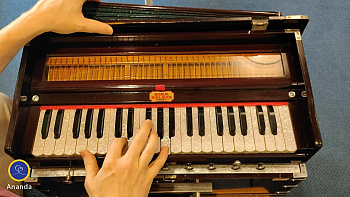
To wrap up this article on playing the harmonium, let me leave you with my rendition of “I Will Sing Thy Name,” again in the video, in which I employ several playing methods as well as Yogananda’s five-stage method of chanting.
I begin by singing loudly and playing with more volume, using more harmony (chording) to “whip up the feelings in the heart” as Yogananda put it. As I get softer, going into the middle stages of chanting, I think those chords until I’m playing the melody with rhythm accidentals. I play in that style more quietly, signifying the “silent subconscious” stage of chanting, but then play more loudly, but without singing, to indicate the “silent superconscious” stage at which I focus my awareness at the spiritual eye. After playing loudly for a bit, I play softly again for a short time before ending the accompaniment but continue singing the chant mentally. You can’t hear that continued singing on the audio, of course, but perhaps you’ll be able to hear it within yourself!
What I’ve found is that by chanting in which way, you can effectively implant the chant throughout every level of your consciousness such that it continues in the background as you go through the day. I can understand, then, why Yogananda said that “chanting is half the battle,” because having the uplifting words and melody of a chant running through your heart and mind all day long is a tremendous spiritual aid and spiritual blessing.
May you, too, be blessed in your devotional chanting.
For more about working with the harmonium, see these resources:
- The Harmonium Handbook, available in print, ebook, and audiobook
- The Ananda Chant Book
- What Is the Harmonium?
- A Brief Tour of the Harmonium
- Choosing and Buying a Harmonium
- How to Play the Harmonium, Part 1: Mechanics
- On Recording the Harmonium Handbook Audiobook
