Swami Kriyananda’s Prophetic Guidance
When Swami Kriyananda spoke with us about the college 23 years ago, he emphasized the importance of educating young people about sustainability. Looking back, I would say he was prophetic.
In 2002, Nakula (my husband) and I started a small college, the Ananda College of Living Wisdom. “Let it grow organically,” Swamiji recommended. “And grow your own food.” There were other things Swamiji shared with us during the first 11 years of the college, but our primary support came from inward attunement to his guidance and devotion to God.
Preparing for the Future
Swami Kriyananda was seeing a future when things would drastically change. He wanted us to be prepared. Swami once told us that in the hard times, money would be worthless and the real “gold” would be food—a commodity everyone needs for survival.
Today, with growing uncertainty about food supply chains, the self-sufficiency movement is experiencing a revival. Many are embracing the idea of homesteading in the countryside, cultivating gardens, and adopting a simpler way of life.
The Loneliness Epidemic
New research indicates that Gen-Z (Ages 13-28) is the loneliest generation, surpassing even older adults in feelings of loneliness. Young adults especially crave in-person experiences in small communities of like-minded peers. They want to grow their own food, meditate together, and volunteer their services. Ironically, many are turning away from social media and online communities in favor of more substantive and meaningful connections.
One of the best things we can do to help future generations and ourselves is to model key components and activities of self-sustaining communities. We need to get out of the office, step away from the computers and phones, get outside, and into the gardens.
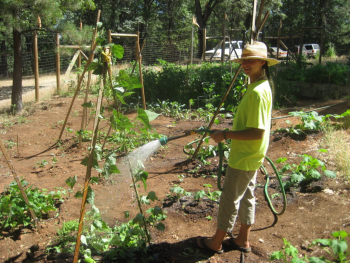
Paramhansa Yogananda was certainly not wimpy when it came to gardening. Swami Kriyananda states that:
His sensitivity to all living things inspired sensitivity from them in return. Not only people and animals, but even plants seemed to respond to his feelings for them. His gardens flourished. Tropical mangoes and bananas grew at Mt. Washington, where the climate is not conducive to their survival.
Yogananda explained that plants have a degree of consciousness and, above all, like every sentient being, respond to love. Yogananda promoted working in gardens and declared that people should spend three days working at their jobs and four days outside working in the garden.
Thousands of youths must go North, South, East and West to cover the earth with little colonies, demonstrating that simplicity of living and high thinking lead to the greatest happiness.
Building a Sustainable Campus
 One of the first things we did with our students at the Ananda Seclusion Retreat campus was to build a biodynamic garden. Under the direction of an expert in solar garden design, the students created a vibrant space that featured raised beds, a solar greenhouse, and a chicken coop. This garden, and about 20 chickens, supplied the kitchen with fresh eggs and vegetables nearly year-round.
The deer and wild turkeys were impervious to our good intentions, so when we created a botanical garden, we also built a fence. Undeterred, the wild turkeys defiantly roosted on the garden posts, daring us to banish them.
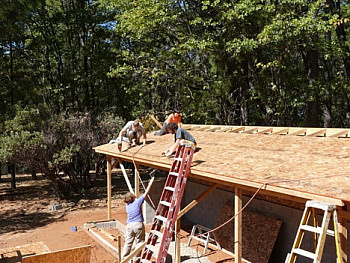
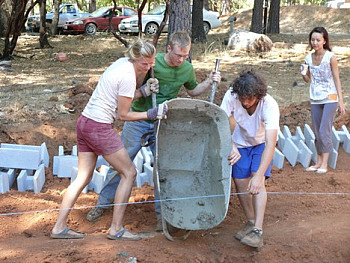
With the help of our students and Divine Mother’s grace, we built 10 canvas bungalows that housed 20 students. Together with one of the residents and Nakula, the students also created a beautiful cob temple, now known as the Temple of Joy.
Our goal was to nurture a small group of young adults in a unique way—living off the grid, immersed in a yogic lifestyle at a remote meditation retreat, surrounded by monastics, peers, and the serenity of nature. The secluded environment of our meditation retreat campus, combined with daily meditation, yoga practice, and experiential community living, provided the ideal psychic space for young adults to grow, transform, and flourish.
I once asked Swami if we should encourage the students to pursue a monastic life, and his answer surprised me. “No,” he replied, “After all, college is where young people may meet their future partners.”
Throughout the years, Swami Kriyananda often spoke about the need for small communities. He didn’t insist that they all be Ananda Communities. In fact, he once said that a community of 12 would be ideal.
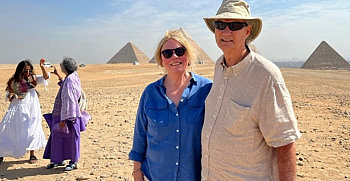
Nischala & Nakula in Egypt on pilgrimage with students. Vanamali Devi can be seen in the background.
The GAP Experience: A New Beginning
In September 2025, the Ananda College GAP Experience will be launched. This month-long program includes two pilgrimage adventures and a focused, ten-day immersion into higher consciousness at the Ananda Meditation Retreat.
Haridas and Roma Blake, the Spiritual Directors of the Ananda Meditation Retreat, led Ananda’s Bangalore, India center for 20 years. They are the ideal leaders for Ananda College to partner with for our 2025 Gap Experience.
Living in Harmony with Nature & All That Is
There is a revealing passage in the Autobiography of a Yogi where Sri Yukteswar, having just completed writing The Holy Science, receives a visit from Babaji, who appears to him sitting under a banyan tree. Yukteswar invites Babaji to join him for tea, but Babaji declines, saying, “No, child, we are people who like the shelter of trees; this spot is quite comfortable.”
This simple but profound statement reflects a trait of Satya Yuga, the golden age of highest consciousness, a time when humanity lives in harmony with nature and people maintain an awakened awareness of their oneness with Spirit and all that is.
-Nayaswami Nischala
* * *
For info on College GAP programs: anandacollege.org/gap/
For info on Micro College at Ananda Meditation Retreat: anandacollege.org/micro-college/

One Comment
Being new to Ananda, I am continuously impressed by the unique programs and progressive ideas being put into practice! I just love the community-minded encouragement by Yogananda.