Key 3: When the energy is “stuck,” action is the answer.
Corollary: Almost any action is better than inaction—once the energy starts to flow, the momentum can be turned in the direction you wish to go.
Just Three Things
Sometimes after eating dinner, I feel lethargic. I look around the kitchen and think, “Oh, gee, look at this mess! I’m too tired to clean all this up.” So I tell myself, “I’ll put away just three things,” and give myself permission to stop after three if I want to. However, almost every time, after putting three things away, I’m on a roll. Soon I’m finishing the entire kitchen.
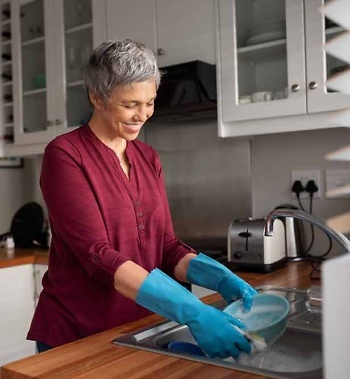 I think, “Well, I’ll just clean up the table or the counter before I stop.” Pretty soon, I look around at how little is left and conclude, “Might as well finish now because it will feel great to get it done!” Five minutes earlier, I felt I just could not clean up the kitchen. What happened?
I got the energy moving!
It takes more energy to begin anything than to keep going once we’ve begun. Continuing to act is easy compared to getting started in the first place. It’s Newton’s law applied to people.
From Listless to Enthusiastic in a Moment
One of the most memorable instances I know of this principle at work involved Peter (Kabir) MacDow, a third- and fourth-grade teacher at Ananda Living Wisdom School. One morning he began class by singing a song with the kids. However, only one or two students were really singing; the others just dully sitting there. So, he tried playing a little game to get their enthusiasm sparked. But they complained, “Do we have to?” (Every teacher dreads hearing that phrase!)
Finally, in complete exasperation at their unwillingness, Peter, with sudden inspiration, shouted, “Catch me if you can!” Then he ran out the door.
Bewildered, the children looked at each other.
“What did he say?”
One ran to the window, “There he goes; he really meant it!”
“You’re kidding,” others said, jumping up to look.
“He’s really running off. Let’s go.”
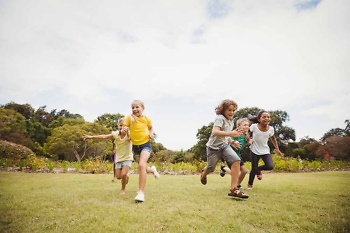 By the time the children realized what had happened and got outside, Peter had a great head start, but he stopped and looked back, yelling, “You’ll never catch me!” knowing this would incite them even more.
“Oh, yes, we will!” several shouted, everyone taking off after him.
Standing his ground, Peter taunted, “No, you can’t,” and turned and took off when the kids were only twenty yards away. He led them on a merry goose chase around the field, dodging them around the playground equipment until they finally divided up and caught him amid peals of laughter.
Breathlessly giggling and chatting, they all walked back to the classroom together. Everyone’s mood had lifted, and Peter had their complete attention for his activities the rest of the day.
Overcoming inertia is difficult. In order to get the energy moving, it is okay at first to get it going in a different direction than desired. If necessary, you can then redirect it. For teachers, this principle is an essential key. For example, a tried-and-true technique to help recalcitrant students is to send them to take something to another classroom or the principal’s office. When a student would show up in my office with a book I didn’t want, I knew exactly what was happening. They would get an enthusiastic, “Thanks for bringing this over!” By the time they returned to the classroom they were almost always ready to join in the classroom flow. Getting them moving is so much more effective than explaining to children why they should cooperate.
A body at rest tends to stay at rest.*Newton's Law of Inertia
Reason, emotional appeals, even threats — none of these work as well as just moving when one is stuck in inertia, unwilling and unable to act. When the energy is stuck, action is the answer.
Start Small
Just as I tell myself to just do three things when inertia is strong, children sometimes need a boost to get started. When a child refuses to begin a task, often it’s because the task seems so overwhelming that they cannot raise their energy to meet it. In that case, often it works to give them a small success first. Break a task down into small parts, and ask them to do only the first step. For example, if it’s a page of math problems, ask them to do just the first three. Give them praise for that and ask if they could do three more. Or if it is organizing their desks, have them just find all the trash and throw it away. You may discover that the energy generated by doing just a small piece of the task gathers momentum, and they can continue.
Writing teachers use this principle all of the time. When students are stuck, unable to think of what to write, the teacher tells them just to write (or type) anything — whatever they are thinking at the moment. Teachers may also get things moving by offering one sentence, or even just one word to get things going. Nine times out of ten, beginning to write “primes the pump,” and students flow right into completing the assignment.
I had a chance to use this key of “action is the answer” at school one winter day when it began to snow. Kids get ultra-excited when it snows during the school day in areas where snow is uncommon. They run to look out the windows, chattering excitedly, hoping it will stick so they can sled and make snowballs. It is challenging to get them calmed down and focused on work again. Savvy teachers will often take them out to play, knowing that afterwards they will be able to concentrate better.
The snow began during silent reading time. Students begged to go outside, and I agreed. However, two students, both avid readers who were in the middle of good books, began to whine, “I don’t want to go out.” I was surprised that ten-year-old boys would object to playing in the snow, and I knew it would be good for them to play and get the fresh air and exercise. But to make them go play seemed a bit authoritarian. Besides that, you can’t make anyone play!
Thinking of the axiom that once the energy is moving, it gets its own momentum, I told them, “Okay, you may read inside, but you have to go outside first and play for just ten minutes. After ten minutes, you can come back in if you want to.” I suspected they would not want to go in; but if they did, they at least would have ten minutes of exercise.
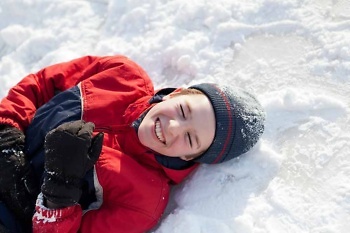 Do you think they came back in ten minutes? No, a quarter of an hour later found them running, shouting, sticking out their tongues to catch snowflakes right along with the rest of the class. They were totally involved in the flow of the energy. When the kids returned to the classroom, every individual was happy and energized.
A Walk Gets a Seven-Year-Old Out of a Pout
Robbie came to my office for about the third time one October, both angry and sad that he was in trouble again.
I asked, “Why are you here?”
“The teacher sent me.”
“What happened?”
He shrugged. Often when children have not been able to respect boundaries, resulting in an upset, they cannot speak. They are overcome with emotions such as guilt and anger that they cannot control. If you force them to talk, they will either cry or start to justify their side of the story, or invent complete falsehoods to try to escape the consequences of their actions.
Usually in an incident like this, I would offer the child a drink of water and have them sit down, telling them I will talk to them in a few minutes. I start playing calming music to slow down their heart and respiration rates and calm their minds and emotions. After five or ten minutes we talk about what happened and alternate ways to handle the situation next time.
But this child, I could see right away, was in a contractive state of self-pity and resentment and not moving through his emotions. I knew some of the reasons he might be having behavior problems (a diet too high in carbohydrates and processed foods and an erratic home schedule without regular sleep), and we were working on those with his parents, but what should happen right now? Inspiration struck: “Get him moving.”
“Come on,” I said, we’re going to the library! He looked up, startled. I looked stern. “Come on, I have to go to the library, and I cannot just leave you sitting here, so you will have to go with me.”
We walked outside down the sidewalk and into the parking lot. As I shut the gate, I noticed that Robbie’s expression had changed. Walking ten yards in the fresh air was already moving his energy. I said nothing. We had not gotten halfway across the parking lot before I heard a very quiet voice say, “I shoved Jason.”
“What was that?” I said matter-of-factly, looking inquiringly at Robbie.
“I shoved Jason.”
Now this was amazing. I had very seldom had a child volunteer information like this, and if they had, it would be accompanied by the inevitable, “But he called me a name!” or something similar.
“Ahh,” I nodded sagely, slowing my pace. “What else happened?”
He talked about what happened as we walked through the park toward the library.
“How could you have handled it better?” I asked, and he gave a good answer (he had, after all, had practice at this!).
I returned my books, and we walked back, chatting amiably, where he apologized to his teacher and entered back into his classroom calmly. It amazed me to see him work through this process that we had been through before, but all on his own. He had a new sense of maturity about him from taking responsibility and apologizing without prompting.
 Science tells us that physical activity actually helps us access the higher levels of our brains. I had discovered another tactic to add to my toolbox of helping kids who were shut down or caught in their own negative energy vortex: Get them moving so they could access the higher levels of their brains again.
This technique works just as well with a group as with an individual. When children begin to tire or look bored, help them regain their focus with action. For instance, toss a beanbag to students when you ask a question, and have them toss it back when they answer. Or play a quick game, for example, Simon Says (just for fun; no one ever is “out”), a clapping game, or Scrambled Anatomy.
If you are working with a group of adults, you can have them stand up and stretch, do a standing yoga posture, or clap to some music. Even asking a few quick questions where people have to raise their hand will produce an instant “reset” of the energy — and therefore the attentiveness and receptivity of the group.
Don’t take my word for it; try it. Action is the answer!
_________________
* A modern phrasing. Newton’s actual words: The vis insita, or innate force of matter, is a power of resisting, by which every body, as much as in it lies, endeavors to preserve in its present state, whether it be of rest, or of moving uniformly forward in a straight line. —Sir Isaac Newton, Philosophiæ Naturalis Principia Mathematica
Find Awake and Ready: How to Work with Energy and Motivate Anyone at Crystal Clarity Publishers.
