Young boy with wooden toy.I recently began an online training through the Education for Life Institute, and one of the most inspiring aspects has been having “homework” that is so immediately applicable to everyday life. Each assignment feels less like something to complete, and more like something to experience and inwardly absorb.

One assignment in particular, “Entering the Child’s World,” stays with me. It invites us to gently set aside our adult agenda and allow the child’s unique nature to unfold. It asks us to step into their inner experience—to see through their eyes, feel with their heart, and listen beyond their words.

In parenting, we naturally wish to nurture and guide our children. Yet this practice reminds us that true guidance begins with understanding—honoring the individuality and soul nature of each child.
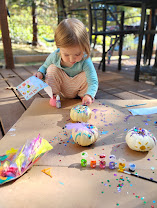
A Toddler's World

Toddler painting outsideWith my daughter, I see how powerful this practice can be—and how easy it is to forget. When we are on a schedule, moving from one activity to the next, it is natural to rush. But when I pause, even briefly, and release my expectations, something softens. Space opens for real connection.

I might set up an activity with a clear idea in mind, only for her to take it in a completely different direction. My first instinct used to be, this isn’t what I planned—and in that moment, the energy shifts, I get frustrated, and her interest fades.

Now, when I let go and allow her to lead, something beautiful happens. The experience becomes creative, spontaneous, and often far more joyful than I imagined. In those moments, I am reminded of the wonder of seeing the world through a child’s eyes.
A Teen's World

With older children, entering their world looks different.

I recently spent time with a child who seemed closed off—offering short answers, avoiding eye contact, and showing little engagement. It would have be easy to assume they did not want to connect.

Instead of pressing, I paused and reflected on what matters to them—something I have noticed before—and asked one simple, sincere question about it. Instantly, something shifted. They lit up, began sharing, and a genuine connection formed. From there, participation flowed.

This experience offered me an important lesson: when we meet a child where they are, we open the door to trust. And from that space, connection arises. 

Practical Ways to Practice

Whether in your home or with other children in your life, here are some simple ways to begin cultivating this approach:

  1. Pause before responding
    Take a moment before reacting. Ask yourself: What might this feel like from the child’s perspective?
  2. Observe without interpreting
    Notice what the child is experiencing without immediately labeling it. Just notice: What are they experiencing right now?
  3. Reflect their experience
    Gently mirror what you see or feel:
    “That looks really frustrating.”
    “It looks like you’re having so much fun with that.”
    This helps the child feel seen and understood.
  4. Follow their interest
    Join them in what engages them—whether it is a game, a feeling, or a topic. Even a simple question about something they love can open the door.
    When in doubt, ask their favorite ice cream flavor! (All kids get excited about ice cream.)
  5. Let go of your agenda
    When possible, soften expectations and allow space for the child’s way of exploring.
  6. Get on their level
    Kneel down, make eye contact, and meet them with calm, open energy. Your presence communicates as much as your words.
  7. Listen more than you speak
    Give them time to express themselves fully, without rushing or interrupting.
  8. Connect before guiding
    Once the child feels understood, they are far more receptive. Then guidance, redirection, or teaching can come more naturally.

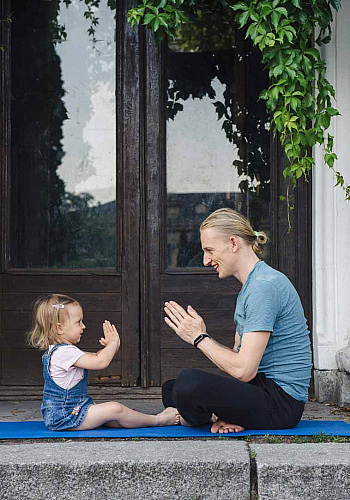
Father and daughter on yoga mat.In the end, entering a child’s world is not another task to add to our busy lives, but an extension of our own spiritual practice. It calls us to slow down, to open our hearts, and to attune.

I’ve seen how even small moments of presence help me understand my daughter more deeply. I notice her joy, her creativity, and her unique way of experiencing the world. And in those moments, I also see how much fun parenting can be—how much joy there is when we let go of expectations and simply play, explore, and connect together.

Perhaps the greatest gift of this practice is that as we enter the child’s world, we rediscover the simplicity, wonder, and expansiveness of our own.
In Friendship,
Gayatri Kretzmann for Ananda Families

Leave a Reply

Your email address will not be published. Required fields are marked *