As our school got out one afternoon, several shouting children were chasing each other around the playground, unable to contain their anticipation of an overnight birthday party. Watching them, one of the teachers commented, “Sometimes I think that parents confuse their children’s excitement with happiness.”
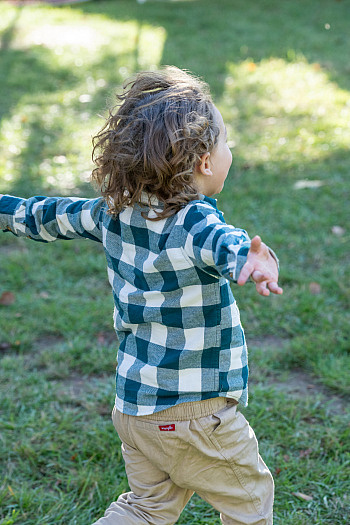 There is a profound truth behind that statement. Just as in nature, every action has an opposite and equal reaction, so in human nature, every emotional mood swing upward has its opposite. Because the “happiness” (actually excitement) experienced by fulfilling a desire for something which lies outside of ourselves is transitory, there will inevitably be a corresponding emotional downswing.
How do you define happiness? Is it the sort of temporary high you experience when you get a new car or dress or fishing rod or electronic gadget? Is happiness the stimulation of ever louder music, evermore suspenseful films, ever more friends, parties, sports events, and thrills? Corporate advertising which drives our media would certainly have us think so.
Or does your definition of happiness have more to do with contentment: the joy of quiet, inner calm that comes from self-acceptance, from being content in almost every circumstance, and from being able to recognize the needs of others and have compassion for them?
Observe a child who has been inundated with too many gifts at a special occasion or who is overstimulated at a theme park. They may speed-talk or run around restlessly without aim, unable to be still. Their relaxed laughter may become high-pitched and nervous. And, what happens soon afterwards? Within a day, or even a couple of hours, they will inevitably experience a crash from this emotional high. There will be dissatisfaction, whining, and even tears or a temper tantrum over some seemingly trivial disappointment.
This type of excitement masquerades as happiness, but it leads to agitation, not contentment. One might imagine the only alternative to a child who lives in this emotional maelstrom to be a bored child who is disinterested and dull. Nothing could be further from the truth. Children can be actively calm and calmly active, centered, happy, creative, and loving. This does not mean they are always quiet and still, but their activity has purpose and balance. As a result, people around them also enjoy their energy.
At a family camp one year, Michael (Nitai) Deranja (founder of Living Wisdom Schools) and I decided to have the parents each share their favorite childhood memory as a way to get acquainted and engage their participation. It was really touching to hear others’ precious childhood memories, such as picking berries with their parents and making pies, canoeing on a lake on camping trips, spending the night with their grandparents, or making Christmas cookies every year.
I continued to do this at Education for Life workshops. Over the years, I have also asked colleagues and friends to share their memories with me. And I discovered that there were common themes in the vast majority of the answers: cooking, eating together, outdoor experiences, nature, solitude, family, especially parents and grandparents. Quite often, the experiences were activities that repeated year after year. No one ever gave an answer such as a fabulous birthday party or a big trip to Disneyland! And, amazingly, in all those answers over the years, only one person ever mentioned a gift or toy (a bicycle a parent hid in the yard for a Christmas surprise).
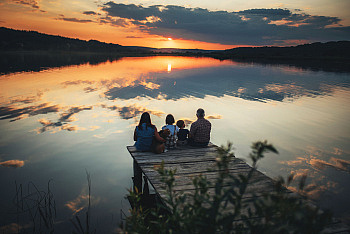 Notice and reflect on your own experience and those of people close to you. What has brought the greatest, lasting happiness? You may find that it is often experiences that involve awareness of being part of something bigger than oneself (the natural world) or connection with others, and contentment in the moment. It may not be the fast-paced thrills of driving ATVs or playing the latest computer game, but something deep and meaningful enough to always be remembered.
Friends of mine were looking for a hard-to-find rural property to buy, hoping to change their suburban lifestyle. They had been searching for several months when I ran into them at a local market. Thrilled that they had found just the place, the wife began telling me all about it. She was so excited that I could almost see sparks shooting out from her body as she chattered on and on about how perfect it was. I expressed happiness for them, but inwardly I got a very nervous feeling from her. Just a few weeks later, I heard the whole thing had fallen through after they spent more time on the land. They had found several problems, causing them to back out of the deal and lose their deposit. While I was very sorry for them, I wasn’t surprised. Her energy seemed too ungrounded around this choice.
Learn to “Tune into the Energy”
If you quietly observe your children, in time you will begin to notice that certain games, music, and friends, that may initially produce what looks like happiness, really result in over-excitement leading to agitation. Other activities or companions nudge your child into that centered, relaxed state of consciousness that we all enjoy being around. Take special note of when others are calmly happy, engaged and focused, open and receptive. In this state, whether doing an art project, dribbling a soccer ball, stacking blocks, or chatting with a friend, they are totally identified with the process, not the outcome. 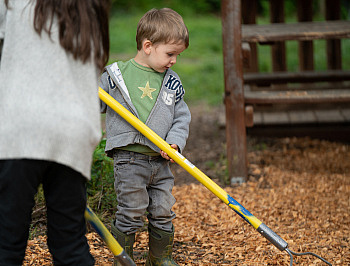 They are relaxed but entirely alert. Their eyes are soft, yet bright. The limbic system is calm and the higher brain centers are activated.
Mihaly Csikszentmihalyi, the well-known psychologist and one of the founders of the positive psychology movement, described this state, which he calls “flow,” as, “…being completely involved in an activity for its own sake. The ego falls away. Time flies. Every action, movement, and thought follows inevitably from the previous one, as in playing jazz. Your whole being is involved, and you’re using your skills to the utmost.” (Interview with Wired magazine.)
Being able to discern which activities result in inner contentment and which result in lack of focus can be your first step in helping your child to become calmly happy. Parents of younger children can exercise their discretion and, as much as possible, expose their child only to the most uplifting influences to help them develop the habits of inner calmness and self-control.
Of course, every child will experience some disappointments, some anger, some frustration, and dis couragement, but childhood does not have to be an out-of-control period of life. It is difficult for the brain to learn anything new when the body is experiencing a negative emotion. Everyone, child or adult, thrives and learns best in a state of relaxed alertness.
As children mature, you can help them become self-aware of when their energy is “off.” You can help them to notice when they are becoming agitated and how to stop and breathe or step back from a situation. In a class of fourth and fifth-graders, I used to challenge the children to walk across the room balancing a book on their heads. It was fun, but also a practice that develops focus, concentration, and self-control.
One of the fifth-grade students simply could not understand the need to “settle down.” One day, when he was beside himself, his inner agitation disturbing everyone, I told him that he needed to go outside and run to release his excess energy.
“No, I’m calm,” he insisted.
“Okay,” I replied, “if you’re calm, show me you’re in control by walking to my desk with a paperback book balanced on your head.”
Grinning, sure he could do it because he had done it the day before, he put the book on his head and quickly started across the room. The book immediately fell off. He was stunned; he tried again, more slowly; it fell. Finally, he took a deep breath, and with concentration and will, he made it to my desk.
With this living demonstration, the entire class understood that it wasn’t just an adult opinion that someone needed to get control of themselves. We had an objective measure! It was a great realization for him and the rest of the class.
If you can help your children recognize when their own energy fluctuates and what over-stimulates them, it will give them a lifelong tool for creating the life they want and for being able to follow through on their intentions. Even if they don’t always make the ideal choices, the self-awareness you help them develop in childhood will not be forgotten and will be there for them to come back to as young adults.
Outward Behaviors Can Be Anticipated
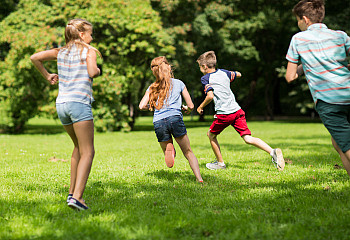 I clearly remember the first time I was able to “tune into the energy” and recognize something was going wrong before it manifested itself outwardly. I walked by some kids I knew who were playing around on the lawn. They sounded particularly rowdy, so I paused to see whether they were fighting. But they were not, and so I went inside. In just a couple of minutes, I heard loud crying! Looking out the window, I saw that indeed someone had gotten hurt, either by accident or because a child had become too aggressive. I had actually intuitively known the energy was going in that direction because I had picked up on the voice tones and group dynamic. I realized that if I could tune into the energy better in the classroom, I could perhaps intervene or shift what was happening before the energy manifested outwardly in lack of control, hurt feelings, an accident, or even just a distraction from our goal.
Learning to tune in to the subtle (and sometimes not-so-subtle) cues of voice tone, nervous movements, and facial expressions gave me the opportunity to “change the energy” before it became impossible to stop. The rest of this book will give you many examples of how to do that, plus how to work with each child’s energy to help them grow.
The Goal
In yoga, it is taught that the highest level of existence is pure consciousness.
Consciousness can manifest as energy, and it is energy that produces outward forms. Modern science has caught up to this truth: we know matter is not solid, but vibrating energy. When we learn to tune into the vibration or energy of others, whether as individuals or groups, we can help them more effectively, making our homes, classrooms, committees, and workplaces more harmonious and effective. Then, when we are able to tune into the energy flow of others, we can use the eight principles, or keys, in this book to:
- Create more harmony, whether at home or in school;
- Help others focus on the tasks at hand;
- Get a reluctant student or employee started on something they find difficult;
- Minimize conflict and willpower struggles with kids;
- Increase children’s and teens’ ability to use their will to master challenges;
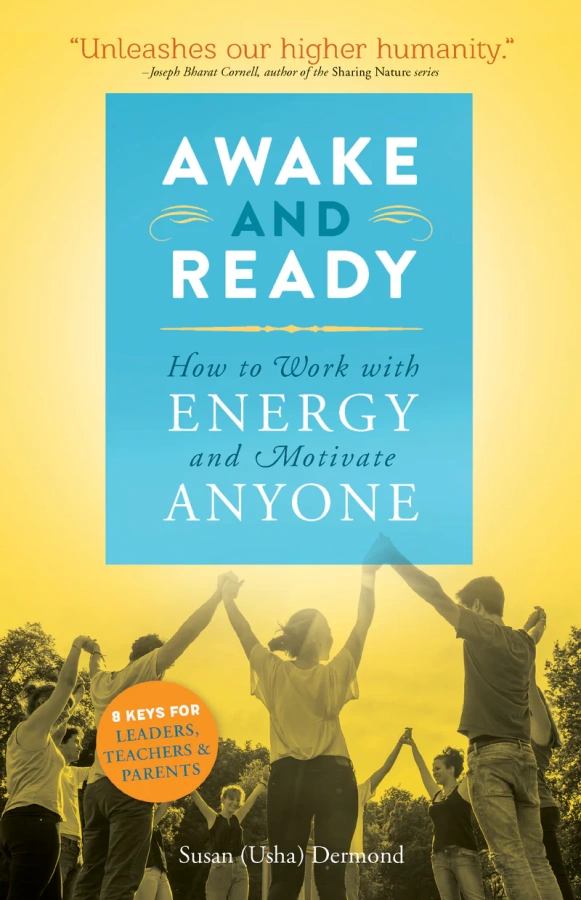
Make school more fun; - And, improve academic or other performance based outcomes. For teachers, it is crucial that they know how to help their students, no matter their age, become “Awake and Ready,” actively calm, and calmly active.
And for parents, understanding the difference between excitement versus happy, engaged energy will make all the difference in their children’s ability to be attentive and content. For everyone, improving our ability to “read” our own energy and that of others is a step toward more awareness, more self-control, and more true happiness. It is a gift to those we love and to future generations.

5 Comments
Thank you Usha! You articulate so clearly a basic truth of life that support true happiness for both children and adults, relevant and practical!
Thank you for sharing these wonderful practical teachings! Calmness is a secret key to moving through life with awareness and joy. Your book is helping so many learn that.
Blessings, Lorna
Thank you for sharing some of your wonderful book. The lessons of being calmly active and actively calm are very powerful. When we create balance within us and around us we become more accomplished and loving. I am looking forward to reading your book. Blessings
Thank you, Usha, this chapter is fabulous. I’ll share it next with my daughter who has and also teaches elementary kids. I’ve observed this behavior so often with my younger grandkids. Well written and super valuable information and truths. Wonderful that it is shared on ananda.org.
I think often about happiness in contrast to joy. I like your equation of happiness to excitement and the normal letdown that occurs after the excitement melts away. As I continue my work to understand the substance of joy, I see that happiness is fleeting; joy is Devine. One does not have to pursue joy, but simply just claim it. The meditative process leads me to the deep recesses of my inner self where joy can be experienced. In Spirit. 🙏