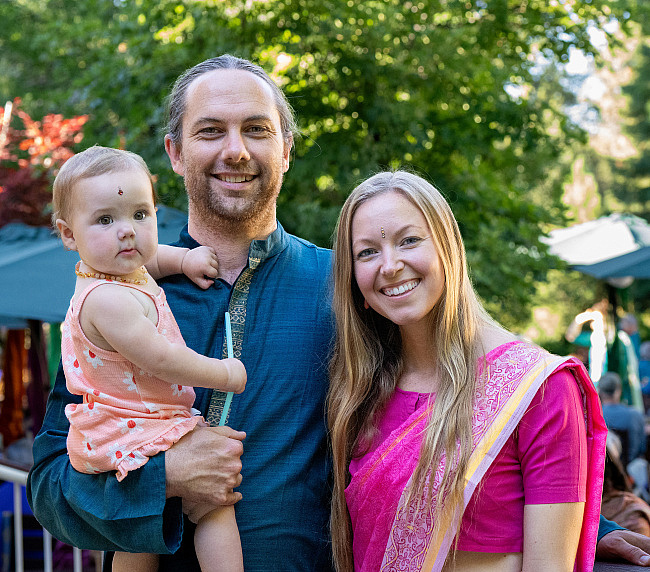
As my daughter, Aurelia, nears her second birthday, I find myself reflecting on the beautiful—and often humbling—journey of spiritual parenting. Raising her has become a living classroom where Divine Mother gently reveals lessons through everyday moments. It’s a path that invites us to see children not merely as personalities, but as souls on their own divine journey.
I remember an exercise from my Education for Life (EFL) teacher training called “Look for the Light.” We were asked to observe the children in our lives and consciously note the soul qualities they naturally expressed—kindness, enthusiasm, wisdom, joy. At the time, it felt simple and uplifting. Of course, I could see the light in those children.
But since becoming a mother, I’ve found this assignment more challenging. Admittedly, there are moments when I catch myself wishing for more calmness, better sleep, a little less noise. Why do I make comparisons, or wish she had certain qualities I think she should have?
Perhaps it’s the deep sense of responsibility we feel as parents—the desire to do everything “just right.” Or perhaps it’s that we are so personally invested in the unfolding of our own child. But even our most well-meaning expectations can become barriers to seeing a child’s true nature.
So how can we learn to see our own children with more detachment, more clarity, and less judgment?
Look for the light.
From the beginning, Aurelia has radiated light and enthusiasm. Her energy is bright, joyful, and expressive. She gives of herself freely and generously—sharing smiles, laughter, and bursts of joy with everyone she meets.
According to the teachings of Paramhansa Yogananda, each soul enters this life with its own karma and dharma. Naturally, there are lessons each must face—we all have them—though in EFL we shine light on the soul qualities a child already expresses and use those strengths to uplift the areas still in development. Our role as parents is not to shape our children into our own image, but to help them express their highest potential—to support them with love, wisdom, and inner guidance as they unfold.
Celebrate your child for who they are—not just for the qualities that are easy to love, but especially for the ones that stretch you to grow in patience, even-mindedness, and unconditional love. Celebrate their light. Honor their joy. Let their soul teach you how to return, again and again, to the Divine.
And in those moments when we stumble, remember: looking for the light also means looking for it in yourself. It’s already there—in your child, and in you. And when you choose to look for the light in yourself, you reconnect with the very source that guides your parenting: the Divine.
In Friendship,
Gayatri Kretzmann for Ananda Families
