Master said that there must be at least one physical contact with the Guru, but that contact can be through one of his disciples. Even when he was in his body, he did not always initiate disciples himself. On many occasions Swamiji initiated on Master’s behalf.
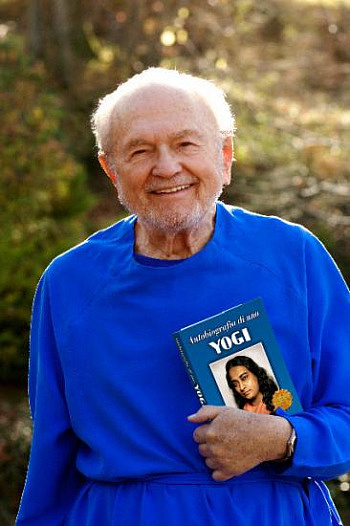 In Autobiography of a Yogi, at the end of Chapter 25, Master’s sister Nalini says to him, “Dear brother, please tell Sri Yukteswarji that, through you, I humbly count myself as one of his Kriya Yoga disciples.”
Swamiji told us, “During Master’s lifetime, Reverend Stanley was serving as the minister for one of the SRF [Self-Realization Fellowship] churches. A member there felt it was her place to give him the title, ‘Realized Christ.’ You would think Master would have dismissed the idea. Instead, he accepted the title, suggesting he call himself Rev. R.C. Stanley. Master never tried to suppress us.
A devotee put a picture of Dr. Lewis on her altar, because he was the one who had brought her to the path. Someone ‘told on her’ to Master, thinking he would tell her to remove it. Instead, Master said it was perfectly fine to have it there.
Swamiji always insisted that his photo did not belong on any of our public altars. But in keeping with Master’s response to the picture of Dr. Lewis, private altars are another matter. In my own house, Swamiji’s photo was always on the altar, as prominent as Master’s. That altar, however, was in the living room, not tucked away in a private meditation space.
Swamiji often came to visit, and always saw his picture displayed that way. “It was a dilemma for me,” he eventually told me. “Because you are a community leader, and many events are held in your home. Your altar is both public and private. But when I asked Master what to do about it, I felt his answer was to let you follow your own feeling in the matter.
In India, they just assume I’m the guru. In 1974, when I visited Anandamoyi Ma with Jyotish and others from Ananda, Ma wouldn’t answer the spiritual questions they put to her, saying, ‘Ask your guru.’ It took them a few minutes to realize she was referring to me, not to Master.
But if we put my picture on the altar now, then later they will put pictures of many others and it will become more and more diluted. This work was founded by a line of avatars and we need to keep the focus on them. We are all just channels for that power.
SRF is now saying that it was only out of humility that Master put the photo of himself on the far end of the altar. That his rightful place is closer to the center. They are trying to make out that he was greater than Lahiri Mahasaya and therefore they should change places.
Masters don’t have humility in the way the disciples think they do. They are impersonal; they follow the principles of truth. Master didn’t put himself at the end because he was humble. He put his picture there because he was the last in the line of Gurus. That’s the fact of the matter. He had no qualms about including himself in the prayer, either as guru-preceptor, or simply sometimes as Guru. He was way past the need to express humility in any outward way.
I am telling you this so that after I am gone you won’t start saying that I didn’t want my picture on the altar because I was humble. I don’t belong there, that’s how it is. Master was the last in the line.
Two hundred years from now, when this work is well established, perhaps it will be different. At that time maybe my picture can be, not necessarily on the altar, just more prominent. But not now.
My reason for advocating a more prominent position for him, I explained, was because I have found that if people don’t appreciate the role he plays, they don’t thrive at Ananda. It isn’t just my bias; it is what I have observed over many years.
“Putting my picture on the altar,” Swamiji said, “won’t help.”
I had to agree. Merely creating an outward symbol is no guarantee of inward attunement. “A refined person,” I said, “will intuitively recognize that Ananda itself is an expression of your attunement to Master, and will be grateful to the source of this inspiration.”
I said to Swamiji, “This is how I sometimes explain it. Master is the King of the spiritual realm in which we live. You are the Prince, the son of the King, and appointed by him to be in charge of our province. You don’t please the King by disregarding the Prince. For this reason I suggest that people that they attune themselves to you as well as to Master. They are not mutually exclusive.”
“Yes,” Swamiji said, “that is a good way to think about it. “When you tell stories, don’t make them about how the storyteller feels about me. Some may be inspired by your devotion, but others will feel imposed upon, that you are trying to tell them what they, too, must feel.
Make the stories about objective events that show my character, rather than merely subjective experiences. The listener then has the freedom to decide for himself what he feels about what you have said.
From a forthcoming book of conversations with Swami Kriyananda
