Our job in this world is to find God, and in the process of finding Him, to express Him ever more perfectly in our lives. One of the ways we can do this is through music. When we can open up a channel so that the Divine can flow into this world, then is the purpose of mankind fulfilled.
—Swami Kriyananda, World Brotherhood Day talk, 1987
On the Road
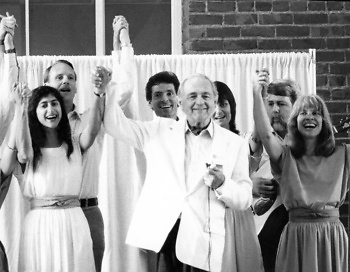 My first experience on the road with Swamiji was at the Los Angeles Whole Life Expo in the 1980s. I’d helped promote his appearance for months beforehand. When his portrait appeared on the cover of the Whole Life Times, I was overjoyed. It was rare to obtain such good press coverage. Many people would have the opportunity to hear him for the first time.
That weekend, in his hotel suite with about six others, Swamiji was planning the music that would be sung before his talk. He was correcting one of our gifted soloists at length, in minute detail. The singing sounded beautiful to my ears, so I was curious about what the lesson was. I was impressed by how well this person was accepting the corrections.
Then Swami turned to the three women standing nearby. Smiling sweetly, he asked them if they would also sing at the Expo. They looked stunned. They had rarely sung a note in public before. “Sing for me,” he asked kindly. Naturally, they were far short of what Swamiji usually seemed to want. Yet he lavished praise on how wonderful they sounded.
That unpolished group sang at the Expo before his keynote talk. He (and they) were delighted. Whatever they lacked musically, they more than made up for in their shining smiles and faces. In fact, they beamed so much happiness and goodwill to the audience that they deeply touched many people that day.
That was one of my first experiences of how differently Swamiji worked with his students, and how much more was going on than met the eye—or ear.
John Anderson
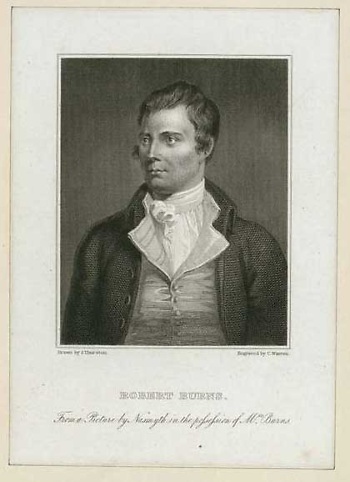 Robert Burns wrote a famous poem, “John Anderson,” which has been set to music by several composers, including Swamiji.
I was about to perform this solo one night before Swamiji and a large audience in a beautiful outdoor amphitheater. I had many years of experience singing solos, but tonight I felt more nervous than expected.
“How annoying,” I thought. “I am disgusted with this ego!” I did some breathing exercises, but the nerves didn’t go away.
I’d had enough. I allowed a strong, powerful force to rise in me. I visualized slashing my body into pieces with a sword until there was nothing left. My focus was intense. It took less than 15 seconds to obliterate everything—my body, my personality, and my nervousness.
Whatever was left walked onstage and sang. I both observed it and was part of an effortless flow. I sang for the orange blur that was Swamiji about halfway up the amphitheater. (My vision is poor without glasses; usefully, his orange blur was easy to spot.)
A short intermission followed. Another blur approached and said, “Swamiji wants to see you now.” I came over.
“I have never heard that song sung more beautifully,” Swamiji said, weeping. “And I have never heard you sing more beautifully.”
Dozens of people in the audience said they wept, too, and were profoundly affected by this song. Something else came through that night; I have never received feedback like it before or since. Since then, I have listened to the recording. It was not as beautiful as others I’ve made. But it wasn’t the sound. It was the consciousness.
Wherever my consciousness was when I sang (or otherwise), he noticed.
Swamiji often told us that he didn’t compose this music; he received it. His compositions were an attempt to write down what he heard. My musical training was not enough. I needed to practice a level of attunement that would help me reach toward where his consciousness was.
I remembered, too, the experience he had with Master, when one night he said to himself with great force, “I’m absolutely sick of this ego. I don’t want it. Take it!”
Afterwards, Yogananda said, “Very good.”
Swamiji continued, “Ever since, I have not been troubled by it. Sometimes we must do violence to our ego to overcome it.”
The Mysterious Power of Swamiji’s Music
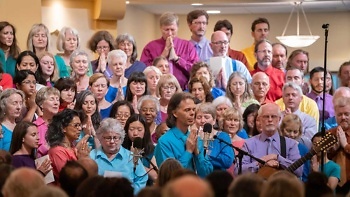 There is a power in Swamiji’s music hidden behind its outward form. I’ve been immersed in it for many years—singing, playing, and supporting others.
One of its powers is inexplicable. It remains fresh and inspiring to me, despite its outward simplicity. By contrast, I find much great classical music immersive and enjoyable for a time, but then my interest fades.
I have come to feel that Swamiji’s music is an invisible carrier wave. It yields a subtle wisdom and an upwelling of inner joy. It can dispel moods. For some, it is profoundly healing. Even after more than 40 years of singing Swamiji’s music, I have not begun to explore its depths.
Swamiji was rarely so explicit about the impact of this music. Only after many years did I hear these comments from him.
“Rajarsi (Janakananda) told me that Master would give me the power I needed to do this work. What he meant, among other things, was the music.”
At another time, he said, “Ananda would not be what it is today without the influence of the music. Books and lectures are the outer form of the teachings; music is its coursing blood. This music is not my music. It is a new consciousness coming into the world as music.”
A Beacon
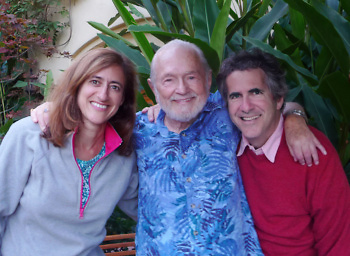 I once asked Swamiji if he ever listened to other music. He said yes. He sometimes listened to classical music by the great composers.
He added, “There is only one place in the world to hear Ananda music. When we perform at Ananda, it’s Ananda music we should be sharing with people. That’s not to say other music isn’t beautiful. But this music is unique to us.”
If I’d given it a moment’s thought, I would have realized even the humble store owner follows the same principle. An Italian restaurant doesn’t play folk music. A French bistro doesn’t play rock.
As I grew in sensitivity, I understood Swamiji’s music as a vibration of our particular ray of grace.
It is uncanny how often someone brand new to Ananda weeps when first hearing this music. Countless times, I have heard someone say, “When I first came to Ananda and heard the music, something in me knew that I was home.” This music is a sacred beacon, calling out to anyone who might be receptive.
Anaya Gamow is a longtime member of the Ananda spiritual community, author, musician, and teacher who worked closely with Swami Kriyananda for more than three decades.
Along with her husband, David Gamow, Anaya has contributed to many aspects of Ananda’s outreach, including publishing, music, meditation programs, marketing, and spiritual education. She directs vocal and choir programs at Ananda Palo Alto, having toured internationally with the Ananda Joy Singers, and she co-authored At the Feet of a Saint: Lessons, Stories, and Experiences with Swami Kriyananda.
