How can we know whether or not we’ve led a victorious life? Generally, victory implies a comparison—one team outscores the other; one party or country wins a battle; someone rises to the top of the corporate ladder and becomes wealthy. But when it comes to the battle of life, it is fruitless to compare one person’s life against another’s. Does material wealth, high position, or an easy existence mean that you have led a victorious life?
None of these gets to the core of the question. Is there, then, no way to determine whether you’ve led a triumphant incarnation? There is, indeed, a way to evaluate your progress, but it involves measuring inner, not outer, victories. In the end we will take with us only our consciousness and the realizations we have gained.
This, then, gives us a way to assess whether or not an incarnation was victorious: Did our consciousness expand, or did it contract? Did we grow toward Self-realization or become more self-involved? More properly, since we are complex creatures, the question should be, “In what ways did the choices I made help me expand, and in what ways did I contract?”
This is the focus of the “life review” we will face as the soul exits the body in death. But it is also a good question to ask during a nightly review of the day’s activities. Each evening, sit quietly, review the day, and ask yourself: “How did I expand, and how did I contract?”
Given the complexities of life, it may not be easy to determine whether we have expanded or contracted. Many of the most important choices we face are driven by karmic tendencies, especially those related to the primordial compulsions seemingly imposed upon us by the nature of creation.
Life’s basic urges for security, pleasure, and power are reflected in the energies of the lower three chakras. Each chakra has two poles, a spiritual direction and a worldly one: one that expands and another that contracts our consciousness. Here is the essence of the choices we face:
 1st Chakra: Security. The choice: possessions versus faith.
2nd Chakra: Pleasure. The choice: worldly desires versus contentment.
3rd Chakra: Power. The choice: outer authority and control versus fiery self-control.
Autobiography of a Yogi is filled with stories and examples of how the saints deal with these issues. Yogananda’s wonderful story of his trip to Brindaban demonstrates the issue of worldly possessions versus faith. His elder brother, Ananta, flings a challenge at him: “So you feel quite independent of Father’s wealth.” Master’s immediate reply is, “I am conscious of my dependence on God.” Game on.
Could Master “go forth in perfect faith in the power of Omnipresent Good, to bring me what I need at the time I need it”? Yogananda relates what happened when he returned, having “miraculously” fulfilled all of the conditions of the challenge. His skeptical brother “turned sober, then solemn. ‘The law of demand and supply,’ he said, ‘reaches into subtler realms than I had supposed.’”
But how does this apply to our daily lives? When faced with an important choice, pause and ask yourself this question, “What will be the effect on my consciousness?” As an example: If offered a promotion or new position at work, the vast majority of people will make the decision based on material considerations: increased money or social standing. Few will pause and ask, “What will the effect be on my consciousness?” Be one of those few.
When the end of life comes, we will be asked whether or not we made good choices. If we work day-by-day at expanding our consciousness, using the techniques of meditation and selfless service, we will be able to say, “Yes, I did. I had a victorious incarnation.”
In the light,
Nayaswami Jyotish
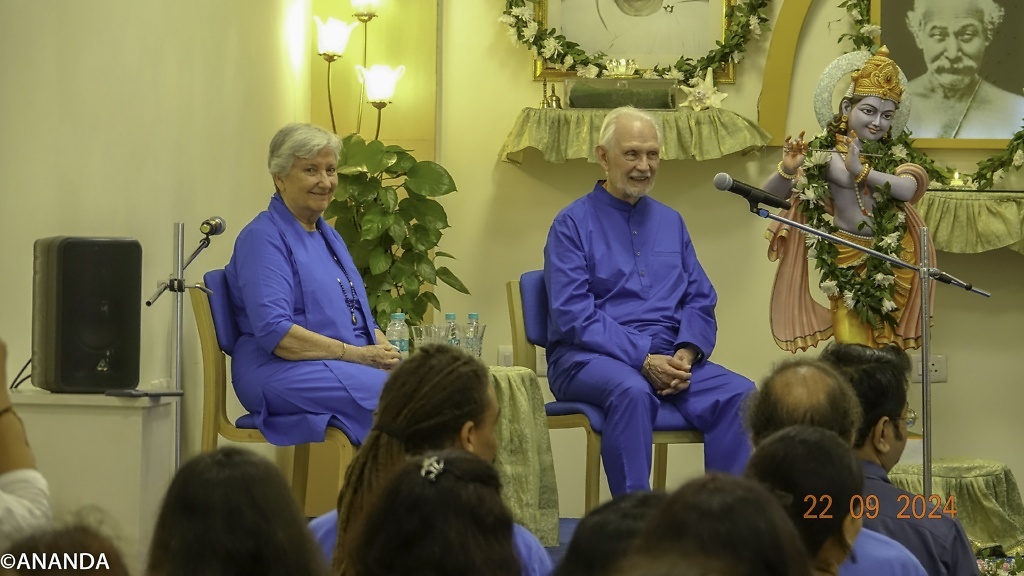 P.S. We discussed this topic at greater length in a recent talk we gave in Gurgaon: “How to Be Victorious in Life.”
Listen to Jyotish as he first reads the blog, then expands on its meaning and messages for readers with behind-the-blog commentary. Subscribe to the podcast or download the audio recording by right-clicking here. Or listen to it here (9:07):
22 Comments
Beautiful….So inspiring & introspecting🌹
Jai Guru🙏
‘What will this mean to my consciousness’, at each step of our decision making moments decides the fate of this incarnation! Indeed, this is deep and to develop that sensitivity to raise this question in itself requires a certain inclination towards self-realisation. A very good karma to dwell on these. Much gratitude.🌷🤗🙏
For three years I have been stuck in my thirth chakra. Now I climb to the fourth chakra again.
I am very grateful for the change to myself and to my heart.
Thank you for sharing this thought, though I read the Book Autobiography of a Yogi, and follow his principles as much possible, these small notes and explanation is really helpful to rewind the books each part.
Thank you Nayaswami Jyotish ,very inspiring and insightful.✨🙏
Thank you for distilling this teaching down to the most simple and practical action of asking, ” what will this mean to my consciousness?”.
Brilliant in its simplicity. Life-guiding in its truth. 🙏
Thank you Jyotish! This is so helpful. I will be watching the video of you and Devi as soon as I can. Oh and Jyotish? Do you and Devi really read all the comments on your blog?
Thanks for your comment, April. We certainly do read the comments. In fact, we eagerly look forward to the feedback. It helps us know whether or not we are addressing issues that are meaningful to people.
One of the best answers to eternal questions about the meaning of life, or for those who want to know what you can expect from a quality spiritual life..
That Ananda remain true to our motto: “Jato dharma, tato jaya: Where there is adherence to right attitude and action, there is victory.” Indeed, Ananda should define victory itself in terms of this principle, and never seek victory, even for the sake of its own survival, at the cost of this principle. If Ananda’s institutional survival demands that this ideal be compromised, survival itself will no longer be worthwhile. For, again, Ananda is a spiritual institution primarily. It is, moreover, a spiritual ideal, for the meaning of Ananda is, “Divine bliss.”
https://www.ananda.org/about-ananda-sangha/swami-kriyanandas-testament-and-legacy/
Profoundly inspiring, deeply practical. Thank you for the gift of this blog, which bears the fruit of a victorious life, fully lived in God.🙏
Rings so true!
Great and fantastic spiritual inspiration and insight 🙏🙏🙏
These insights and analyses are means to cleanse ourselves of desires and other retarding forces. Indeed, the topic is of great help for everyone.
Thank you so much for that!
Soo interesting this!! What are we here to learn, and what constitutes a good lived spiritual life.
I often wonder how traumas ties into this. For me, I have looked at traumas as something I had to conquer in order to grow spiritually, and most often felt I failed. In my later years I have started to look at traumas more as a grinding stone which have grinded away my hard shell leaving me humble and with more compassion towards life.
I am pretty sure I, at some point, have chosen this, but when the shit hits the fan, I beg God to take it away from me. :-)) Is it the mastering or the experience that is ultimatly important? I more and more feel it is the latter!
Thanks again!
THE SOUL LOVES TO MEDITATE, FOR IN CONTACT WITH SPIRIT LIES ITS GREATEST JOY. WHERE THERE IS DHARMA, OR RIGHT ACTION, THERE IS VICTORY.
Learn to Meditate.. Through meditation and introspection, learn first to love yourself in the soul way, by sensing the hidden joy of your own being. Then, with that egoless love, reach out to touch your spouse, your children. Refine your love so that it becomes more and more pure; so that it contains less of the consciousness of „I and mine“. Love your family as you love yourself: for their souls, not merely their personalitis.
As we perfect our inner natures, we achieve a balance betwen reason and feeeling, end between wisdom and love. Man become kinder, more compassionate. Woman become more reasonable, less emotioanl. We all long, at least subconsciously, to achieve this balance; that is why we find ourselves instinctivly drawn to the opposite sex. Our attraction is far more than physical. It is born of the disare to achieve perfect balance within ourselves. The more we achieve this inner balance, the less we have to affirm it outwardlay, in human relationship. The longing then develops in our hearts to atttain inner, soul relationship with God.
“The soul loves to meditate, for in contact with Spirit lies its greatest joy.” Yogananda
Meditation is natural and deeply rewarding. It offers a direct and intuitive experience of states of consciousness that are healing and inspiring:
Inner peace, self-acceptance, unselfish love, vitality, creativity and a calm joy that transcends life’s ups and downs.
The benefits of meditation, which are many, have been amply documented by medical testing. Just try searching the internet on the “benefits of meditation” and you’ll be amazed!
There is an Indian saying that has become Ananda’s fundamental principle: “Where there is dharma, or right action” (that is to say, action in tune with truth and spiritual ideals), “there is victory.” When we put principles first in our life, everything goes as it should, and there can be no failure. As the Bhagavad-Gita says, “Oh, Arjuna, know this for a certainty: My devotee is never lost.”
I am very happy to read your thoughts. What you wrote is hundred percent correct.
Beautiful, ever timely, and practical. Thank you so much, dear Jyotish!
Dear Nayaswami Jyotish Ji,
Thank for sharing this blog. Enjoyed reading it and in particular ‘Game on’. That’s the faith and courage I need too.
The points you have mentioned here gives a different perspective. Thanks for the guidance.
Joy,
Prem
Thank you dearest Jyotish Ji for this inspiring blog. Between reading it and listening again to the Gurgaon talk by you both, its just goosebumps all over again. like introspection on Gita’s first verse ‘what was the outcome’. Loved your pointers on expansion of consciousness day by day, meditation and selfless service. Thank you both again for helping us as our souls make the journey back to God bit by bit.
Dear Jyotishji,
Thank you for this inspiring blog. I was struck by this statement: “In the end we will take with us only our consciousness and the realizations we have gained.”
A very powerful reminder that this life, however long or short it will be, is our chance to rise above our little self and expand, grow, & evolve!
Bless you great soul. 💛 Josette
Dear and Great Soul, this is one blog I missed. I found it “cleaning up” my computer stuff.
I will treasure this timely Wisdom and act accordingly. I am deeply grateful for your love and consideration for all your fellow Gurubhais. In Divine Friendship, Namaste