A man sat by the river, watching a holy man bathe. Suddenly a scorpion fell into the water from a tree branch. The holy man quickly scooped him up and placed him gently on the shore—but, as he did so, the scorpion stung him.
Some time passed, and again the scorpion, having crawled back up the tree, tumbled into the river. And again, the holy man rescued it. And again, the scorpion stung him.
The observer could contain himself no longer. “Why do you keep picking up that ungrateful creature? All it does is give you a painful sting!”
The saint replied calmly, “It can’t help itself. That is its nature.”
“But why do you rescue it again, knowing what it will do?”
With a gentle smile, the saint said, “I can’t help myself either. That is my nature.”
When Swami Kriyananda told us this story there was often a tremor in his voice, a glistening in his eyes. He clearly identified with the holy man, for it was his nature to serve even if his help was returned with indifference or ingratitude.
In the final years of his life, Swamiji told those close to him, “I don’t want to return to this world again. My heart has borne enough pain.” But later, with quiet resignation, he would say, “I think I will have to return. My desire to help others will pull me back.” That was his nature.
All of us live out the pattern of our nature. Our choices—thoughts, words, deeds, and feelings—when added up and averaged, create a tapestry of tendencies. Over time these tendencies form our personality. The pattern is formed by the magnetic pull of our likes and dislikes.
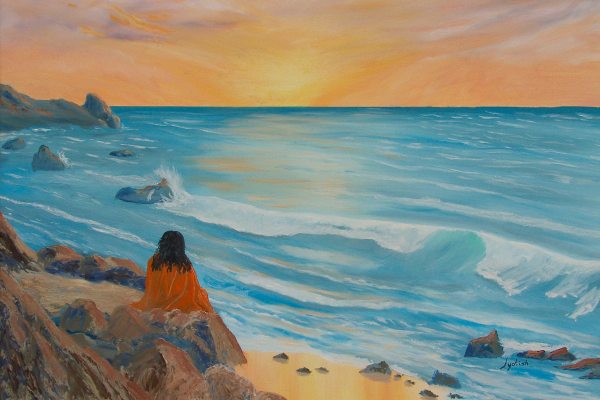
Infinity by Nayaswami Jyotish.
Patanjali begins his great treatise on yoga with, “Yoga is the neutralization of the waves of feeling.” Union with God, he says, comes only when the duality of attraction and repulsion is dissolved.
Our likes and dislikes are far more subtle and pervasive than we realize. Every breath we take is driven by a cellular desire for oxygen. Every bite of food, glance of the eye, every daydream, or night dream, is steered by our desires and repulsions.
The ego, in a sense, is a giant bundle of likes and dislikes. We experience thousands of them every day, almost all of them below the conscious level. As long as we inhabit this dream world of God, as long as our senses are active, we will be subject to duality’s endless tug of war.
The only way out of the long maze of evolution is to open ourselves, ever more completely, to what Yogananda called “involution,” or the attractive force of God calling us back to our true nature. Meditation is the fastest and surest way to make our return journey. It withdraws the life-force inward, away from the churning of the mind and the whirlpools of the heart.
In Autobiography of a Yogi, in the chapter “An Experience in Cosmic Consciousness,” Yogananda wrote, “The breath and the restless mind, I saw, were like storms which lashed the ocean of light into waves of material forms—earth, sky, human beings, animals, birds, trees. No perception of the Infinite as One Light could be had except by calming those storms. As often as I silenced the two natural tumults, I beheld the multitudinous waves of creation melt into one lucent sea, even as the waves of the ocean, their tempest subsiding, serenely dissolve into unity.”
Let’s offer our desires—noble or petty—into that One Light. Gradually, we will come to realize that we are that Light, and that nothing else exists.
Until then, whether saint or scorpion, we will act according to our nature.
In the One Light,
Nayaswami Jyotish
Watch Jyotish and Devi’s 50th Anniversary Celebration online here.
Listen to Jyotish as he first reads the blog, then expands on its meaning and messages for readers with behind-the-blog commentary. Subscribe to the podcast or download the audio recording by right-clicking here. Or listen to it here (8:58):
7 Comments
Great Souls suffer enormously from the mean minded nature of fellow men.Yet they come to this world as savour to mankind.
I bow to you Jesus
Amen
This is most witnessed and experienced by people of god. The pain breaks, indeed, but it breaks open the consciousness into a Reality unknown in time or beyond human understanding. While a truly loving human being is a lamp in darkness, the premise for that unconditional love would have been pain. That is in the nature of divine knowledge. There is freedom only to say ‘yes’ and yield.
Thank you for talking about this awakening topic and for reminding us to refer to the amazing chapter “An Experience of Cosmic Consciousness” found in Yogananda’s Autobiography of a Yogi.
A beautiful blog, Jyotish. Thank you for this touch of Wisdom this morning. See you around for the big weekend celebration ✨
Thank you for this extremely important and insightful commentary on our true nature!
Thank you Jyotish. This was a very good topic and a good story. May all of our natures be like Swamiji’s, even if it causes temporary suffering.
BEAUTIFUL! Thank you!