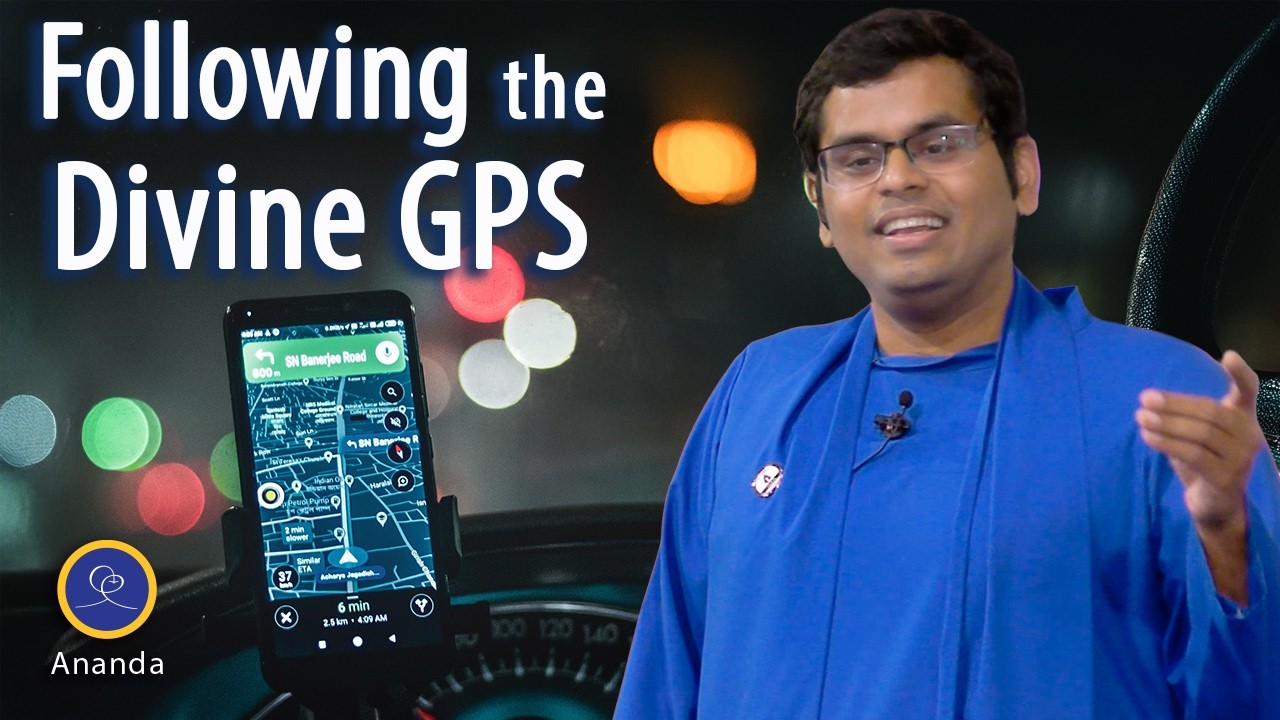
Following the Divine GPS
Watch this inspiring Sunday Service with Nayaswami Sagar recorded at Ananda Village on June 14th, 2026.
Sagar deliberately lightens what he found a heavy topic by reframing it. Instead of the loaded language of "falling," he draws on Yogananda's poem God's Boatman, which speaks of a "stray brother left behind" — straying rather than falling permanently. His central analogy is a GPS: when you make a wrong turn, it doesn't punish or condemn you, it simply says "rerouting" and finds the fastest path from wherever you now are. God and guru work the same way, with even more compassion, so the real danger is not the wrong turn but the guilt and self-punishment we heap on ourselves (illustrated by the plague demon whose victims actually died of fear). He identifies three causes of going astray, all present in Judas's example: doubting the "GPS" (the guru), inattentiveness or "fair-weather discipleship," and being pulled off course by habits and temptations.
The guru waits without imposing, entering our lives only to the degree we invite (shown by Yogananda telling Señor Cuaron he'd "lost sight" of him for lifetimes because he hadn't wanted help). The proposed solution for all three is traveling in a "convoy" — the magnetism of spiritual community keeps us steady and headed the right way ("steady wins the race," not necessarily slow). Sagar closes with an inspiring 1951 letter from Yogananda praising a new Australian meditation group and stressing the importance of group meditation and fellowship.
The reading for this week from Swami Kriyananda's book Rays of the One Light is
How Devotees Rise
Truth is one and eternal. Realize oneness with it in your deathless Self, within.
The following commentary is based on the teachings of Paramhansa Yogananda.
Last week we asked the question, Why do devotees fall? and we considered the downfall of Judas in this context. Jesus, in answer to Judas’s criticism for allowing Mary to rub his feet with spikenard, a very costly ointment, said, “The poor always ye have with you: but me ye have not always.”
Jesus is saying here that there is one supreme “injustice” that needs eradication: poverty, yes, but not of a material kind: poverty in a spiritual sense.
Divine blessings are not common in this world. They are extraordinary. When they come, we should give them priority above every other consideration.
Never allow a moment of inner joy, for instance, to be set aside for lesser “duties.” Divine attunement is our highest priority. As Lahiri Mahasaya, the guru of Yogananda’s guru, said, “To listen to the heart’s inner sound (AUM, which issues from the very center of our being) is man’s highest duty.”
Mary was not, at that moment, communing with the Master inwardly. She was serving him outwardly – but in a spirit very different from the restless fussing for which Jesus had reprimanded her sister, Martha. Those who see a radical difference between the paths of action and meditation should understand this distinction. To serve in the right spirit is necessary, for only thereby can we overcome our karmic tendencies toward restless activity. The important thing is that that spirit be always inwardly focused: that in everything we do we act in loving service to the Lord.
Therefore the Bhagavad Gita says in the third Chapter:
The state of freedom from action [that is, of eternal rest in the Spirit] cannot be achieved without action. No one, by mere renunciation and outward non-involvement, can attain perfection.
Whenever the spirit of God descends upon you, however, remember the words of Jesus, “Me ye have not always with you.”
Thus, through holy Scripture, God has spoken to mankind.
