What Is the Inner Kingdom?
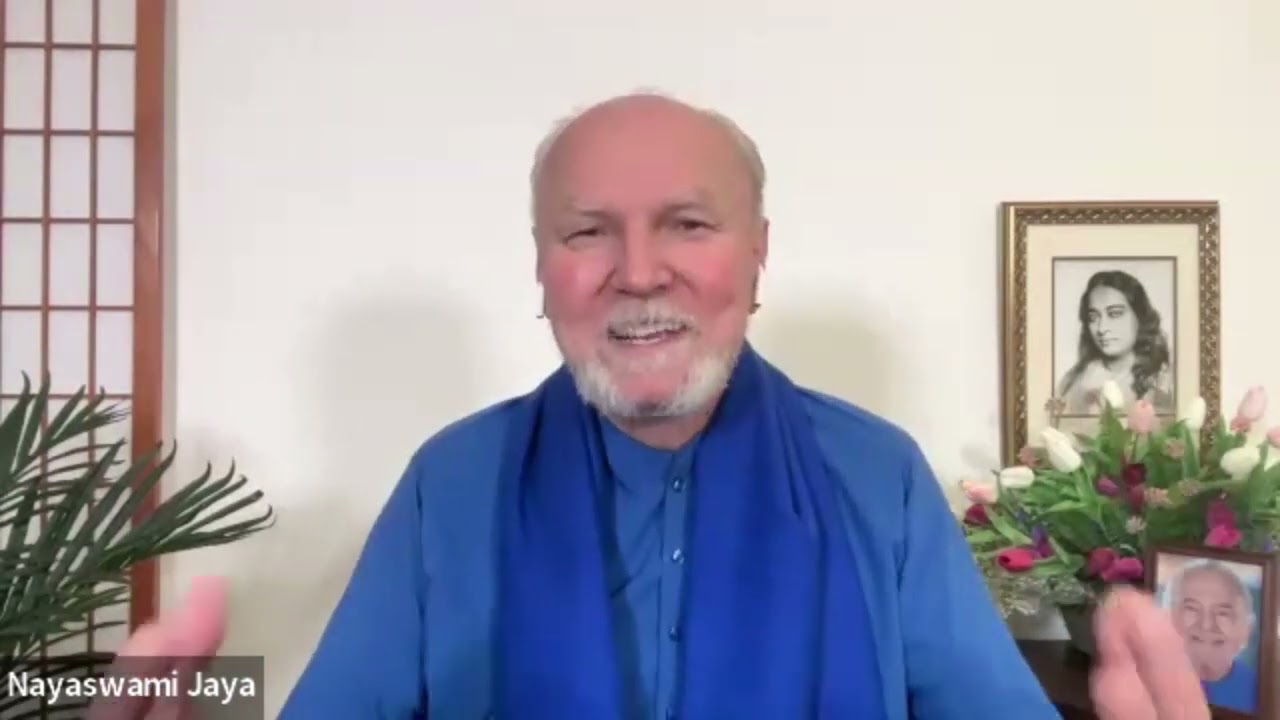
Watch this inspiring satsang by Nayaswami Jaya recorded on 25th April, 2024.
#anandapune #bhagavadgita #yogananda #swamikriyananda
Transcript
Nayaswami Jaya:
And welcome once again, and it's a joy to participate with everybody there in Pune. And today, this is our Thursday, so we have our regular Gita satsang on Thursdays, and I'd like to— I have a reading here I'd like to share in a moment, but the general topic I want to speak about today is— it's a big one, it's a big topic, and I can only do just a little bit of justice to it. And I want to— it's on the topic of the inner kingdom. And of course, this is the background teachings of the teachings of yoga. And we hear about this inner kingdom.
It's talked about, referenced perhaps directly, or oftentimes just metaphorically in scriptures, East and West. And I'd like to just share 3 qualities that I think are necessary for the devotee to focus upon, because the question comes up, well, if there's an inner kingdom, of course, the natural one question is, well, what is it? But then we go beyond that, and we said, I want to go there. I want to enter in. How do I enter into this inner world that has been offered and perhaps suggested by the saints and sages of all traditions throughout the ages?
And so I'd like to take 3 particular qualities and just touch on them lightly. And the reading from the Gita today is from Chapter 15, Shloka 1 of that, and it goes as this. "The Blessed Lord said, Krishna, the Blessed Lord said, 'They, the wise, speak of the imperishable ashvata tree, with its roots above and its branches below. Its leaves are the Vedic hymns. Whosoever understands this tree of life knows the Vedas, or the meaning of the Vedas.'"
And Swamiji gives a bit of commentary on that, of which I'll just read a short section. And Swamiji says, the mythical-seeming tree described here is the human body. Its trunk is the spine. Its roots above are the rays of energy which both emanate from and nourish the brain and body through the sahasrara, the thousand-petal lotus at the top of the head. The tree's branches below are the much-ramified nervous system.
And of course, he goes on to speak that, that tree, it's symbolic of this very nervous system and It reminds us of something that Paramahansa Yogananda said, which was, I think, you know, very striking. If we— at first it seems, well, just a statement, but if we think about it in the context of the larger world religions, because this is not just applying here to India; this applies to Christianity, Islam, Buddhism everywhere. Because the principles are based upon the Sanatana Dharma. We are all humans built in the same way, and it's that same Ashvatthri that is represented in everybody. It's not just one culture or another.
And Master said this, he said the pathway to God is through our very own nervous system. Now, he didn't say, you know, he didn't talk about gods and goddesses and devotion and this and that, although many of those things are implied in that. And it's something that even the atheists might take note of, that the pathway to God is through our very own nervous system. It's somewhat revolutionary in religious teachings, although for the yogi, of course, it's quite obvious. But you see this reference to an inner kingdom in many traditions, particularly in the Bible.
And Master had come, he said one of his missions in coming in his world mission to the West and out to the world was to show the underlying similarities and uniformity of the same message in scriptures of the East, represented by the Bhagavad Gita, and scriptures of the West, it's represented by the Bible. And there it is in one of the books, I believe it is of Matthew, I believe, or maybe it's Luke. Uh, it says, the Bible says, "Neither shall they say 'Lo here or lo there, for behold, the kingdom of God is within you.'" Now, what is this kingdom that keeps being talked about? Of course, it's the vast inner kingdom.
We look out into the world, and we see the material universe, and it's vast. I mean, the telescopes, you've seen those pictures, and it's just, it's inconceivably vast. But it's interesting, the yogis say, and Master confirmed this, he said that inner universe, the outer universe is just a fraction compared to the vastness of the inner universe. And it's into that inner universe that is the pathway by which ultimately all souls seek liberation. It's through that pathway into the inner kingdom that we fulfill our heavenly hopes, our heavenly aspirations, our deep-seated desire for fulfillment.
We'll never find that, you know, Shankhya philosophy makes that quite clear. We're never going to find that outwardly in that outer universe. We have to go beyond that, or within that, deeply within. And the doorway to that is not out there in some other universe, fly to in a spaceship, and find the doorway. That doorway is within each one of us.
And more specifically, that doorway is here at the spiritual eye. And it's the science of yoga has been, been passed down for millennia in the ages past down to us, giving us the, you could say, the map or the pathway, the description of how we can attain that. And these have been passed down to us. And so how do we do that? How do we find that pathway?
How do we get it? How do we enter into that inner kingdom, that land of bliss or milk and honey, as they say, that land that something inwardly all of us have a sense of, I think all of us do, particularly if we're on the spiritual path. We have a sense there's something more. How do we get there? How do we find it?
Because to describe it is one thing, but that's not enough. And we need to— and this is what the Masters have brought to us. They brought to us the methods by which we can actually enter into that, into that inner kingdom, explore that inner kingdom. And as I said, there are certain elements, you know, a vast long list of elements that could be, but I've just taken 3 today. And I start with a story that I've told many, many times, and I'll say it really quickly again because it represented one of these elements, maybe 2 even, of these elements that are necessary.
And I mentioned this story that it was some years ago I was teaching in Delhi on a topic similar to this. I was more in line of teaching about Kriya Yoga, and I was going off on about this inner kingdom and how to get there. And it was very— it was a little bit too esoteric, honestly. I was speaking way too above the general audience because it was a general introductory class. People from outside came and they didn't have the background.
And so I, that was my mistake, which I realized later because afterwards, this one lady in the class, she raised her hand and she basically said, I mean, all of that you've talked about, you know, she was very respectful. All of that you talked about, I'm sure is very fine, but I'm not interested in all of that. I live in the neighborhood here. "and I'm trying to improve my life. And honestly, what I want in life is I want to be a good neighbor.
I want to be a good person. I want to help people. Isn't that enough? You know, why all this talk about, you know, inner kingdoms and those sorts of things?" And I recognized she had a good point. She had a good point.
It was my— you might say my talk was perhaps to the wrong audience, but what could I say to her? And so she asked me, what could I say? And I said, well, ma'am, what I would say is I wish there were millions and millions of more people just like you.
In other words, people who wanted to be a good person, people who wanted to be a good neighbor, people who wanted to serve other people, people who wanted to— in a sense, she was saying people who wanted to live a dharmic life. I said, I just wish there were millions of more people like you. It's a wonderful thing you said. He says, but there's going to— I said, I would predict that there will come a time when being a good neighbor and just living a dharmic life outwardly is not going to be enough for you, and you're going to want something more. And when that time comes, please come back, come back, and then let's explore that.
And I think that's really true. It was really true what I said. And she was satisfied too, because we chatted afterwards. And she actually was a devotee who did want something more. She just didn't quite realize it.
In other words, there's a longing, and this is one of the basic elements if we want to understand the inner kingdom, we have to have developed within ourselves a deep longing for something more. Something more than happiness outside, good job. It's like we fulfilled everything. And you see this, people, and typically the people who want something more, the people who dedicate their lives to living a high life and becoming saints, the great ones, you look at their biographies, oftentimes they were not poor and downtrodden and on the base level materially in society. They were people who had attained something.
They were people who had perhaps reached a high status even. It's just that it was not enough. And you find this, but until you perhaps reach that point, You're going to— you're almost impelled to seek it outwardly. You want to find happiness. You think it's in money.
We think it's in fame. We think it's in a good family. We think it's in knowledge. All of these things call us, and we go, and we're impelled to go that direction. But inevitably, there's this feeling, there's got to be something more.
Haven't you ever had that feeling? There's got to be something more. And if you don't come to that feeling, you're just going to continue trying to look here and there. And there's a billion ways to try to look and where to look, and you're going to do that. And how many lifetimes have we spent seeking that very thing?
It's that something more that the heart seeks, its desire. And we need to cultivate, you know, that desire. Now they say desires are, you know, and then you can never fulfill all your desires, but there's one desire that is important to have, and that's the desire for God. And that is what that something more is, although we don't always identify it. It's that calling that is haunting us, that ever and again and again and again, and we seek that until we find that.
And I think this is— I start with this as a primary thing to consider because I think it's the most important thing to have on the spiritual path. Yes, you can have other things. You can have the guru is important, and there are many other things, but you're not even going to get there to want that until that desire for God is strong. You have to be like that baby in the crib who screams and screams and screams, and you give it toys, and the mother gives it toys to pacify the child. But then, finally, toys won't answer, and the baby cries and cries until the mother picks the baby up, and then the baby is satisfied.
And that's how it is for us. We're satisfied with the toys, but that's not going to be enough. Now, it is said that in spiritual life, the greatest, you might say, obstacle or temptation or the thing to take us away is not these outward things. The greatest obstacle, you could say, to watch out for is spiritual indifference. I don't care.
And that comes on us, it comes on us. You get to the point where you get tired. I just don't care. That, if you feel the little stirrings of that indifference, that's what you, as a devotee, as a disciple, that's what we want to watch out for. We just lose, you could say, in the spiritual tradition of the Western monastic tradition, they say a person loses their vocation. Loses their— they enter into the monastery with great fervor.
Time goes by and they become discouraged, and pretty soon they're here and there and they've lost their vocation. And when that happens, you could say that lifetime, or until— unless we can recover, that lifetime is going to be filled. It might even be a good life, but it's not going to give us what we really want. So that you could say is the first thing that I would say.
The second element, or necessary, is I think something similar. This one, this lady, I think she had that a little bit. It's, in other words, it's we have to be open to be able— we want God, but we don't, we're not open to receive it. Now, we just wanting God does not mean we're open to receiving God. Why is that?
It's because there's so many blocks, there's so many things inside ourselves that are impeding. Yes, part of us says, oh, I want God, I want God, and the ego is just standing back saying, "Aha, aha, but you know, and you want all these other things." And just to want God is not enough. We have to be open to receive it. Now there's a .., you know, sometimes we do this ceremony called the Purification Ceremony, and one of the things we repeat in that is the person that's conducting the ceremony with an individual says, "The Master says, 'Open your heart to me, and I will enter and take charge.'" of your life.
And we think, "Okay, I'll open my heart. I'm open." But it's not so easy. Can we really open our heart if there's so many other things blocking? So, you could say, this is why part of this is why this lady, I think, was actually on the right track, because she wanted to be a good neighbor.
She wanted to be a good person. She wanted to be dharmic. And that's the necessities that are needed in order for the devotee, for the disciple, to be able to receive whatever it is that the guru is offering. We have to have, we have to clean out the blocks that are in us, and that right living, cleaning up our habits, doing all of the things that prepare, the yama, niyama, all of these things are elements to make us open to be able to receive. Because you see people say, "I want God," but if they're an egotist, if they have spiritual pride, if they have meannesses of the heart, as Sri Yukteswar says, where can God fit in there?
Where can what is being offered fit? It doesn't work that way. And so you have to have this openness of heart. And of course, in a more literal sense, you have to open the heart devotionally. It means it in that way, too, but it really means something larger than that.
We have to want that Divine God, come to me, come to me, you know, but then be open to receive, because sometimes God's right there wanting to come in. He said, I'm here, I'm here, but you don't open the door, and then I can come in. And isn't that what we're saying? Open the door. And so consequently, we want God, we want God, but the door is closed.
The heart is closed. And that's the second. Now the third element is something also I want to mention, and this is, you might say, a little bit more, uh, takes a little bit more of advancement of understanding. There is a story in the—, or I'm gonna have it here somewhere— there, there's a reading from the Bible that applies to this. It says, and this is, uh, which I'll read it here.
It says, "When Jesus came into the coast of Caesarea Philippi, he asked his disciples, saying, 'Whom do men say that I, the Son of Man, am?' And they said,' meaning the disciples, 'Some say that thou art John the Baptist, Some say Elias, or perhaps Jeremiah, or one of the prophets.' He saith unto them"— in other words, Jesus saith unto them, "'But whom do you say that I am?' And they didn't answer, except Simon Peter answered and said, 'Thou art the Christ, Son of the living God.' And Jesus answered and said unto him, 'Blessed art thou, Simon BarJonas: for flesh and blood hath not revealed it unto thee, but my Father which is in heaven.'"
"'And I say also unto thee, that thou art Peter, and upon this rock,...'" You know, Peter means in Latin or Greek, rock. "'Thou art Peter, and upon this rock I will build my church, and the gates of hell shall not prevail against it. And I will give unto thee the keys of the kingdom of heaven, and whatever thou bind on earth shall be bound in heaven, and whatever thou shalt loose on earth shall be loosed in heaven.'" In other words, he asked Peter, "Do you know who I am? Who do you say I am?"
And Peter recognized Christ. In other words, he recognized who he was. In other words, he just in his presence, he intuitively understood who the Christ was. And There's a story in the gospels of Christianity that when Jesus came, first came, he went to gather his disciples, and many of them were fishermen. He went down to the Sea of Galilee, and he approached them, and he says, "You, James, you, John, come follow me." And he says that the disciples immediately upon seeing him, they dropped everything and they went home, and they started and they followed.
They put their fishing aside, and they followed him because they recognized him. And I think there is a certain degree that if we want to enter into that kingdom of God, we have to have that ability to recognize God, the Guru, Spirit, that vibration when it comes to us. And the way we do that is we have to have attunement with it. To just see something intellectually, outwardly, isn't enough. In other words, if we want the Guru's grace, we have to inwardly attune ourselves to the Guru and recognize that grace that's before us.
And that's not done intellectually, that's done from attunement of the heart. And so we have to have that. In other words, we recognize— those fishermen recognized that something more that they were looking for in their guru, who was Christ. I think back to when I first read the Autobiography of a Yogi, and perhaps this was what you also perhaps may have recognized. As you read it, you recognize something. And I didn't, couldn't identify it, but I recognized there's something here.
I'm going to follow this. I'm going to explore it further. Now, I didn't totally give myself up to that. I hadn't yet, you might say, opened my heart to that. And perhaps I hadn't yet perfected my calling to that.
But I recognized it. It was familiar to me. And I think this is— and this is something that we develop along the spiritual path— is there's that recognition that this is my path, this is my guru, this is the path I must follow, this is God talking to me in this way, because there's some level of attunement. And we, we only just get the edge of that. To all those who received him gave you the power. And we begin to seek it, and then we begin to cultivate it.
And if you see this happening in Master's disciples, when you— Dr. Lewis, of course, is— and he had developed, he was a very virtuous man. He had developed that openness of heart. He was open and he was a very, very deep seeker. But he wanted to know, and he went to Guru the first time, and he expressed to him his great desire to know. And Master told him, and he says to sit on the floor, and he said, "Will you love me as much as I love you?" In other words, Dr. Lewis, who had never heard such a thing before, and he was a dentist, in his heart, he said he recognized something.
And he said, "I don't know why I said it, but I said, 'Yes, I will. I do.'" Because immediately, that love struck his heart and he said, "Yes." And with that, Master revealed, you know, the light at the spiritual eye to him, and he went into a very deep state. Perhaps it was even a samadhi state. And then, when he met Kyanamata, something similar happened. And I'd like to read the little account from Kyanamata's life.
And about that first meeting. Gyanamata often told of the instant recognition between guru and disciple at that first treasured moment when they met. Her son had been taking lessons from Yogananda in 1924 or '25. And they, her son invited, had been telling his mother about Yogananda, and they invited Master to their home for dinner.
So Gyanamata told of the instant recognition between guru and disciple at that first treasured moment. They meditated together, and then Paramahansaji told her that she had been one of his disciples in a previous incarnation. Recognizing the spiritual receptivity Janamata had attained through her efforts in past lives, the guru was able at that first meeting to give her the direct experience of God as the great Amen or Om, the creative cosmic conscious vibration. So she recognized him. There was a recognition.
And I think this recognition sometimes comes immediately. You say, "Ah, I know something," and we don't always understand it, or it develops a little bit later. First times, maybe we put it aside, but there's something in there. And I think this element is necessary for us to have that because it's an expression of attunement. And so to recapitulate these three elements that I'm saying, we need to have a deep desire, we need to have an openness to receive what it is that we're desiring, and we have to be in tune with what it is that we're desiring.
And that attunement comes, I think it comes through love. It doesn't come intellectually. It comes by feeling. The heart's feeling must— there must be some element of recognition that develops, and it's through that recognition that the Guru comes to us. And it's through the Guru coming to us in that attunement that opens the door for us to be able to enter into that inner kingdom.
And it can take lifetimes and lifetimes for us to go through that, to be able to develop that point. But in each lifetime, again and again, we lose sight of the Guru, but remember, the Guru doesn't lose sight of us. But of those, I would say we have to start with that deep cultivation of desire. It's like that story of Master seeing the high, beautiful garden on the mountaintop and everybody else saying, "Oh, oh, it's beautiful, but it's too high for me. I can't go there." And Master, in his dream, he says, "I— nobody will go, but I will go." And this— we have to have that.
And I think that sense. Look within yourself. Do you have that sense, or have you in the past? Maybe you've transcended that by now. Didn't you have that sense that there's got to be something more in life?
And what is it that we're looking for? Now, different paths that might answer in different ways, but we wanted joy, we wanted peace, we wanted fulfillment. We wanted, I think ultimately you would say, we wanted bliss. And lifetimes after lifetimes, it's that seeking for that bliss and that truth. Maybe you could say it, that's how Sri Yukteswar defined it.
We want to know what's real, what's true. And we understand this is false, that's false, that's false. You take all those away, and what is truth? And he said that truth will guide us, having that truth very, very strong. And I think that lady in Delhi, that's what guided her.
She wanted truth. She wanted to know. She just didn't know what that truth— how it manifested. But that truth will guide us, and first it guides us to other people who have similar feelings as we do. And then little by little, we begin to gather those feelings, and we gather— we find that mutual love, satsanga, we begin to cultivate that, and we begin to refine that, and eventually we begin to clarify.
And the guru then comes to us when that heart is purified. All of this is being purified as we're seeking that truth. We're purifying the heart, doing all we can to live according to dharma. And then, when the time is right, the guru comes. And then, you know, we don't necessarily find that fulfillment in one lifetime.
It's again and again. And I think all of us who have felt that recognition, it's been lifetimes. We've been working on it one lifetime to the next, and we pick it up just as Master said to Lahiri Mahasaya, or Babaji said to Lahiri Mahasaya, that he had passed from this worldly scene. Babaji was watching until the time was right, and then Babaji came once again. I remember I was in China.
I met this lady. Had come, very sincere lady, and I asked her how she came. He says, "I was walking by a bookstore and I looked in the window and I saw the Autobiography of a Yogi, and I saw the picture of Master's face on that cover. And she says, "I walked right by it, and I turned, and I went 5 or 10 steps, and that face just entranced me. And I turned around, and I went back, and I looked at that picture, and I broke into tears."
"I began weeping, and I didn't know why, but I felt there was something more had come in answer to my quest," because she had been seeking. And she bought the book, of course, and then she took up the spiritual path. And this is how it is. And you could say in the Festival of Light, another ceremony we do, and Swami Kriyananda writes, he says, "For now, by the grace, by God's grace, our redemption is at hand. The promise has been given."
"The divine light returning anew to Earth has given us power, as the Holy Bible proclaims, to become the sons of God. Into our hands have been delivered the sacred keys of awakening. Abundant now is our hope." And I think this is— the Guru comes to redeem us, and he brings— what does he bring? He brings hope. That's one of the first things.
But he also brings the keys, the keys of attunement, the keys of techniques, the keys of awakening that if we are open to be able to receive them. "To all who received him gave he that power to become the sons of God." And so these are the things we must work on. Cultivate that desire for God. Open the heart so that we can receive and cultivate that remembrance of Guru's grace, that attunement, putting ourselves in line with the Guru, serve the Guru.
Everything we do, attune ourselves to the Guru's grace. And then it's like spiritual mathematics, as Master said. Ultimately, we must find God, and we'll be guided along that pathway. So take these thoughts, apply them as you can in your work week, and cultivate those three elements, and surely Success will be ours. Success will be yours.
Bliss will be ours. Bliss will come to us. God bless all of you, and joy to you.
