Foundations of Discipleship
Swamiji gave his first Kriya initiation in May of 1949 at the request and direction of his guru, Paramhansa Yogananda. For some 64 years, until his passing in 2013, Swamiji traveled throughout the world, training and initiating disciples into Kriya Yoga.
 In the last decades of his life, he commissioned other Ananda ministers also to give Kriya initiation. From a sheer numbers point of view, Swamiji’s contribution to the spread of Kriya is remarkable; however, it is the quality of his transmission that I would like to especially comment upon.
Swami Kriyananda was blessed with the gift of clarity, whether expressed in his lectures, the lyrics to his music, or in his many books. That clarity enabled him to combine two qualities that often do not exist harmoniously side-by-side: loyalty and creativity.
Let us look first at loyalty. Paramhansa Yogananda described loyalty as the first law of God. Put simply, you have to stick with something or someone to truly know your subject. In the spiritual traditions of the world, training, knowledge, and the keys to the higher teachings are given only within the context of a pledge of loyalty and a lifelong commitment to practice.
Kriya continues in this tradition, with the expectation that the student becomes a disciple of the guru in exchange for learning the Kriya technique. Moreover, there is a period of training needed to prepare the student—physically, mentally, emotionally, and spiritually—to experience Kriya.
Balancing Discipline & Devotion
Nonetheless, when the Yogavatar Lahiri Mahasaya was commissioned by Mahavatar Babaji to resurrect Kriya in the modern age for the benefit of sincere seekers, he was permitted to loosen some of the ancient strictures surrounding Kriya.
 No longer was a pledge of complete outer renunciation required. Instead, sincere men and women from all walks of life and from all faith traditions were permitted to receive Kriya as Lahiri’s disciples. Thus, while discipleship continued to be an important part of receiving Kriya initiation, other, more formal expectations were relaxed.
Yet the heart of discipleship did not change. A true disciple should be fiercely loyal to the guru and to the guru’s teachings. But loyalty can too easily become rigidly dogmatic if demanded by others and not expressed with the love of the guru and the understanding that true spiritual guidance is individual.
Swamiji explained that the discipleship relationship of Kriya initiation is a pledge of loyalty and commitment between the initiate and the guru. Yogananda reminded disciples that “God is the guru.” It is not between the initiate and Ananda, as an organization.
Thus, the guru-discipleship relationship cannot be seen through the lens of an ordinary human relationship. Whether the guru is in the body or has left the body, the relationship is primarily an internal one of silent communion, openness to the guru’s instructions, service to the guru’s work, and deep reverence and respect. Swamiji understood that the pledge of discipleship is a beginning, not an end. The trajectory of its evolution will depend on the sincere effort, wisdom, and purity of the devotee’s love and loyalty.
One important piece of advice Yogananda gave to Swami Kriyananda during his training was this: “Too many rules kill the Spirit.” When it came to giving instructions on the practice of Kriya Yoga, Swamiji was precise and loyal to the instructions Yogananda had given. And yet, when he made one or two minor suggestions of his own, he made it clear that these were based solely on his personal experience of the technique.
Guided by Wisdom
 Swamiji was not only clear, but also insightful and creative. For most people, a creative mind can be undisciplined and disconnected from the desire to remain loyal to the teachings and vibration of the guru. Too easily they may become lost in their own whims and fancies. Yogananda’s own guru, Swami Sri Yukteswar, warned him against this shortcoming and asked whether he would allow himself to be disciplined to overcome this tendency among neophytes.
Anyone who knew Swamiji or has read about him knows that he sat on a personal volcano of creativity. He composed hundreds of original musical works – some instrumental, some folk songs, others choral masterpieces reminiscent of George Frederick Handel, including a complete oratorio. Many of these pieces echoed a variety of ethnic themes from around the world, and a few were laced with gentle humor.
Swamiji wrote approximately 150 books, including a novel or two, on a wide range of topics such as scriptural commentary, an educational system for children, leadership, marriage, success, saints, essays on life and death, and so much more.
Add to this a non-stop parade of lectures, interviews, unending correspondence, counseling sessions, and ceaseless worldwide travel to build and share Master’s work and teachings; what more could reflect a dynamic, creative intelligence employed in the service of his guru? And let us not forget that Swamiji, inspired by the clarion call of his guru, founded intentional spiritual communities throughout the world.
Creativity & Clarity
Swamiji, with the blessings of his guru, possessed the clarity of mind to remain both grounded in the teachings while open to creative expression appropriate to the situation or to the person.
 A humorous and early example of kriya-creativity was one Swamiji himself told about his own experience. Yogananda typically recommended the use of light oil to lubricate the tongue. So Swamiji suggested to Master the idea of adding a few drops of a flavored essential oil to give it a more cooling taste. Yogananda laughed and said, “You Americans are always trying to improve things.”
Curiously, there was not a firewall between Swamiji’s genius for fresh insights and his loyalty to the teachings. The blending of loyalty and intuition in Swamiji’s teaching of Kriya Yoga was so nuanced that a typical student would not even know the difference except for the fact that Swamiji would point it out!
Thus, while Swamiji established the Ananda Kriya Ministry in the context of discipleship to Paramhansa Yogananda, he said nothing about an initiate’s traditional family faith or other prior spiritual practices. Nor did Swamiji insist that a new kriyaban become a member of Ananda.
Subtle Aspects of Yoga Teachings
Now I would like to share some examples of how Swamiji, with creativity and originality, would explain subtle aspects of the yoga teachings. By doing so, Swamiji expanded upon Yogananda’s teachings for the accessibility and benefit of modern students.

Electromagnetism – In teaching Kriya Yoga, Swamiji compared the rotation of prana through the astral spine to the electromagnetic field generated when electricity is passed through a wire. This illustrates the increasing energy in the spine that the kriyaban experiences, which helps to cauterize the vrittis of past karma; thereby eliminating the need to experience karma through the slow, ordinary processes of time and natural circumstances.
In a related metaphor, he stated that the devotee’s attunement to the guru draws the guru’s grace into the spine and karma, just as a magnet placed next to an unmagnetized bar of steel can transfer magnetism from the magnetized steel bar (the guru) to the unmagnetized steel bar (the devotee).
Kundalini – In his classic work Art & Science of Raja Yoga, Swamiji describes it as, “Kundalini is the entrenched vitality of our mortal delusion.” Nowhere in the many books on Kundalini will you find such a compact, aphorism-like definition of something that has been all too commonly depicted as mysterious, even dangerous. Practical yet profound, this one descriptive sentence opens vistas into the paradox of human existence.
Sound of Aum – In a class where he was teaching the Aum Technique of meditation, Swami Kriyananda asked the students:
“If there was a sound heard continuously since birth and throughout life, what would you call it? Silence!”
Swami describes the background vibration of all creation, which is called many things in different traditions, and among those names is the Aum technique.
The Gift of Awakening
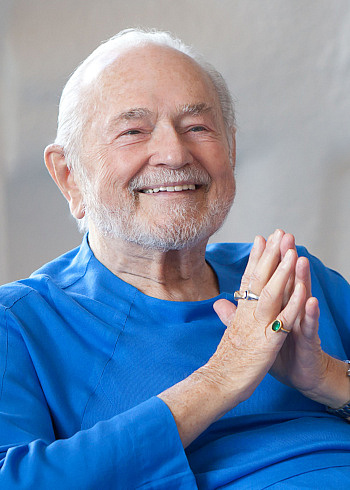 As a technique, Kriya is relatively simple. It is free from the trappings of time, place, culture, dogma, or ritual. Yet it is not stripped of vibration or spiritual power. That power flows from the lineage of the Self-realization Masters. If a practitioner does not cultivate inner attunement and devotion to the masters, the efficacy of the Kriya key may be less.
Even this attunement, however, need not be personal, at least not in the imagined forms that devotion often assumes in many faiths. Gratitude, appreciation, respect, reverence, and a desire to draw inspiration and guidance on how to live are the “valves” that open the floodgates of grace.
In Autobiography of a Yogi, at the close of Chapter 35, “The Christlike Life of Lahiri Mahasaya”, Paramhansa Yogananda wrote:
“Through the use of the Kriya key, persons who cannot bring themselves to believe in the divinity of any man will behold at last the full divinity of their own selves.”
It is through the experience of awakening the soul-Self, the direct experience granted through the practice of Kriya Yoga, that I, along with countless other kriyabans throughout the world, have received a sacred gift. For this blessing, transmitted through Swami Kriyananda as a faithful channel of the Kriya Masters, I am profoundly grateful.
—In divine friendship


3 Comments
Thank you for this DEEPLY inspiring article on Kriya, Swamiji, and discipleship, Hriman. 🙏🏼
Thank you Nayaswami Hriman for these wonderful insights on Swamiji’s life, discipleship and Kriya! Jai Guru.
Thank you Hriman ji for highlighting the beautiful aspects of Swamiji’s deeply inspiring life and the noble Kriya discipleship! Jai Guru.