From the moment a child enters our lives, we fall deeply in love. With that love comes a sacred responsibility: to give of ourselves wholeheartedly to this little soul. And yet on the spiritual path, a spiritual question soon arises—how do we meet this responsibility with faith and expansiveness, rather than fear, control, or expectation?
Paramhansa Yogananda reminds us that the soul of a child comes from God, not from the parents. Our children are not possessions, nor are they here for us to mold according to our personal preferences. Rather, we are entrusted with guiding, uplifting, and lovingly supporting the divine soul placed in our care.
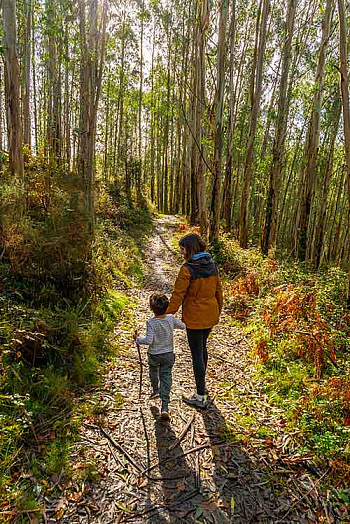
Walking this path requires courage. It asks us to loosen our grip on fear and control —those subtle forms of attachment that can quietly cloud love. Withdrawing attachment does not mean withdrawing love. Instead, it refines personal love into a high expression of divine love.
Loving without attachment is not easy, especially within a bond as intimate as that between parent and child. And yet, with reflection, practical tools, and grace, this inner transformation is possible. What follows are a few practices my husband and I are striving to live, offered in the hope that they may support and inspire others on this sacred journey.
Yogananda offers this guidance: “Give freedom to your young child and suggest to him only with love what you think is right. Remember, it’s important that the willpower of your children be developed.” Willpower is a divine gift—a spark of God within each child—and an essential foundation for spiritual growth. Over-controlling parenting, though motivated by love, can unintentionally weaken that inner strength.
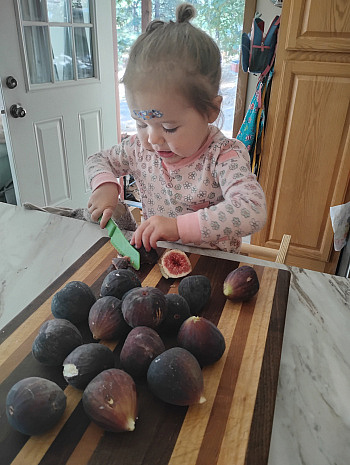 I became especially aware of my tendency toward impatience after becoming the parent of a toddler who joyfully proclaims all day long, “Me do it by myself.” Whether it’s taking a long time to put on her clothes herself, climbing into the car seat and buckling herself, or wanting to help with dinner, I often feel my patience slipping away. I could do it quickly for her—but she grows when I step back.
So I try to wait and give her space to learn. One of the most practical tools I’ve found for working with impatience is japa. Any time I feel impatience begin to rise, I silently repeat, “Aum Guru.”. This simple practice gently redirects my awareness. Instead of focusing on time, outcomes, or my own plan, my attention returns to God and Guru. And when the heart is focused there, impatience has no place to rest.
We also try to follow Yogananda’s counsel regarding requests and rules: “Try not ask anything of your child that you can’t back with a good reason.” There are times when a clear rule is necessary—for safety, or to guide appropriate behavior in a given situation. When a rule truly serves a purpose, I find that she feels it and respects it (usually!), because it makes sense to her.
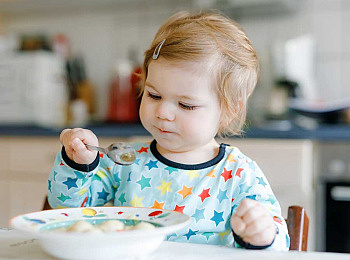 At the same time, too many arbitrary rules can dampen a child’s spirit. When I pause before imposing a rule, I often discover that it arises not from true guidance, but from habit, ego, or impatience. If there is no real need for a rule, and I can allow things to flow naturally, I try to do so—trusting her process and honoring her free will.
Offering small, age-appropriate choices—what to wear, or the order of daily activities—becomes another way to nurture willpower. I offer two good options and allow her to choose, remembering that this is not about letting her “rule the roost,” but about cultivating confidence and inner strength within loving boundaries.
Each moment becomes an opportunity for us both to grow: for her, in discernment and self-trust; for me, in patience, surrender, and love.
Here is a simple visualization I practice each morning to guide my day.
- Take a slow breath (inhale for a count of six, hold for six, exhale for six).
- Visualize your child surrounded in divine light.
- Say inwardly: “Divine Mother, You are the true Parent. Guide her soul through me.”
- Offer any fear or expectation into the light.
- Bless her softly: “May Your light guide her thoughts, actions, and path.”
- Sit quietly in stillness.
 Each time I do this, I feel that I am not parenting alone. There is a Greater Love holding us both
May we walk this path of parenthood with calmness, joy, and a sense of divine companionship. And may we remember, again and again: our children belong first to God. We are simply instruments of His love.

4 Comments
I really appreciate the distinction here between loving fully and clinging — it’s easy to confuse attachment with depth of feeling, when it often brings fear and control into the relationship. The idea that non-attachment can actually make love more spacious and less conditional feels especially relevant in close relationships. It’s a helpful reminder that inner stability changes how we show up for others.
Dear Gayatri,
thank you so much for bringing practical examples of your daily life with your daughter and how you are able to face them being a spiritual Mom.
May we on the householder yogi path be blessed with insight, courage and strength as you are!
Jai Guru
Dear Gayatri, Will you be my mom?
Thank you for the spiritual calm and comfort you bring,
Myriam Yvonne