At this moment in history, not only society but the music world itself is going through a time of uncertainty and challenge. The creation, production, and dissemination of music is being disrupted by the mass production of songs generated by artificial intelligence—music created without lived experience, discipline, or deep inner listening.
What is most concerning is not the technology itself, but the danger that some music is being stripped of core essential qualities: inspiration and the soul’s connection with the Divine. These components have always been a wellspring of artistic creation and have shaped the work of great composers of history and all true artists.
Swamiji’s Music as a Channel of Grace
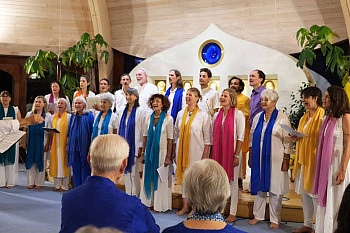 Swami Kriyananda’s music irrefutably belongs to the lineage of inspired creation. His compositions have the power to uplift both singers and listeners into a field of higher consciousness that lovingly and delicately opens the heart. His music does not merely entertain—it attunes, harmonizes, and awakens something deeper within us.
There is a quality of grace in his music, a subtle current that calls us to remember our soul connection and divine origin. In this sense, Swamiji’s compositions are not just notes and compositions but vehicles of devotion, not just artistic works, but also vehicles for inner communion and devotion.
A Personal Journey with Ananda Music
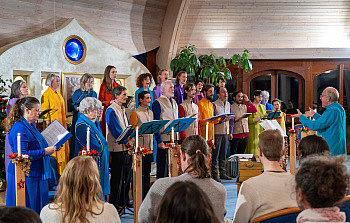 I have known Ananda music for over 25 years, and for nearly a decade I have been involved in training the Ananda Assisi choir. During this time, much has changed for the choir and me.
Music has been the central focus of my life since I was young: first as a flautist and teacher, then as a director of music schools, and later through a personal transformation that led me to explore sound in a more holistic and spiritual context.
Like many professionally trained musicians, I did not find my initial approach to and love of Swamiji’s music—and of Ananda music in general—easy or immediate. It took time for me to appreciate the simplicity of many of his compositions (with a few exceptions). Yet even then, it was clear that his musical language carried a message—sometimes joyful, sometimes deeply contemplative, and often both at the same time.
Transformation through Service & Attunement
So what changed?
I would say that I changed—not simply because of the music itself, but through a quiet metamorphosis that took place as I worked intensely with the choir.
A choir is a micro-community that contains all the opportunities and challenges of on-going teamwork that includes the dynamics between conductor and singers, the relationships among the choir members themselves, the effort to align and rally around a shared goal, the willingness to accept guidance even when it is not immediately shared or understood, the angst of changing tried and true long-standing habits, and the patience to wait for the right moment—musically and otherwise.
The changes in myself rose from a growing desire to enter ever more deeply into the various levels of interpretation that music, in general, requires of performers. This is especially true of Swamiji’s music, which calls for an approach beyond technical execution because it requires inner listening, attunement, and openness to grace.
Through such a steady commitment, I have gradually become more and more aware of the transformative power of music—not only in Swamiji’s music, but also in the works of other truly inspired composers.
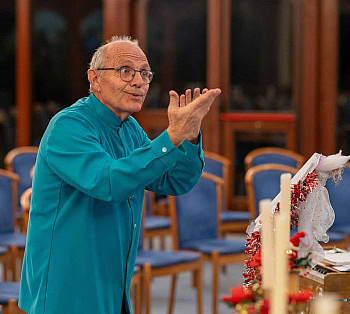 I am, therefore, happy and very grateful that Swamiji asked me to come to Ananda. He gave me a tremendous opportunity to grow both as a person and as a musician. His invitation allowed me to discover what I love most in conducting choir—understanding that working with voices and music provides us with a vehicle to deliver to the world one of the most precious things we have as human beings: the ability to share inspired songs and vocal music as messengers of the higher Self to share compassion, light, love, and joy.
Music as a Living Spiritual Practice
In my view, Swamiji’s music and music in general need interpretive space to be and remain alive and inspirational—delivering perpetually new musical and spiritual perceptions and revelations. Otherwise, the music risks calcifying and perhaps losing its power. Swami often reminded us that he was planting seeds and asked us to nurture them with respect and devotion.
In this way, music becomes not only a performance, but a spiritual practice—one that refines awareness, deepens devotion, and aligns individual consciousness with higher realities.
A Wish for the Future
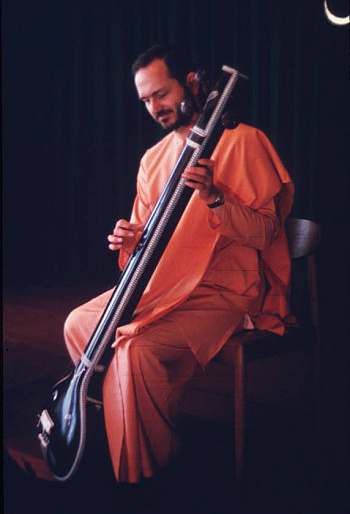 My wish for the future is that Swamiji’s music be shared ever more widely throughout the world, and reach beyond the boundaries of Ananda. Many of his compositions carry an intensity and spiritual power that the world urgently needs today.
May Swamiji’s music, whether instrumental or choral, be performed in a way that can be experienced with ever-renewed freshness and ever-new joy.
We remain faithful to the very essence of Swamiji’s legacy: by engaging deeply and devotionally with his music, by remaining open to inspiration wherever it arises, and by living in harmony with divine guidance—offering our lives, and our creative lives, to God and Master.

Peter Treichler, a longtime visitor to Ananda Assisi who now calls it home, serves as Director of the Choir. Music has been central to his life since he began studying the flute at age ten and later graduated from the Winterthur Conservatory. He went on to teach flute, chamber music, and choral conducting at the Conservatory of Italian Switzerland while remaining active in classical performance and choral direction.
In recent years his work has expanded into the healing dimension of sound. He founded the sound therapy studio Spaziosonoro and now offers meditative concerts and workshops with Tibetan singing bowls, gongs, and other tonal healing instruments.

One Comment
I appreciate his insight! Music and art and living are not stagnant but ever new.