“Education for Life will be bigger than Ananda!”
 Hearing Swami say this (or approximately these words) at the book launch of Education for Life in the summer of 1986 was startling to many of us!
I had moved to the Village in 1984 and had just completed my second year of teaching at Ananda School. I believed world brotherhood communities would spread “like wildfire” and that the Education for Life (EFL) philosophy was for our schools. This was my first hint that the truths Swami was sharing with us would be accepted and influence education in a greater arena beyond our communities.
For years, I subscribed to a small newsletter put out by Nitai and the staff of what was then called the Ananda How-to-Live School. In college, I became interested in alternative education, as I knew something was lacking in regular schools, though I had no idea what!
Teacher Training
Nitai had written The Art of Joyful Education, which gave us hints of the yogic foundation of the Education for Life philosophy, and Swami had begun writing about education in 1983. But it was in the summer of 1986 that Swami gave us Education for Life. The book is a blueprint for our philosophy of education and also contains many practical suggestions for applying the concepts. We were told several times that the book was a “seminal” work, and it was up to us to build upon it.
Ironically, Nitai, the founder of our schools, was not here when Education for Life came out. He had moved to Portland, Oregon, as the first full-time minister to establish a work there. He was able to start a community and a café and set the tone for a thriving work to come. Later, he returned to the Village, restarting a high school, getting it accredited so we could accept foreign students, and then founding two more online high school programs. Nitai travels worldwide and is the “glue” who has united all of us working with EFL in India, Europe, and the U.S.
Four of us working in the school were new—not to the path, but to the Village: Jay Casbon, the second school principal, Bruce and Carol Malnor, and I. Swami invited us to spend a couple of mornings with him to help us attune to EFL. It was a preview of what he would share with the whole community on Saturday morning at the book launch and class, held outside at Crystal Hermitage. We met each morning at the Crystal Hermitage dome.
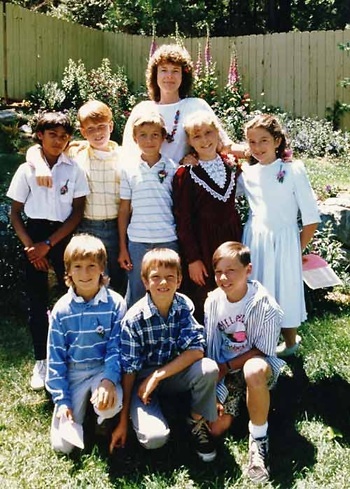
The author with a class on Awards Day
In addition to the four of us, also in this group were Nayaswami Asha, Helen Purcell, David Praver, and Anaya and David Gamow. The blessing of spending those hours with Swami and seeing how much energy he devoted to sharing his vision with our whole community deeply affected us.
The First Circle
Almost immediately, the Gamows were tasked with giving talks about EFL in Sacramento and other communities. Jay wrote the introduction to the book, eventually became the president of Oregon State University in Bend, Oregon, and later served on the Ananda College Board.
Asha was instrumental in establishing the second school in Palo Alto, and years later, Helen became its second director. In 1997, I became the founder and director of the third Living Wisdom School in Portland, Oregon. Bruce served as the third director of the Village School for seven years, and Carol directed the junior high for fourteen years before going on to create curriculum materials for children.
To my surprise, Swami spent much of our time together speaking of teacher training! I remember thinking, “How are we going to train teachers when we don’t even understand all of this ourselves yet?!” Of course, Swami always reminded us of the importance of serving others. In fact, we started hosting week-long EFL trainings just a few years later.
Years later, leading workshops for parents at the Portland school, I realized how much deeper the teachers went into EFL by sharing with others. Swami asked us what we wanted to give teachers who came to us for training, and his comment stayed with me always:
Ultimately the most important thing we can give is God’s love.
Swami gave EFL so much energy during that period. Over a decade later, when I started the third school in Portland, I often felt that I was riding a huge wave of energy that had begun that summer. It was up to me to stay balanced on my surfboard, but the wave was carrying the other teachers who joined in, and me.
Less than fifteen years later, we were asked to create a course for Tina Rutar (now Anjali), a devotee who wanted to start a school in Slovenia. Our online training began, and today we have online EFL training in Italian and English. There are also teachers from schools such as Waldorf and others taking the training—attracted by the inspiring ideal of educating the whole person, not just the intellect. (The school in Slovenia is thirteen years old now, and is recognized and partially funded by the Ministry of Education.)
Music
The mid-eighties were a time when Swami focused on education and children in other ways. Many of his children’s songs were written during this period: “It’s Time to Go to School,” “Lightly I Fly,” “Move All You Mountains,” “Sing in the Meadows” (1985), “All the World Is My Friend,” and “Say Thank You” (1983).
Interestingly, Swami also composed a lovely chant in 1985, while he was in Italy – “What Is This Life” – which I believe he first shared with the Village residents in 1986. I immediately noticed that each verse corresponded to one of the Tools and Stages of Maturity that Swami saw fit to spend 30 percent of the book discussing (five chapters out of seventeen!). One might also see a correlation between these four types of yogic paths: bhakti, hatha, karma, and gyana.
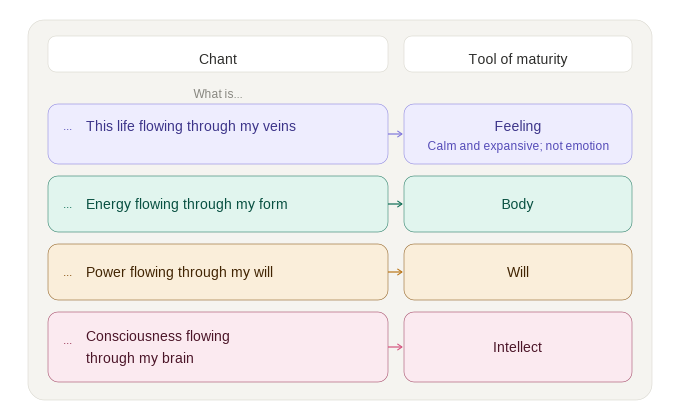 At about the same time in the realm of education, with the 1983 publication of Howard Gardner’s Multiple Intelligences, a more expansive view of intelligence was becoming accepted. However, the four Tools of Maturity reflect a deeper understanding of human nature and the capabilities needed for a well-rounded, successful life.
Not long after the first edition of the book came out, Swami mentioned that he wanted to clarify his scientific explanation of specific gravity. About ten years later, he did revise not only that chapter, but the whole book.
The second and more definitive edition contains not only minor changes in wording, but also the addition of an extensive chapter on curriculum, which changed at least one subject (meditation) from Wholeness to Personal Development. Swami remarked earlier that he renamed the six curriculum categories so that teachers would look at the underlying purpose of each subject in a new way. The other four curriculum areas are Our Earth/Our Universe, Self-expression and Communication, Understanding People, and Cooperation.
A Conversation on Camera
Around that same time, in 1996, we received a donation to create a promotional video. Linda Connor, as she was then known (she later became Maitri Smithhisler and was one of the leaders of the Dallas meditation group), and I worked together to plan the content. Linda filmed and edited. Swami agreed to be interviewed for the video, and Linda, Bruce Malnor (then principal of Ananda School), and I interviewed at Crystal Hermitage.
One of the questions we asked was a rather technical one about specific gravity, I believe. Swami surprised me by asking us what he had said about it in the book. He nodded, closed his eyes, and seemed to go away into a different level of consciousness. Bruce, Linda, and I meditated. After two or three minutes, he opened his eyes, said, “Ready,” and proceeded to give an articulate, inspiring discourse on the topic as if he were quoting some higher source.
Of course, I knew Swami wrote from divine inspiration, but I had never before witnessed up close his accessing his understanding this way. It reminded me of how he said Divine Mother wrote music…that he asked for a melody on a certain topic and then listened.
A little later in the interview, I mentioned that EFL says a teacher should love the subject they teach, though in the very early grades, the teacher is essentially teaching not subjects as much as skills such as reading, handwriting, numeracy, and how to cooperate in a group. I loved Swami’s reply: “A teacher of young children should love childhood itself!”
I realized that what he described was characteristic of all of the best teachers I had worked with. It reminded me of Swami Sri Yukteswar saying we cannot take a step forward on the spiritual path without love.
Love as Pedagogy
 In the book Education for Life, Swami does not discuss loving the students very often, perhaps because people tend to think of love in a personal way. We are told to work with children’s strengths (rather than concentrating on correcting any weaknesses).
Reflecting an individual’s gifts and potential creates an atmosphere and energy flow that spills over into actualizing the person in many ways. It’s a gift that good leaders in every field do consciously or unconsciously: recognizing their colleagues’ strengths and giving them opportunities to expand them. In fact, the word expand (and its derivatives, such as expansion and expanding) is the most frequently used word in the book.
The explicit goal of EFL is “the ability to relate appropriately to the realities of others.” In my mind, the “realities of others” does not only mean other people but all realities, whether of an animal, a tree, or an atom. The principles of EFL apply to every age, as Swami says in the book, “Maturity is a continuous—even a never-ending process.”
During a break in this recording session, Swami said to me in reference to EFL, “Make it broad.” The broader the base of a pyramid, the higher it can be at the top. This advice guided me. Years later, I mentioned it to Nitai, and he said something to the effect of, “Well, he told me to make it high!” I immediately visualized a tall waterfall drawing people to the cool spray.
Consciousness Everywhere
In May of 1999, Swami turned his attention again to education at the annual colony leaders retreat, held in Assisi that year. One of the outcomes was that he made clearer to us the universality of EFL by suggesting that we change the names of the schools affiliated with Ananda communities to “Living Wisdom Schools”. EFL is the philosophy that schools are based on, and other schools can adopt all or part of the system.
Reading the transcripts of this event in Assisi, I discovered Swami said that EFL could bring an awareness of Divine Mother to America. When he visited the Portland Living Wisdom School a few years later, I asked if he could speak more about what that might look like. He replied that maybe we could not speak about the Divine Mother with parents unfamiliar with the concept, but we could share the reality that “There is consciousness in everything!”
How thrilling! Young children often seem to have this belief, already treating their stuffies as real, looking for fairies (or devas) behind plants and flowers. The adult world smiles indulgently but sees this as a fantasy to be outgrown, rather than encouraging that feeling of oneness. Even some physicists, given that the atom has practically no physical content but consists of vibrations in certain patterns, have concluded that there must be something beyond the physical that determines these patterns.
Law of Motivation
Never should the wise condemn the ignorant for the ego-motivation they manifest. Instead, being themselves enlightened, they should seek to inspire others in the direction of preferring to perform right, dutiful action. -Bhagavad Gita, 3:26
The book Out of the Labyrinth, a revision of Crises in Modern Thought, came out in 2001. Swamiji told me. “You must read it! All Education for Life teachers should read it!”
So, of course I did. Chapters seven and eight, “Truth in Relativity I and II”, address the very same topic as chapters ten through twelve in Education for Life—Progressive Development—but from a slightly different point of view. In Out of the Labyrinth, we learn about the caste system in Vedic times and the four levels of the soul’s evolution.
In Education for Life, Swami calls the different levels of consciousness specific gravity and names three levels: Heavy, Ego-active, and Light. These correspond to the three gunas: tamas, rajas, and sattwa. He concentrates on what motivates each level.
 This understanding is vital not only to teachers but also to parents, managers, and all leaders. All of life is an education for us if we choose to learn by experience. Swami describes these levels as Levels of Energy, and encourages us to always “tune into the energy” and to “work with the energy” of others. Three ways of recognizing others’ specific gravity are mentioned: how the individual responds to challenges, body language, and who one’s friends are. Kriya yoga is all about energy and magnetism, and so is education.
Reflections
For me, diving deeply into understanding Tools of Maturity and Progressive Development opened many doors to understanding myself and going more deeply into the spiritual path. I am sure that whatever aspect of Ananda’s work one focused on, from music to leadership to selfless service to hatha yoga, would have the same effect on anyone who devoted themselves to an aspect of Swami’s work.
I find it miraculous that I found Master and then Swami, and that I was so blessed to have work that inspired me and gave me a way to serve and tune in to Swami’s guidance. I am convinced that EFL is uniquely poised to be the Dwapara model of education because, at its core, it is about working with energy, and this is the age mankind will come to a deeper understanding of utilizing our own energy. I know many of us have eternal gratitude that Yogananda left his homeland to help usher in a new consciousness in the West, and to Swami for his dedication to Master’s mission.

2 Comments
Excellent, Ushaji, thanks!🙏
I will never forget when once I had asked a little girl in Kindergarten, when I was her teacher and we were visiting a nearby park, if she would know the name of this flower she had picked up to show me. I had in mind if she already would know the name of Daisy …. and she looked for a while very intensely at the little flower between her fingers, and she replied: “I don’t know for sure, but Sofia maybe?”