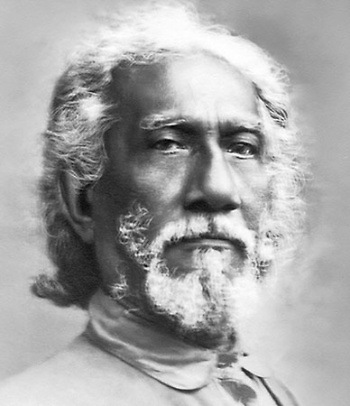
 Sri Yukteswar was born to a wealthy businessman and his wife on May 10, 1855, in Serampore, India. He was given the name Priya Nath Karar. After leaving college, he married and had a daughter. In 1884, he became a disciple of Lahiri Mahasaya and received initiation into Kriya Yoga from him.
Babaji Meets Sri Yukteswar
At the 1894 Kumbha Mela, Babaji appeared to Yukteswar and gave him specific spiritual instructions. Babaji told him that one day he would send a disciple for training who would share the teachings of yoga in the West. Paramhansa Yogananda would be this trainee.
Babaji asked Sri Yukteswar to write a book on the essential unity between the Christian and the Hindu scriptures. He was to “Show by parallel references that the inspired sons of God have spoken the same truths, now obscured by men’s sectarian differences.” Yukteswar wrote this book in 1894, titled The Holy Science. Yukteswar’s interpretations of the scriptures require an intuitive, superconscious understanding, as they delve deeply into the heart of Yoga and Vedanta, exploring the divine teachings and the inner life.
During that meeting, Babaji also initiated Yukteswar into the Swami order, although he was married – Yukteswar’s wife did not pass until 1895. He was later formally initiated into the order in 1906 and given the name Sri Yukteswar Giri.
Training of Paramhansa Yogananda
Yogananda met Yukteswar after completing high school, became his disciple, and received training from him for nearly 10 years. In 1920, Yukteswar sent him to the West as his emissary, entrusting him with the task of sharing the spiritual wealth of India. This move proved pivotal, as Yogananda established a lasting spiritual presence there, notably through his book Autobiography of a Yogi, which has introduced many readers to the depths of the teachings of the masters of India.
Sri Yukteswar’s belief in the unity of all religious faiths led to his establishing the Sadhu Sabha (Society of Saints) to promote a scientific spirit in religion. The initiative brought together leaders of different sects and traditions, fostering a sense of unity and understanding.
He founded two hermitages: his family home in Serampore, twelve miles from Calcutta, given to him by his father as his inheritance, and a seaside hermitage at Puri. In the last year of his life, Yukteswar turned over all his property to Paramhansa Yogananda, asking him to assign someone to maintain them.
Sri Yukteswar’s Spiritual Influence
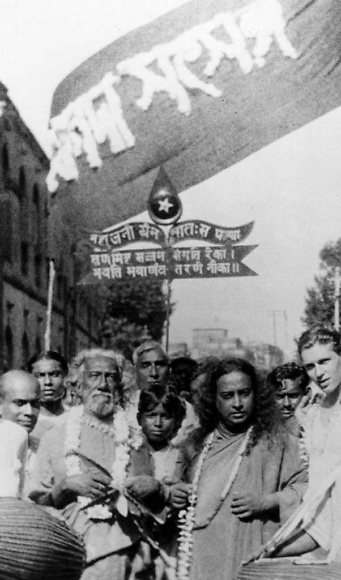
Sri Yukteswar and Paramhansa Yogananda in a procession, Calcutta, 1935
Sri Yukteswar had a profound influence on Paramhansa Yogananda. His gentle demeanor, pleasing presence, and deep spiritual insights earned him the veneration of all who knew him. He prepared his disciple specifically for the challenge of bringing India’s teachings to the materially minded West, shaped by his own keen interest in the welfare of people in America and England.
Yukteswar had a comprehensive approach to spirituality, blending discipline, devotion, and harmonious integration of Eastern and Western thought. Yogananda’s mission, as he understood it, was to uplift Western society spiritually within its own cultural context, an approach centered on meditation and inner calm.
Yogananda called Sri Yukteswar a gyanavatar, an incarnation of wisdom, an avatar being a fully liberated master who returns to fulfill a special divine mission. From this understanding, Yukteswar’s task was to secure divine guidance for Dwapara Yuga’s scientific and cultural advances and prepare Yogananda to carry that purpose forward.
Key Teachings
Sri Yukteswar emphasized several key teachings that were foundational to his spiritual guidance:
- Kriya Yoga: He highlighted the value of Kriya Yoga as a powerful spiritual practice and a key to unraveling the final mysteries of life through meditation. This technique was central to his teachings, and he encouraged a disciplined approach to its practice.
- Unity of East and West: Yukteswar aimed to further people’s understanding of the universality of truth. He saw the West as specializing in objective development through logic and reason, while the East specialized in inner, intuitive development. He taught that the time had come for these two halves to unite.
- Devotion and Inner Realities: He taught that devotion is the heart’s desire for connection with the inner realities of the soul. Although Yukteswar at times outwardly seemed to be primarily gyani in his demeanor, at the center of his spiritual life was pure love for God.
- Self-Respect and Discipline: He emphasized living a life of self-respect, calmness, determination, simple diet, and regular exercise. These principles were part of his holistic approach to spiritual and physical well-being.
- Scientific Spirit in Religion: Yukteswar believed in incorporating a scientific spirit into religious practice, advocating for a rational, experiential approach to spirituality.
Sri Yukteswar left his body on March 9, 1936. Soon after, he appeared to Yogananda and described to him the nature of the afterlife. This description can be found in Autobiography of a Yogi.
