What is the purpose of life and, specifically, of my present incarnation? What is the essence of the techniques of our path? How do we form a stronger connection with our Guru? These are the questions we were exploring during our talk on “The Essential Elements of Kriya” at the annual Kriya Renaissance week here in Assisi.
We’ve all read that the goal of life is to find God or, alternatively, to dissolve the ego. But do we have a clear idea of what this means? Who is God? Where is He located? We know that He isn’t an angry man condemning sinners to hell, as Michelangelo painted Him. Nor can He be depicted only as one of the many deities of the Hindu religion. All forms show aspects of Him, but none is able to capture His essence.
The problem is that He is pure consciousness, and because the human mind can’t picture such an abstraction, we substitute a form that we can see and touch. Or perhaps we’ve been taught that to be spiritual we must live a life filled with “Do this” and “Don’t do that.” How, then, if He is pure consciousness, can we find Him? It can only be by expanding our consciousness until we can directly experience God. But this experience, too, is hard to visualize.
Paramhansa Yogananda solves this dilemma for us by giving us a clear image. In Autobiography of a Yogi, the chapter “An Experience in Cosmic Consciousness” is surely one of the clearest descriptions of Divinity in all literature. That chapter, which I read just as I was beginning my spiritual quest, changed my life forever. Master also gave us the poem “Samadhi,” which again provides a crystal-clear portrayal. Let’s then restate things: The purpose of my spiritual search is to achieve samadhi. This, for me, brings clarity to the goal.
What about the techniques we practice? Yoga has hundreds, probably thousands, of them. If we approach each one as separate and unrelated, we end up with a jumble, like a bowl full of loose beads. Even if we limit the number to just the four main techniques of our path—the Energization Exercises, Hong-Sau, Kriya, and AUM—we still have a group of seemingly separate practices. But we can string all the beads together by saying that each one helps us control our life-force, withdraw it from its fixation on external experiences, and focus it at the spiritual eye so we can attain samadhi.
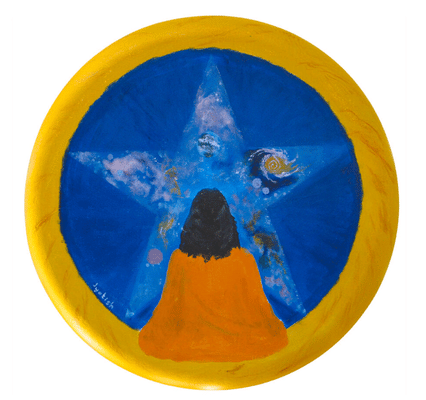
King of the Infinite by Nayaswami Jyotish.
Why do we need a guru? The delusions of the ego are like a labyrinth, and the mind is too limited to find its own way out. The guru knows the way and can lead us to freedom if we open our hearts and minds to him.
So now the essence of the spiritual path seems much clearer: I am trying to attain the state of samadhi. In order to do so, I need to withdraw the energy from the senses and focus it completely at the spiritual eye. And Master will give me the inner guidance and the grace to accomplish this.
Although the goal and the method may be clear, it is still not easy to accomplish. Lest we despair, here are some comforting words from Master that apply to every one of us: “If ever you have a desire for God, it can never be crushed. I want you to know that. This is a message of hope to you: If you have had the desire to be redeemed, you will find salvation. You may delay your development, but sooner or later that desire will lead you to Him. Why wait? Why let anyone shake your determination? You must find Him. Let no one dilute that desire.”**
In His light,
Nayaswami Jyotish
*Solving the Mystery of Life, Self-Realization Fellowship, p. 135.
Listen to Jyotish as he first reads the blog, then expands on its meaning and messages for readers with behind-the-blog commentary. Subscribe to the podcast or download the audio recording by right-clicking here. Or listen to it here (9:57):
22 Comments
Thank you🌷. The only desire whose pursuit can take us home.🙏💕Aum Guru🕉️
Wow! How simply and beautifully you gave us the clarity of the essence of the spiritual path. Thank you!
Thanks Jyotish 🙏
Jai Guru🙏
Thank you Jyotish
I really enjoyed your explanation and just what is needed as I approach receiving Kriya next weekend. AUM Guru.
Also I love your painting of the King of the Infinite.
🙏
You have touched my heart. And I even think, you have touched my spiritual eye, to be exact. Love, gratitude and deep bow to your spiritual journey to reach this place of absolute inspiration and upliftment for others. Thank you.
Dear Nayaswami Jyotish Ji,
Thank you for sharing this blog. Inspiring and a very clear explanation.
And so comforting to read Masters’s words 🙏
Joy,
Prem
I look forward to reading the messages and it feels so personalized and tailored to my situation
I have read the book and many times have thought about coming to the center and do a course but life gets in the way.Have been facing a very difficult period for the last 6 years and your words come as a balm
Very nice ❤️
Aum guru 🙏
As always, beautiful sentiments. Only thing, God has no gender. The use of ‘He’ is not needed (though capitalization rightly represents Divine reverence). This is not a feministic sentiment. God is beyond our worldly understanding. Our sexes were designed specifically for this game we’re in. They have no spiritual relevance, since biological procreation has no spiritual relevance. In this world, genders exists to divide labor, a more efficient way to survive. We try to express our understanding of what God is in our limited vocabulary and pronoun logic, but God is, at best (and worst), an ‘It.’ An entity beyond our binary, dualistic comprehension. ‘All That Is’ can have no label. God is all genders and no genders. God is Force. God is Energy. God is all Things. God is Divinely Beautiful. But God is not a gender-specific thing.
Thank you for your group e-mails. They often arrive at just the right time to remind me to re-examine situations from a spiritual perspective, with an eye toward growth.
I have lived in the USA all of my life. I spent ages 11 through 18 attending a fundamentalist Protestant church. It was all about a patriarchal God who considered men to be superior to women. Our pastor taught us that women were supposed to serve men. I now believe in equal rights for women and men. I hope that y’all do, too.
I often wonder whether y’all use the words “God,” “He,” and “Him” to appeal to westerners, to make us feel more comfortable with the viewpoints and belief system that you promote. Such words discomfit me. They make me think of The Patriarchy, and my second-class place within it. Just the opposite of inclusive and welcoming!
Have y’all thought of either:
1. Alternating your use of gender-specific terms, e.g., “Her/Him” or using “God” one time and “Goddess” the next?
2. Using a gender-neutral term such as “Deity” or “Creator” instead of “God”?
Thank you for thinking this over.
Jyotish, thank you from my heart for that saying of Master’s, that if we’ve ever felt a desire to know God, that desire can never be “crushed.” It seems to reflect something that I experience, that the desire needs constant renewing, and that God is endlessly ingenious in how He helps us reawaken it.
By the way, I was at a talk where Swamiji urged us NOT to neglect the Aum technique. “It is,” he said, “after all, the main meditation technique of our path.” I have a feeling – maybe it’s just me – that people sometimes neglect it because it threatens to dissolve the ego. As a respected friend remarked to me circa 1970 when I was in SRF, “Aum is how we crawl back to God.” I can’t help feeling it’s a serious mistake when people say, “Do Kriya, and oh, if you have a little time you might want to perhaps try doing a little Aum technique, too.” That’s simply wrong.
My first Samadhi experience was on June 20th 2009 during a 6 hour meditation. I always knew that Samadhi would come and that made all the difference. Never give up believing that you will get there.
It is just a matter of concentration and devotion.
At some point I would like to work with devotees on working through their final blockages. This can take months or years. There are many things that would shorten this time. You are already that which you seek.
That is very important to remember.
Namaste!
Beautiful; clarifies wonderfully this path we are on!
SUCH CLARITY!!! SO HELPFUL – AGAIN AND AGAIN 🙏🦢🙏
Thank you Jyotish, :You make it sound reachable. Now the work.
Dear Jyotish & Devi,
Thank you for your spiritual viewpoints. I would like to share with you the essence of what you have expressed in my poem. The wonderful thing about poetry is that it can go straight to the heart, whereas prose is more set in the intellect.
The Search That Never Left Home
I sought a God beyond the sky, A distant light, a hidden eye—
In temples carved of stone and gold,
In ancient tales the sages told.
I drew His face in lines of art,
But could not hold Him in my heart.
For every form my mind could make,
Was but a shadow—not the wake.
I thought that I must climb and strive,
To keep some holy law alive—
“Do this,” they said, “and don’t do that,”
To earn a grace I could not grasp.
But rules are rails upon a track,
They take you there, but not back—
To where the journey first began,
In simple knowing—not in plan.
And then I learned, in quiet hours,
That God is not a thing with powers—
Not far, not near, not up, not down,
Not king, not sage, not saint, not crown.
Pure consciousness—without a name—
The light in which all knowing came.
And this same light, this seeing, too,
Is what I am—and what is you.
I once believed the goal would be
A state called union, wild and free—
Where thought would cease and time would bend,
A blissful trance without an end.
But even peaks must have a base,
And every state has time and space.
True knowing is not in the height,
But in the ordinary light.
For when I see a leaf unfold,
Or hear a story being told,
Or taste the salt upon my bread,
Or rest my weary, heavy head—
In every act of knowing, there,
The truth is breathing—everywhere.
Not in a flash of lightning bright,
But in the quiet, steady sight.
So let the search at last be done—
The race was over, never won.
For what I sought in distant skies,
Was never hidden—never lies.
It is the seeing in my eyes,
The knowing that no thought denies.
The wave was searching for the sea,
And found the ocean—simply me.
Stephen Sturgess © 2026
I noticed in the comments that there are a few that need understanding answers. They are related to the old religious model of using the word “God” and the pronouns “He” and “Him.” I can understand their problem on this subject. When we speak of God, we almost instinctively reach for pronouns—He, Him, His. These words slip from our lips in prayer, in praise, in moments of desperation or gratitude. But have we ever stopped to consider what happens when we confine the infinite to such human categories? What does it mean to address the Source of all existence as though It were a person, complete with gender, personality, and preferences?
When we refer to God as “He,” we are not describing God; we are describing our own limited understanding of ourselves. We have made God in our image, not the other way around. This is not merely a matter of inclusive language or political correctness. This is about the very nature of spiritual practice itself.
When we think of God as a person—even a perfect, loving person—we create an unbridgeable gulf. There is God “out there” and me “in here.” There is the seeker and the sought, the devotee and the Beloved, the sinner and the Judge. This duality becomes the foundation of our spiritual life, and yet it is precisely this duality that keeps us trapped.
Consider what happens in prayer under this paradigm. I speak to God as though God were elsewhere. I ask, I plead, I thank. But where is God during all of this? If God is truly everywhere, then God is also here, within me, as me. The very act of speaking to God as “Other” reinforces the illusion of separation.
This is the central teaching of the ancient wisdom traditions: the separation is the illusion. The seeker and the sought are one. The devotee is the Beloved. The drop is the ocean, and the ocean is the drop.
Even the word “God” has become problematic. For many spiritual seekers, it carries the weight of religious dogma, judgment, and institutional control. It evokes images of fire-and-brimstone preachers, religious wars, and exclusionary doctrines. The word itself has been so thoroughly co-opted by religious systems that it can be difficult to hear it without the accompanying baggage.
This is why many spiritual teachers have sought alternative language. “Consciousness” speaks to the ground of all being, the awareness that underlies all experience. “Self” points to our deepest nature, the one who knows all thoughts, feelings, and sensations. “Brahman” in the Advaita tradition refers to the formless, attributeless reality that is the source of all existence.
These terms are not meant to replace God, but to liberate us from our limited concepts of God.
What if we simply dropped the pronouns? What if we stopped speaking of God as “He” and began speaking of God as “That”—the ground of being, the source of consciousness, the reality that is always already present?
What if we shifted our spiritual practice from outward devotion to inward inquiry? Instead of praying to a God “out there,” what if we meditated on our own deepest nature, asking, “Who am I?” and discovering that the answer is not a person at all but pure awareness?
The practice is not about becoming something we are not, but about recognising what we already are.
Imagine sitting in meditation and simply being aware of being aware. You are not a man or a woman, not young or old, not rich or poor, not a Nayaswami. These are just labels, costumes that the Self wears for a time. Beneath all of that, you are consciousness itself—the one reality that illuminates all experience.
Some might object that this approach lacks the devotion and love that are central to religious practice. But devotion is not lost in non-duality; it is transformed.
In dualistic devotion, I love God as other. In non-dual devotion, I love God as my own Self. This is not less devotion; it is more. It is the devotion of the wave to the ocean, the devotion of the light beam to the sun. It is the recognition that there is no separation between lover and beloved.
When we meditate on ourselves—not as the ego, but as pure consciousness—we are engaging in the highest form of worship. We are honouring the divine presence that is our true nature. This is the worship of the Self by the Self, and it is the only worship that ultimately satisfies.
I hope this clears up some of the problems that have appeared in the comments.
Stephen Sturgess (Kriya Yoga teacher in London).
Nothing to be cleared up. We have limited ways of expressing everything in this existence, fully understood. Yet I wrote an entire book about God and never used a pronoun. Just used God this, God that. It still falls way short, but it’s at least an attempt to unify divinity into one ‘All That Is’ concept. I don’t believe in the ‘divine masculine or divine feminine.’ Our genders are worldly constructs only, and we tend to project that onto the divine, as we project so many other of our anthropomorphic traits (as you point out, particularly in antiquity). Genders exist so organisms can cope with a physical environment where division of labor is necessary. Perhaps an amoeba is closer to the concept of God than higher lifeforms, because it is genderless. But it is only genderless because of it’s biological simplicity. No other reason. As you move up the lifeform scale, division of labor becomes necessary for earthly survival. In a nonphysical, spiritual state, presumably, there is no need for procreation or day-to-day survival, therefore, no need for gender. Either way, the greatest entity we could even slightly hope to ever comprehend, God, in my opinion, has absolutely no need for gender classification, and we should do all we can to represent that in our writings and speech.
Thank you for sharing….
Caro Jyotish,
Grazie per queste parole di speranza, la nostra vita potrà avere un senso soltanto trovando Dio, ritornando a Lui, solo così potremmo trovare il vero e supremo appagamento. Grazie per tuo prezioso servizio. Ramajyoti
Dearest Jyotishji,
That was absolutely wonderful! What an inspiring and inspired blog!
“The purpose of my spiritual search is to achieve samadhi. This, for me, brings clarity to the goal.”
I’d add to the above statement, the purpose of my spiritual search is to achieve mahasamadhi.
AIM HIGH! so even if I fall short, I’ll be well above where I could ever hope. 😊💖
Bless you and Devi on your travels, and thank you for all you do and who you both are. 😇
Aum Guru Jyotish ji,
Your message was such a timely reminder when I was getting lost in my labyrinth. Thank you Master for finding a way to always find me. Ever grateful. Ever Blessed.