Practice Kriya So Deeply That Breath Becomes Mind
December 6, 2019
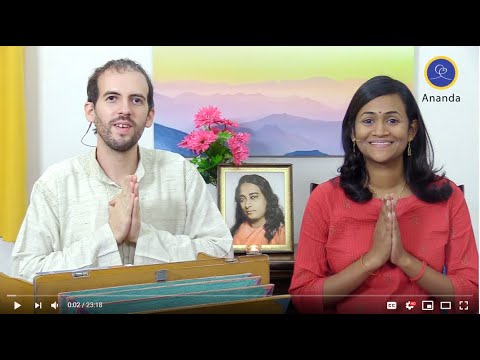
Webinar with Bara and Shamini speaking about Swami Kriyananda's book Conversations With Yogananda: "Practice Kriya so deeply that breath becomes mind. The breath is a gross dream of mind, it can be rubbed away by superconsciousness."
An insightful discussion on Paramhansa Yogananda's teachings, focuses on Kriya Yoga and the profound concept of breath transforming into mind. Baraquiel delves into Yogananda's guidance on achieving a deep state of meditation through breath control, exploring the spiritual significance of breathlessness. Shamini complements this with a reflection on Yogananda's compassion and the importance of continuous effort in discipleship, regardless of past mistakes. The conversation emphasizes the transformative power of devotion, the necessity of aligning one's energy with spiritual practices, and the ever-present support of the guru in a devotee's life.
Transcript
Baraquiel:
Good evening everyone, I'm Baraquiel and this is Shamini and we're very happy to be here once again with all of you, with the book Conversations with Yogananda.
The Significance of Kriya Yoga Practice
And today, we'll start with “Conversation #89”, which is very interesting. It’s one, if you are a Kriya Yogi, you have heard this many times, probably are still puzzling your head what it means. I still am puzzling my head on what it exactly means, but Master said,
“Practice Kriya Yoga so deeply that breath becomes mind,” the Master said to us one day. He added, “The breath is a gross dream of the mind, it can be rubbed away by superconsciousness. True Kriya Yoga practice takes place in the deep spine, the sushumna.”
Now, maybe you have not heard that before, that ‘until breath becomes mind’ but if you have followed Yogananda a little bit, you will know that that's something very often quoted.
"Breath Becomes Mind": Unraveling the Mystery
And then he says “The breath is a gross dream of the mind, it can be rubbed away by superconsciousness.” Now that is very interesting, ‘a dream of the mind’. That, is the breath a product of our mind, that we create the breath? Well, let's first go with the whole thing, “until breath becomes mind.”
Now, interestingly enough, you know we think, “Our breath becomes mind? What does that even mean? Does that mean I have to stop my breath, that I breathe with my mind? What is it?”
And interestingly enough, at the beginning it is very hard when you start in the spiritual path or learning about the yogic truth that, “How can I be without breath? Wouldn’t I die?” And, you know, in a way until you have the experience, that little bit of thought is going to always be there, “What will happen?” Even when you get your first experiences of a little bit of breathlessness, immediately you start getting scared. But you see that everybody, to some degree or the other, has this experience.
The Subconscious Connection Between Breath and Concentration
Now, if you think in mundane ways, it is very interesting to note that whenever we are doing something that requires a lot of concentration, like threading a needle or balancing yourself or something, or many other things that, you know, we may not be as aware of, your breath just stops. That somehow, subconsciously, we know that the breath itself is a hindering to our concentration. That, you know, sometimes you're doing something so meticulously that if you breathe, you think, you know, you feel that it is going to mess it up, that is not going to work out.
And that is something very interesting, because we do it very subconsciously and it comes just naturally. You can say it's just something that we humans do. I don't know if animals do it as well but we humans do it. And when we are in meditation, especially with techniques like Kriya Yoga which is a pranayama, you know, we are using the breath itself or other techniques, we are very much aware of our breath. But then we also start to realize that yes indeed, it is a hindrance.
Breathlessness: A Gateway to Higher Consciousness
And the interesting thing is, the more you practice these things the more your breath starts becoming calm, it starts becoming quiet, that you may have a brief moment of breathlessness here and there, and you say, “Oh wow, I think this may be possible.” Or many times it may happen that after chanting a devotional song for a long time and you feel very devoted, that the moment you stop singing, there is no breath that comes.
The Importance of the Sushumna in Kriya Yoga
And these are very real things that happen. In a deeper way, it’s because the breath is really an outward manifestation of energy inside of our self. Yogananda said that the breath is the outward manifestation of the Ida and Pingala currents going in our spine. And so long as we are breathing, we are in the Ida and Pingala, which he said is the realm of duality. He was saying here that the true practice of Kriya Yoga begins in the sushumna, in the deep spine.
He explained that once we magnetized, once we are able to go beyond the breath, which he said is a cord that ties the ego, the soul to the body, sorry. Once we are able to go to a state of breathlessness, we can go into that deep spine, into the sushumna. “Only then we can, and only then”, he said, “we start making spiritual progress.”
Now that may seem a little depressing for some people like, “Does that mean that whatever I have been doing so far has been worthless?” Well, no, it is not so. Obviously every effort counts and I believe that there is always some energy flowing in our sushumna, even though is not fully flowing, like if we were to go breathless, and some purification is happening.
But Yogananda said that the sushumna, when we really can get into the sushumna when the breath leaves the body, that that is where all our karma is there, it’s lodged there, it’s blocking the flow of energy. That's where our attachments, our desires, our tendencies, all the things that we have accumulated through millions, perhaps billions, of incarnations, it's all locked in our astral spine, in the sushumna nadi.
The True Practice of Kriya Yoga
So Kriya Yoga... the thing, “Why is so effective?” is because, as he said, “True Kriya Yoga happens when we go into the sushumna.” Now we go into the sushumna, when the breath becomes mind, because we can only go into the sushumna when our breath stops, when we are out of the Ida and Pingala. So what happens then, how do we do?
Well, we realize that yes, through our mind, through our will, through our concentration, we can still move that energy we are still very much aware and even more aware than ever. And it is that movement of energy that we do, through the use of our willpower, of our mind, that in the end will help us more than anything else. That is, when we can cleanse ourselves even more because since the breath is not there anymore, we can focus, concentrate our minds a hundred percent. Now that's a very high state, so, but you know, sometimes you will get glimpses here and there, in the spiritual path, even if you practice the Hong-Sau technique.
The Hong-Sau technique, the goal is to go breathless as well. And you will see that sometimes just like that it will happen, that you will see that your breath is not needed anymore. And enjoy those moments but then make sure to again, try through your willpower to raise your energy, to cleanse yourself. Kriya Yoga obviously if you practice it, you will see it does it automatically and it really helps you in that purification.
Overcoming Ego and the Illusion of Breath
Now, it is interesting because again, ‘a gross dream of the mind’…and does that mean like, “We are thinking that we are breathing and that's why we need to breathe?” I think to some degree it is true. That because we identify ourselves with the ego, with the body so much, the thought process goes, “Oh, I am an ego, I am a body, I have this, so I have to breathe.”
Yogananda's Mastery Over Breath
And once we convince ourselves 100 percent that we are not the body, that we are not the ego, is that we can go breathless at will. Like Yogananda demonstrated many times that he could go breathless at will. He would even have doctors come to him and check him and his pulse. And he was able to change and all. He has total mastery of his physical body because he did not identify, his mind did not identify itself with the body, and that's how he went beyond it.
Now I would like to invite Shamani to take us forward.
Shamani:
Okay, thank you. So good evening again and thank you, Bara. And I'll continue with “[Conversation] #90”. And in a way, it's a little bit of a different tone from what Bara was sharing with us about Kriya Yoga, the breath, the mind.
Yogananda's Embodiment of Compassion
This one is about Yoganandaji’s compassion and how he was truly an embodiment of compassion. And I think this is very long, so I won't be sharing each story here. But I just wanted to comment on a few aspects of this and also I feel like this particular subject is something that we should keep in mind as devotees. If not every single day, just remind ourselves over and over again.
So, essentially it shares about different disciples who strayed from the path, from whichever path they were on, or from Master’s path, and how always, whenever they came back, if they did, they always found compassion in the Master. They never found judgment or somebody denying them because they had strayed. And so, some beautiful stories, such as for example, there's Norman.
The Guru's Unwavering Compassion
And Swamiji writes here that Norman, after leaving, he left Master, he came back to Master crying and he said, "'Why did I ever leave this place?’" So Master said to him, "'Wasn't it a paradise?'" And Norman replied, "'You bet it was.'" Master said that Norman “'wept so long that I wept with him. If only he had listened before getting burned!'”
So, isn't that so sweet? That Master, when the disciple who left, no matter how much Master might have convinced him, “Don't go, don't leave”, when he came back, all he did was weep with him for how much he had suffered.
And we know stories of that, we've even heard of Swami Kriyananda, when he would be feeling really sad if he knew that someone was heading for, in a direction that was gonna bring him suffering. He was sad for the suffering that the devotee was going to face. It wasn't a personal suffering for himself or any cause.
Learning from Mistakes
And, you know, that's something, I think for us, that's one of the points to remember. It's just, you know, we as disciples, if we make a mistake, and all humans do, let's face it. I think we have this tendency to judge ourselves, or even worse, to judge other people.
So if they make a mistake and say like, “You know you're putting out all this effort at work and on serving the guru and you're putting a very dynamic effort in and look how much I'm doing.” And then you see another one who's a little lazy and sitting around, taking it easy, they kind of show up and they meditate, yes, but they're not doing as much as you, we can slip into that danger even there of, “Oh look at how, you know they are not doing as much as I'm doing, and so obviously they're not doing the right thing, and, you know, this is not the way to serve the Master…” And we can slip into these little judgments.
And also about ourselves of, you know, “Oh I didn't do what was needed to be done and so Master is never gonna forgive me.” And all these things, in a sense, we were just, as Bara was sharing, about the mind. And the mind is very tricky, isn't it? Because it's also a factor that can really catch us and put us into these little traps of, “Oh now the Master must be disappointed” or “Oh that person is not doing as well.” When all the Master really wants for us, if we really think about it, he wants us to keep trying.
No matter how much we fall, no matter how much we slip, no matter if we have a few months of laziness, get up again, put another fresh energy, that's all he wants from us, isn't it? He just wants us to keep moving in the right direction. And as long as we move in the right direction, those mistakes, those, and of course, this putting out effort and putting out energy is a very specific example where we can look at the most mundane to the biggest things in our lives which we may slip sometimes from. But the direction in which we are moving, are we moving more towards Master, are we moving more towards God?
The Importance of Allowing the Guru to Enter Our Lives
And you know I've been thinking about this for a little a few weeks now, of just how you know sometimes imagine that the Master is always there, the guru is always, there trying to help us, he's always trying to reach us. But sometimes he can't reach us because of how we have created a block.
So when we're negative, when we're complaining, when we're, you know whatever it is, when we're trapped in our delusion, our low energy. He can't reach us there because that's not the place he vibrates at. So he's not gonna come down to meet us where we are, we need to put the effort to raise our energy, to raise our consciousness, that's why we need to meditate and do all the practices, otherwise he can't help us.
You see I was just, I've just been thinking about this and these stories are so interesting, because the next one he talks about is of Swami Dhirananda, who was a disciple who had left long before Swamiji came to Mount Washington, it says. And then he turned against Master, and "Master wrote in a letter about him, 'It will take him another three lifetimes now to be liberated.'”
Enduring Through Life’s Challenges with the Guru's Help
And another story of Sadhu Haridas which is here, and Master had spoken, he had spoken about him, and he was a well-known saint from the 18th century. So even though he had spiritual powers, as the story says, that he basically was the head of an ashram, he was the head of the religion and everybody, he had his own I guess, disciples, and then all of a sudden he fell in love with a woman and he just decided to go and I think got married to her, got together with her, and spent a few years there.
But then after many years, he just decided he had made a mistake and he came back. He came back to all his disciples and he said, “I've made a mistake and here I am.” Now the interesting thing about that story is, at the end of that life, he found freedom.
And so again, these stories are so interesting because, when it comes to Master, he can see, “Three more lifetimes for you to go.” To another disciple he said, “If you leave now, it will take you 200 [additional] incarnations to come back to the place you are right now.” And so when you hear those stories, I think it can be a little scary but that's good for us to contemplate, I think again and again. It's good for us sometimes to be scared. Because when the Master knows where we need to go, he knows how much we have left, how much of the journey there is to go.
Allowing the Guru to Enter Our Lives
And how do we know whether, you know, this is our last lifetime and whether we have this little bit of karma left that, like Sadhu Haridas, that was a very strange karma for someone whose last life that was. But how do we know what that last thing is that we need to go through? As long as we choose the right direction in the end, as long as we come back to the guru, as long as we allow him constantly to come into our thoughts, come into our every part of our being, not try to, you know, just keep some part of ourselves hidden and have these secret desires going on.
Remember when Swami Kriyananda was new on the path, and one of the things that Master said to him was, “I know every thought you think”. And Swamiji said that for most people, that would be a little bit overbearing or a little bit too much to handle. But what did he say? He said, “I was so happy that now finally there was somebody who could just help me, who could come in.” And he wanted Master to come in, to change his thoughts, to help him in his process.
And I think that's also, one more, a very important example for us to meditate on. You know, when those difficult times come, when the mind becomes caught up in whatever delusions, judging, situations that are difficult karmas, do we close off? Or are we able to allow Master to enter in and share that experience with him and say, “Help me in this situation, I can't do this on my own.”
And I think that step that Swamiji had, in the early part of his discipleship, of allowing Master to come, you know, and just embracing, “You can read all my thoughts? Wonderful!” I think that's a huge step in our discipleship also, to even be willing to share every single thing, because we all know how much is in there, how many little things that we don't want, maybe, many people to know. But when we have the guru, who's there ready to help us, ready to listen to us, to go through that situation with us…what better blessing, what better friendship than that?
Dedication on the Spiritual Path
And you know, I was, I wanted to end on this, that you know we, we have some of our Senior Acharyas. And now they are, some of them, are crossing 50 years in Ananda and on the spiritual path. And so some of them have been coming to India and giving lectures over the last months, and in our introduction of them, it goes, "And so and so, a Nayaswami, has spent over 50 years on the spiritual path." And so many of us in the audience will start clapping.
And the amusing thing was, for some of these Nayaswamis, it was like they were kind of confused, like, “Okay, and so what else would I do? What else would I have done with my life?” is where they're coming from. And so they take it in a light way, but for some of us, looking at them, spending 50 years on the spiritual path, dedicating your life, dedicating every single thought, every single moment, when the difficult times come, “'No, Master, I'm still with you.'” When the difficult tests, the difficult people, whatever it is, when those situations come, to keep making that conscious decision.
And I think some people have it easy. They come on the path and, “Yes, this is what I'm gonna do with my life, there's no two ways about it.” But for some of us, that may not have been the case, even when we first came. It may have been, you know, many past tendencies pulling us, trying to catch us, and we had to make that effort very strongly, to try to make that discipleship, you know, to start that discipleship and start that strongly.
Enduring Through Life’s Challenges with the Guru's Help
But it doesn't end there, in the beginning, I think it's every big decision, every day process to make that choice, of again and again, sharing with Master every single thought, every single situation, every single thing that you're going through. “The meditation didn't go so well…” Give it to Master. “I'm not able to serve as much today, my energy's a little low…” Give it to Master. That's all he wants from us.
And that's so important for us to remember, because he really isn't expecting as much as we may think he's expecting from us. As long as we stay in the right direction. And these stories are so beautiful, because, one, they give us a bigger perspective of devotees who slipped and when karmic test came, but also they give so much hope of Master’s compassion. He wept with the devotee. He didn't judge them and say, “No, you made a mistake. Come back after 200 lifetimes!” He wept with them. He knew what they were going through.
Final Reflections and Closing Thoughts
And I just want to end with sharing what Master said. In the end, it says:
The Master was a spiritual doctor. His one aim was to heal suffering. Once, after he’d scolded a disciple, the young man asked, “But you will forgive me, won't you?” The Master's reply, accompanied by an astonished look, was, “What else can I do?”
And so he's not going to ever push us aside, judge us. The only thing we need to do is, be creative in the way we keep our relationship with him going, going forward, going stronger and stronger every day. And make a secret way that you do that. Make a little way that you can make that commitment stronger, you know, chanting, affirmation, we have our meditation practices.
Even tithing, this is something that recently I was thinking, you know, that concept of, “10 percent of my income is for the guru”? Even that is a way to form that deeper connection with him. That's all it is, it's including him in the good, “Oh I got some money, here is 10 percent of it”...or more, that would be even better.
That's just a beautiful way of cultivating that friendship, keeping it, even in the good times and then, “Oh my God, Master, this person said this to me!” …or that happened, or the situation, or I failed, or I was mean…even in the bad times. But yet he's ever the same for us, and he has been for so many lives. So that's a beautiful thing to keep with us in our hearts.
Bara and Shamini: Thank you all for joining us.
Bara: And have a good evening and a goodnight.
