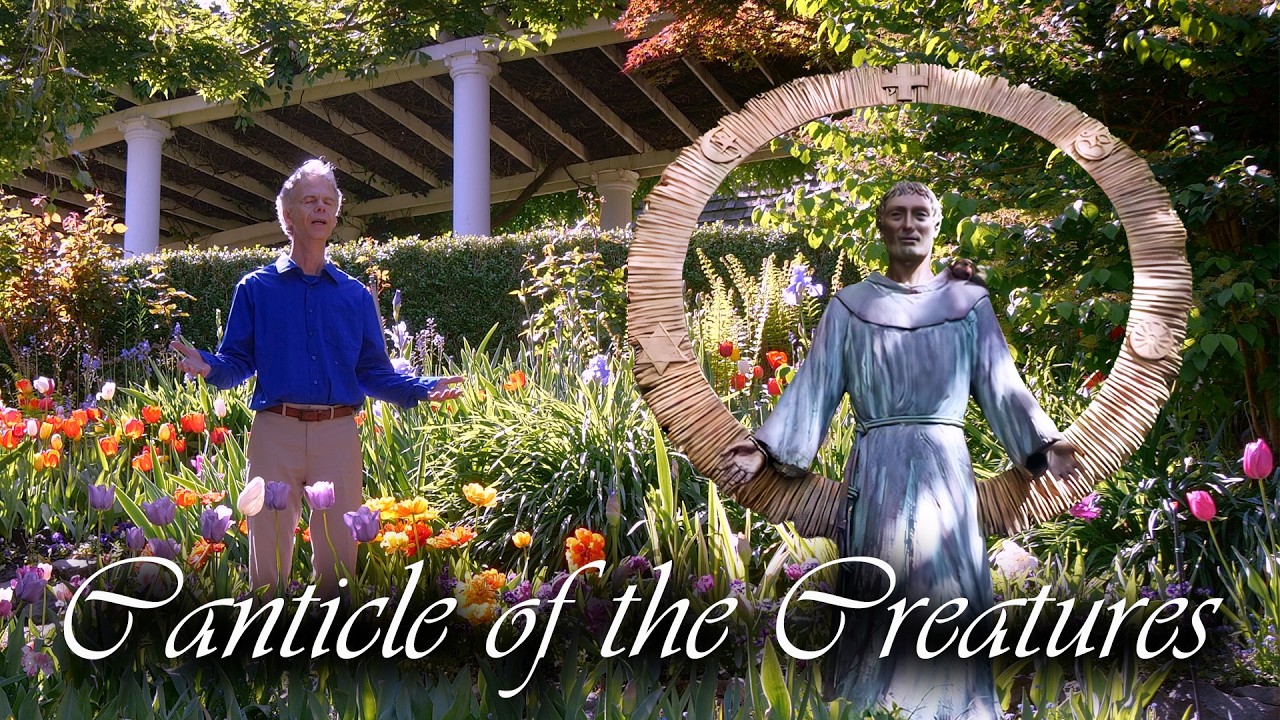
Ramesha 'Canticle of the Creatures' Official Lyric Video | Devotional Song | Ananda Music
We’re really happy to announce the release of the second single from the album Canticle.
Canticle of the Creatures was written by Saint Francis in the XIII century, and is the first known poem written in Italian. Swami Kriyananda beautifully set it to music. You can pre-order the album at 10% off until May 18 here.
Lyrics
1. Altissimo omnipotente bon Signore,
Tue son le laude, la gloria et l’honore
Et ogni benedictione.
A Te solo se confano,
Et nullo homo
È degno de nominar Te.
2. Laudato sia Dio mio Signore
Cum tutte le tue creature,
Specialmente messer lo frate sole:
La quale giorna et illumina nui per Lui,
Et ello è bello, et radiante cum grande splendore,
De Te Signore
Porta significatione.
3. Laudato sia,
Mio Signore
Per sor luna et per le stelle:
In celo le hai
Formate clare et belle.
4. Laudato sia, mio Signore
Per frate vento et per l’aire
Et nuvolo et sereno et omne tempo:
Per le quale dai alle
Tue creature
Sustentamento.
5. Laudato sia mio Signore per sor acqua:
La quale
È multo utile et umile
Et pretiosa
Et casta.
6. Laudato sia mio Signore
per frate foco:
Per lo quale Tu allumini la nocte,
Et ello è bello et jucundo
Et robustissimo
Et forte.
7. Laudato sia mio Signore per nostra matre terra:
La quale ne sostenta et guberna et produce
Diversi fructi et colorati fiori et herbe.
8. Laudate et benediciTe mio Signore et regratiate:
Et servite a Lui cum grande humilitate.
English translation
1. Most High, all-powerful, all-good Lord,
All praise is Yours, all glory, all honor and all blessings.
To you alone, Most High, do they belong,
and no mortal lips are worthy to pronounce Your Name.
2. Praised be You my Lord with all Your creatures,
especially Sir Brother Sun,
Who is the day through whom You give us light.
And he is beautiful and radiant with great splendor,
Of You Most High, he bears the likeness.
3. Praised be You, my Lord, through Sister Moon and the stars,
In the heavens you have made them bright, precious and fair.
4. Praised be You, my Lord, through Brothers Wind and Air,
And fair and stormy, all weather’s moods,
by which You cherish all that You have made.
5. Praised be You my Lord through Sister Water,
So useful, humble, precious and pure.
6. Praised be You my Lord through Brother Fire,
through whom You light the night
and he is beautiful and playful and robust and strong.
7. Praised be You my Lord through our Sister,
Mother Earth who sustains and governs us,
producing varied fruits with coloured flowers and herbs.
*Praise be You my Lord through those who grant pardon
for love of You and bear sickness and trial.
Blessed are those who endure in peace,
By You Most High, they will be crowned.
*Praised be You, my Lord through Sister Death,
from whom no-one living can escape.
Woe to those who die in mortal sin!
Blessed are they She finds doing Your Will.
No second death can do them harm.
8. Praise and bless my Lord and give Him thanks,
And serve Him with great humility.
* These 2 paragraphs are not included in song
Comments by Swami Kriyananda:
“Years ago I wanted to write a melody for St. Francis of Assisi’s best-known song and poem, Canticle of the Creatures. My problem was that the stanzas were so irregular that in one of them a line might have five syllables, and the same line in the next stanza, twenty-five. For years I was thwarted by this difficulty.
Then one day I needed a melody for that poem. I was writing music for a slideshow of the life of St. Francis, compiled from photographs I had taken in Assisi. How could I leave out his most famous poem—the first, it has been said, in the Italian language?
I strongly visualized him as he was described when he first sang it to Sister Clare and a brother monk. Legend tells us that he had risen from his death bed, and was leaning, upright, against a tree, blind and very ill, but triumphant in the joy he felt in his love for God.
When the image came clearly to my mind, I offered it up in prayer and asked to hear St. Francis singing that song. To my great joy, the melody came to me instantly. It was one that could be expanded or contracted to fit every stanza. And it expressed, at least to my satisfaction, the power and beauty of the words.”
–Art as a Hidden Message: Chapter Twelve—Art and Meditation
