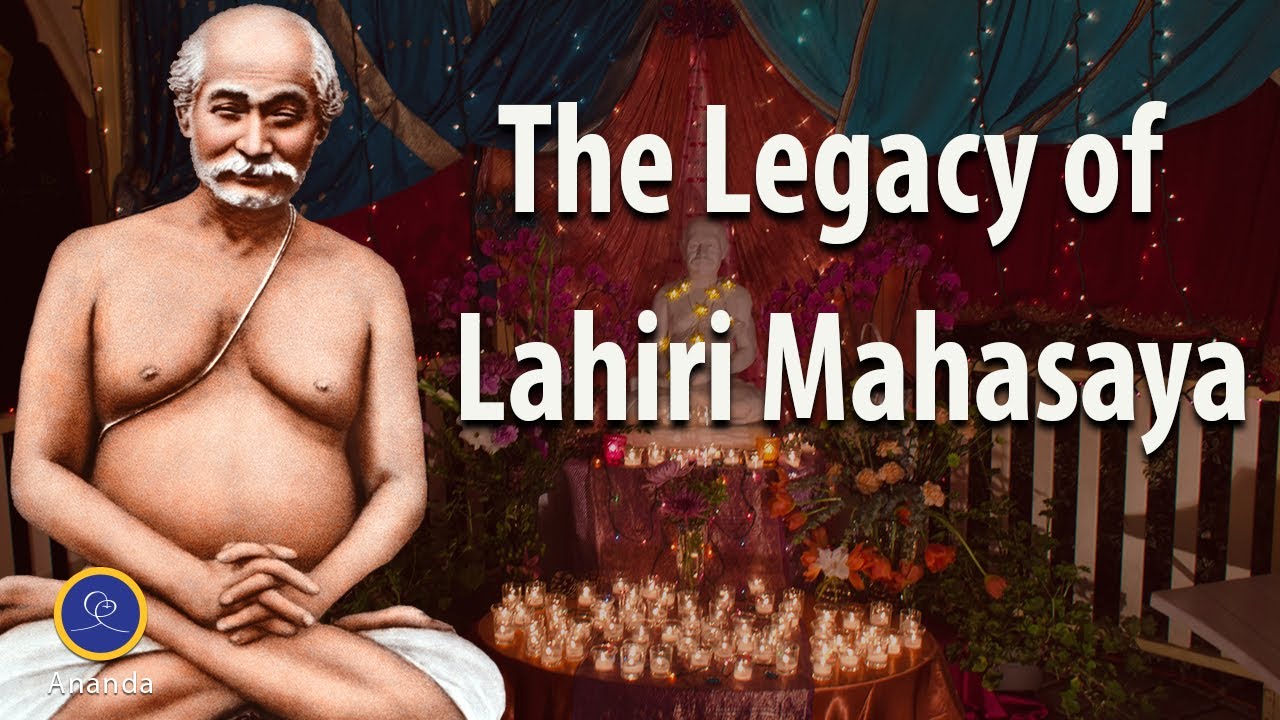
The Legacy of Lahiri Mahasaya
Shyama Charan Lahiri was the birth name of the great yoga master. His disciples lovingly added “Mahasaya,” which means “great-minded one.” Born in Bengal, India, to a Brahmin family, Lahiri Mahasaya was the one who made the ancient science of Kriya Yoga available not just to those who had renounced the world, but to all sincere souls.
Lahiri Mahasaya was a married householder with two sons. He held a job as an accountant to support his family. A disciple of Mahavatar Babaji and a yoga master of the highest achievement, his entire life served as an example of how to live “in the world, yet not of the world.”
Unknown to society in general, a great spiritual renaissance began to flow from a remote corner of Benares [home of Lahiri Mahasaya]. Just as the fragrance of flowers cannot be suppressed, so Lahiri Mahasaya, quietly living as an ideal householder, could not hide his innate glory. Slowly, from every part of India, the devotee-bees sought the divine nectar of the liberated master. -Paramhansa Yogananda, Autobiography of a Yogi
Transcript
Introduction
Nayaswami Maria:
Yesterday, we celebrated Lahiri Mahashaya's Mahasamadhi, and on the 30th of the month is the anniversary of his birthday. So this is an auspicious time right between these two points of deep inspiration because of a very deep and profound life lived.
About Lahiri
For any of you who don't know of Lahiri Mahashaya, I encourage you to read from Autobiography of a Yogi—the chapter [called] “The Christlike Life of Lahiri Mahashaya.” Yogananda wrote beautiful words there and great inspiration and truth. And because his was a life that really sought to see and express the unity of all paths, I wanted to just speak a little bit about him.
Lahiri Mahasaya, Yogananda's guru's guru, so his Paramguru, he was born into the high Brahmin caste. And although this has been reduced largely to determination by birth in times of lesser awareness and realization, for Lahiri we can truly say that this caste exemplified self-mastery and attunement to the infinite. And thus, he was a member in his physical life as Lahiri Mahashaya of the Brahmin caste.
Lahiri came to Babaji, Mahavatar Babaji, also spoken of in Autobiography of a Yogi and part of our lineage, at the age of 33 and was initiated into the ages-old science of Kriya Yoga. And this was a very pivotal point. We owe a great debt, a priceless gift Lahiri has given you and me because of his request to Babaji that all sincere seekers be able to receive initiation into this technique. And Babaji said, “God has spoken through you. Be it so.”
Universal Mission
So even though Lahiri Mahashaya lived a very, really secret life in a lot of ways, this was a turning point to reach out beyond the particulars of any one path, of any one way to God. And it was this universal mission that really characterized, you might say, the whole of Lahiri's life, because he used his—this gift of Kriya, really, and the gift of realization to break down the barriers, as Yogananda said, of the rigid caste system and to reach out to everyone, whoever they were, whatever they did, however they lived if they sincerely wanted to grow spiritually and grow in truth.
Lahiri said divine union is possible through self-effort and no longer need be tied nor limited to theological beliefs or a cosmic dictator. And then Yogananda, in his words in conjunction with this passage, he said, "Through the sacred key of Kriya, persons who would never, have never believed in the divinity of any man, can now realize for themselves that divine reality within." So a very, very significant and powerful turning point.
Yogavatar
Lahiri Mahashaya was a householder yogi. Yogananda gave him the name Yogavatar: incarnation of yoga. And as we know, yoga means union. And again this validation of his life work and really the work of incarnations; I think this is, we can say this is one of the unique facets of this soul that [is] expressed through his lives, his personalities. It is said that Lahiri was the great Saint Kabir.
Aand Kabir also lived a life in which he tried to break through the rigidity of outward appearances, outward affiliations. And at the end of his life, he had devotees of many different faiths, and Muslims, and Hindus.
And at the end, at his Mahasamadhi, they were squabbling over how to handle the body: the Muslims wanted to bury it; the Hindus wanted to burn it. And they could not reconcile this supreme difference in orientation. And when they pulled across, aside, the cloth that covered the body of Kabir, all that was there was flowers. What could they do? It was just flowers. There was no body to bury, no body to burn.
They divided them. Even in death, Kabir could not, you know, stand or tolerate disharmony, such insignificant you know—such an insignificant perspective on reality and truth. And so there were just flowers.
But Yogananda—he gave Lahiri this name: Yogavatar; and he said of Lahiri [that] he was the... "He is, the greatest master of modern times." These are Yogananda's words. So there's something really—
Lahiri as a Householder
It's nice that this birthday and mahasamadhi are so close together and days in between, because we can really savor what that life was about and try to tune into that life. You know, there's a beautiful chant very well known in India: "Ek sadhana, Hari bhaja, Hari." "There is only one path to sing the name of God."
Beautiful, a beautiful truth, and yet even in this, people can twist it and say, "The only way to God is to sing His name and no other." That's the problem, that's what material consciousness does; it makes everything small; it creates a boundary around everything, and people are either on the inside or the outside of that dividing line.
And the whole of his life was really to break that open. You know, don't worry about what you are or how you're doing it, worry about what you are and who you are inside yourself.
As a householder, he lived a very simple life. He was very thrifty. Yogananda says “entirely unostentatious, accessible to all." And Yogananda—I love these words—he said, “Lahiri lived his life. Naturally and happily, he lived a worldly life." "Naturally and happily, he lived a worldly life." Not worldly consciousness but a life, an incarnation on the physical plane in the realm of duality, and he did it, naturally and happily.
And that's a very powerful statement, because here we are. We can't do anything about it. We're on planet Earth at the very beginnings of Dwapara. It's not an enlightened age; it's not always an enlightened environment. You know, we're not always acting in an enlightened way. We're here! We're stuck with it on one level; on another level it's a divine gift, a divine opportunity. Why not live it naturally? Why not live it happily? Why not just be here in all of this chaos and have a good time? And think of God? Why not?!
Naturally and happily in a worldly life—So be it—Here we are—This is what God has given us.
Lahiri’s Secret Residence
Yogananda said of Lahiri that after he returned from the initiation with Babaji, he lived in his home very simply. He said [that] once he retired from work, he didn't even leave his house. He barely even left the room, the little parlor where he lived, to go to other parts of the house. He just sat there in divine bliss.
And from all over India, students came, disciples came attracted, drawn, led to this home in Varanasi, where Lahiri Mahasaya lived with his family, his wife [and] his children. And there they came, and there he shared. And into that environment, as they were drawn, they received. Everyone knew the spiritual stature of Lahiri—they could feel it—they felt uplifted.
Yogananda said that physiologically he exhibited breathlessness, sleeplessness. In meditation, his eyes did not move, his lids were unblinking, perfectly still. And this just went on day after day, day after day, because all of his life [led] up to this point. Naturally and happily, in the life God had given him—
And finally that bliss just spilled over, and that bliss changed lives and attracted those souls who could benefit. A renaissance was taking place.
Yogananda said, “kind of a secret renaissance.” You know, there wasn't an internet. There weren't posters, but the people who needed to know found out and came there and were there.
Yogananda’s Words
And into this reality, we enter when we are initiated into Kriya, when we go deep into meditation. A part of this consciousness is received within us.
And I want to read Yogananda's words because I think it helps us to imagine this consciousness. You know when we talk about honoring many paths, being open to many paths, we're saying [that we are] relating to many realities, all realities. It takes a very big consciousness to make that more than just a platitude, to really live that and experience that and share that.
And so I want to read you Yogananda's words, just a couple of paragraphs here from Autobiography of a Yogi.
A significant feature of Lahiri Mahasaya’s life was his gift of Kriya initiation to those of every faith. Not Hindus only, but Moslems and Christians were among his foremost disciples. Monists and dualists, those of all faiths or of no established faith, were impartially received and instructed by the universal guru.
The great guru encouraged his various students to adhere to the good traditional discipline of their own faith. Stressing the all-inclusive nature of Kriya as a practical technique of liberation, Lahiri Mahasaya then gave his chelas liberty to express their lives in conformance with environment and upbringing.
"A Moslem should perform his namaj worship four times daily,” the master pointed out. “Four times daily a Hindu should sit in meditation. A Christian should go down on his knees four times daily, praying to God and then reading the Bible. With wise discernment the guru guided his followers into the paths of Bhakti (devotion), Karma (action), Jnana (wisdom), or Raja (royal or complete) Yogas, according to each man’s natural tendencies."
Pilgrimage
So this ability to see the needs, the spiritual needs, of the individual was paramount in Lahiri Mahashaya and he guided his disciples thus and all those who came to him.
I remember when I was on pilgrimage in India, going to the home of Lahiri Mahasaya. And we were going as pilgrims. There must have been 25 or 30 of us. We had a guide to take us there. I don't honestly know how you would find your way there without some help.
And it was just down this very, very narrow lane with just, you know, buildings, homes, you know, stucco adobe—whatever it is they use there in India—on both sides only big enough for a single file line down that road, and we shared it with cows, and we shared it with the poor just living there on the little curb next to the building with whatever were their belongings, maybe their child.
And just winding around and around and around, probably 15 minutes or so. But, you know, you can cover some distance in 15 minutes, and I remember having this thought—all I could really see was the person one or two ahead of me—"If I get left here. If somehow I get disconnected from this group, India could just swallow me up. No one would know where I had gone."
You know, it was that kind of an adventure! But that's a good analogy, isn't it? For knowing what our dharma is, we need help, we need a guide, we need a guru, we need some clarity to understand because there is so much, so much to choose from, so much to be attracted by or distracted by. But to know our dharma, to know what our path is so that we can live that.
Dharma in a very real way supports, even parallels we might say, the path of Kriya Yoga. Because when we're living our dharma—and this is why Swamiji stresses this so much, the teachings stress it—more important to die doing your dharma than someone else's. Because when you're living your dharma—just like in Kriya, the molecules in your being align themselves in a north-south polarity, and that channel is focused, and the energy rises when we're living our dharma.
When we're trying to do something else, wandering over here, going over there around and around and around, there is a friction. And we experience that friction. We experience that disharmony, because things aren't right, things aren't in alignment. That's how we know.
Your dharma isn't necessarily easy when you find it. And why would it be? If we're here for liberation, if we're here to grow spiritually, well there's some work that needs to be done, right? There's some growth that needs to happen. So even though you know your dharma, there's certainly going to be rough spots, but there's going to be that alignment just like there is in the practice of Kriya. And it's so important to know what that path—you know, many dharmas, many paths—This is another level of the teaching this morning. And we need to know what our own is and do it and do it dynamically.
There's many great things to do in the world, and if it's your dharma to be in the trenches and go after some cause in the greater world, by all means do it. You'll have to do it; it'll chase you around; it'll haunt you; it's yours! But if it's your dharma to live in community [or] if it's your dharma to live in immediate spiritual proximity and environment, then use too that blessing to its fullest and share it with others. Give it to others in your prayer, in your meditations. Make your dharma, whatever it is, dynamic and have the courage to follow it.
And in this context, I was thinking how that very chant that I said earlier, "Ek sadhana, Hari bhaja, Hari." "There's only one path to sing the name of God," and that is true. That is true. There is only one path, and whatever color it wears, whatever environment it wears whatever world it is in, when we get into that consciousness that Lahiri and all the great masters are a channel for—that consciousness of expansion, of omniscience, of omnipresence—we can truly say, all paths are one. There's only one path and that's to be in God, to love God, to sing God's name.
So, God bless you all.
