In his highly creative life, Swami Kriyananda planted many precious seeds for others to grow: an innovative school system, inspired music, transforming arts, high-principled businesses, crystal-clear writing, spiritual teachings, Vedic astrology, and community-building based on high ideals and simple living. One such seed is Ananda Yoga for Higher Awareness.
The Roots: Yogananda and the Origins of the Asanas
As always, Paramhansa Yogananda is the origin of it all, and while still in India, as we read in his Autobiography of a Yogi, he taught the asanas at his school in Ranchi.
Here is a little sidebar. His younger brother, Bishnu Ghosh, enrolled at Ranchi in 1917. He recounts that Yogananda codified 84 asanas. Later, Bishnu mixed Yogananda’s postures with Western practices and became a well-known Hatha yogi and culturist. One of his students was Bikram Choudhury, who established the famous Bikram Yoga (“hot yoga”), which still teaches 84 postures, condensing them into 26 for beginners. However, it reflects Bishnu’s physical orientation, and very little of Yogananda’s original spirit. Nonetheless, and curiously, it is a “cousin” of Ananda Yoga, as both share their roots in Yogananda’s techniques.
To represent the true “Yoga of Yogananda,” the Master needed someone else: Swami Kriyananda came and brought form, coherence, and a way to transmit its deeper principles. As you can read in his book The New Path, Yogananda asked him to perform the postures for a visiting guest, Swami Premananda. The trouble was that at the time, he says he was (at best) a mediocre Hatha Yogi, and many of the postures he could not contort himself into at all.
Kriyananda’s Gift: Receiving the System
On the special evening, however, in the Master’s presence, Swami Kriyananda miraculously found himself able to assume even the most difficult poses with ease. It wasn’t a blessing only for a moment of dire need; it was also a gift that extended into the future.
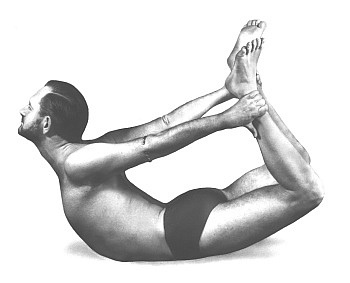 Kriyanada became recognized as Self-Realization Fellowship’s Hatha Yoga expert and posed for many photographs for articles in Self-Realization magazine. In addition, from then on, his Master often had him demonstrate postures to guests. As it happened, Yogananda never told him specifics, like put your knee here and pay attention to your inner awareness. But practicing in his presence, Swami Kriyananda intuitively received the full depth of the ancient science of Hatha Yoga.
In 1967, just as he was founding Ananda, he wrote an introductory book called Ananda Yoga for Self-Awareness. That “Self-awareness” was, in fact, a crucial point of the asanas, as he wrote, “Every posture must be an affirmation of, and must be followed by a return to, the divine Self within.”
He sprinkled many important elements of this system throughout his study lessons, 14 Steps to Perfect Joy (1969), which he mailed to students.
“It would help you to transmute the consciousness of the physicality of the human body, living in it with the thought that it is really a body of light. This is one of the functions of hatha yoga: to become aware of the body not as made of matter, but of light.”
Kriyananda also taught how the postures can train us to live in an aura of light: “Inner energy will be increasing the light within us. As light within you grows more and more, you’ll be able to reach out to the essence of light, the Divine. And to live consciously in that aura is one very important function of Hatha Yoga.”
Three Layers of Awareness
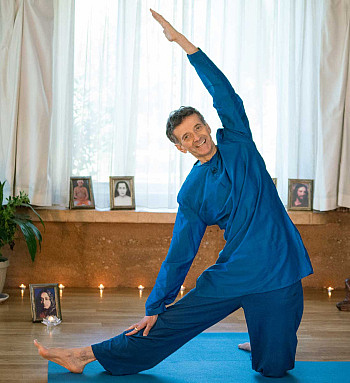 Later it fell to Nayaswami Gyandev McCord to take Swami Kriyananda’s seeds of Ananda Yoga and make them sprout into a strong, beautiful plant. Kriyananda shared many crucial teachings with him for Ananda Yoga practice. Here is one of them: “Ours is a path of constantly coming back to the center, to the spine. That’s the core of it.”
In fact, the Ananda Yogi, after each posture, always brings his awareness inward, to the spine, to one’s center, and then up to the spiritual eye. Listen to this further explanation: “Tremendous joy and awareness are experienced as one’s consciousness becomes centered sensitively in the spine. The spine is, indeed, the holy river of baptism in which the Godward-moving soul becomes cleansed and regenerated in waters of divine joy.”
There is a precious talk by Swami Kriyananda on the yoga postures—perhaps the only recorded one, “Yoga Postures as an Aid to Spiritual Growth” (January, 1983). It reveals the power of Ananda Yoga. In that talk Swami Kriyananda explains what he actually means by “Postures for Higher Awareness” (at the time, it was called “Self-Awareness”):
“So, when we speak of a system, we call it Yoga Postures for Self-Awareness. The idea being that, just as when you do the Energization Exercises, the first thing is you become aware of the tension. Then you become aware of the energy behind that tension. Then you become aware of how to draw that energy and send it.”
In other words, he offers us a concrete training of awareness during our practice of the Energization Exercises:
- First, become aware of the physical tension
- Then try to become aware of the energy behind that tension
- Then become aware of how to draw that energy (from the medulla oblongata) and send it to the part you are tensing.
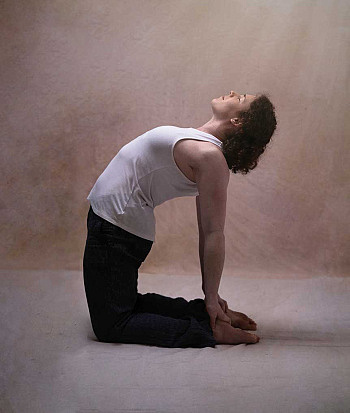 Ananda Yoga follows a very similar progressive path of awareness, Swami explained:
“We become aware of that which we know [the physical body] and through deeper awareness of what we know, we trace that awareness back, and back, and back to higher and higher levels, until we become aware of our Self on the divine level… That’s why I called it Yoga Postures for Self-Awareness, because we begin with the awareness of the physical body. We begin with the awareness of its movements and so on. And then with that awareness we become aware of two things: first of all, the energy involved, the light surrounding our body and so on. Secondly, we become aware of the states of mind that are associated with this particular posture.”
For the asana practice, Kriyananda offers us a specific awareness training:
- First, become aware of the physical body
- Then try to become aware of the energy involved behind the body.
- Then try to perceive the state of mind or state of consciousness of that posture.
The affirmations that Swami Kriyananda added to the postures, which he stated were given to him by Yogananda, serve as guides to the “state of mind” or state of consciousness of each posture.
Why is all this an enlightened system? The answer may be that Ananda Yoga for Higher Awareness simply follows the way human beings are constructed. We have three bodies:
- A physical body
- An energy (astral) body
- A thought (causal) body
Within it is the divine soul. While practicing Ananda Yoga, we “trace back” our awareness from the physical body to the astral body, to the causal body, and finally to the soul. It is, spiritually speaking, quite scientific.
At any rate, Swami Kriyananda affirms in the talk “Yoga Postures as an Aid to Spiritual Growth” that this is exactly how the postures were practiced originally in the enlightened past: “It’s really the ancient science, and we’re just trying to express it again clearly.”
This training in deeper awareness would best be practiced by everyone through the yoga asanas. Swami Kriyananda, therefore, stresses that this system is not at all ours. Could universal truths ever be ours?
“There’s nothing that we can possess. It’s just that it’s our system in the sense, you might say, by default. It ought to be everybody’s. It ought to be included and, rather, made the core of all hatha yoga teaching, because this is the essence of the ancient teaching.”
A Staircase to Meditation
In short, Ananda Yoga is a type of meditation, a movement meditation, or meditation in action. Meditation, in essence, means listening—becoming aware on a deeper level. That’s what we do in the postures. The goal, in other words, is not at all physical: “It’s a mistake to think somebody is better in Hatha Yoga because he can do difficult poses. Our purpose is to develop consciousness above all.”
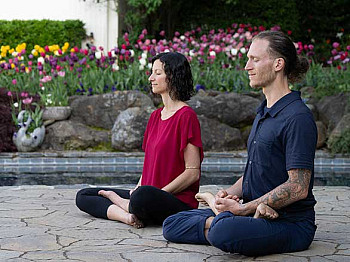 Of course, the postures could never replace silent meditation. In fact, anciently the postures were, as the Hatha Yoga Pradipika says in its very first sentence, “a staircase which leads the aspirant to the high pinnacled Raja Yoga (meditation).” That is exactly what Swami Kriyananda taught: “One of the main purposes of hatha yoga is the preparation of the body for meditation.”
This, then, is the path of enlightened yoga postures which lead to deep meditation: “Through awareness of the body, we become aware of the body on a spiritual level. Through awareness of the body on a spiritual level, we become gradually aware of the spirit without the body. We become aware of who we are in meditation. Then when we meditate, the whole feeling of the consciousness soars more naturally.”
A good question is, how do the postures fit into Yogananda’s teachings? The answer is that on the path of Self-realization, Hong-Sau meditation, the Energization Exercises, the AUM technique, and Kriya Yoga are all essential practices. On the other hand, the postures were recommended by Yogananda, but were not mandatory. They are a personal choice.
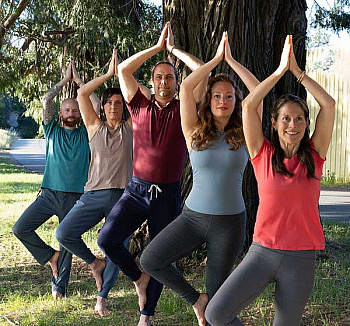 At any rate, Ananda Yoga offers great benefits for body, mind, and soul. It is, on all levels, a healing practice. Most of all, it is a training in higher, deeply subtle awareness. Essentially, it is the “Yoga of Yogananda,” as Kriyananda said, “It is Master’s system, because I do feel he taught it through me.”
This is the spirit in which we should receive it.
For those inspired, let us practice the asanas in the enlightened way they were taught. Go deep! And for those who carry this dharma—the Ananda Yoga teachers—let us take this precious seed, given to us by Yogananda through Swami Kriyananda, and help it grow even stronger and more beautiful. It is a true gem among yoga systems and a vital and enduring part of Swami Kriyananda’s legacy.
Thank you, Swamiji.

One Comment
Jayadev,
Thank you for this fine clarification of the hatha yoga “journey”. As a senior practitioner ( 85 years) of hatha yoga almost every day, this essay helps me with needful concentration!
In Master, Elisabeth Minthorn