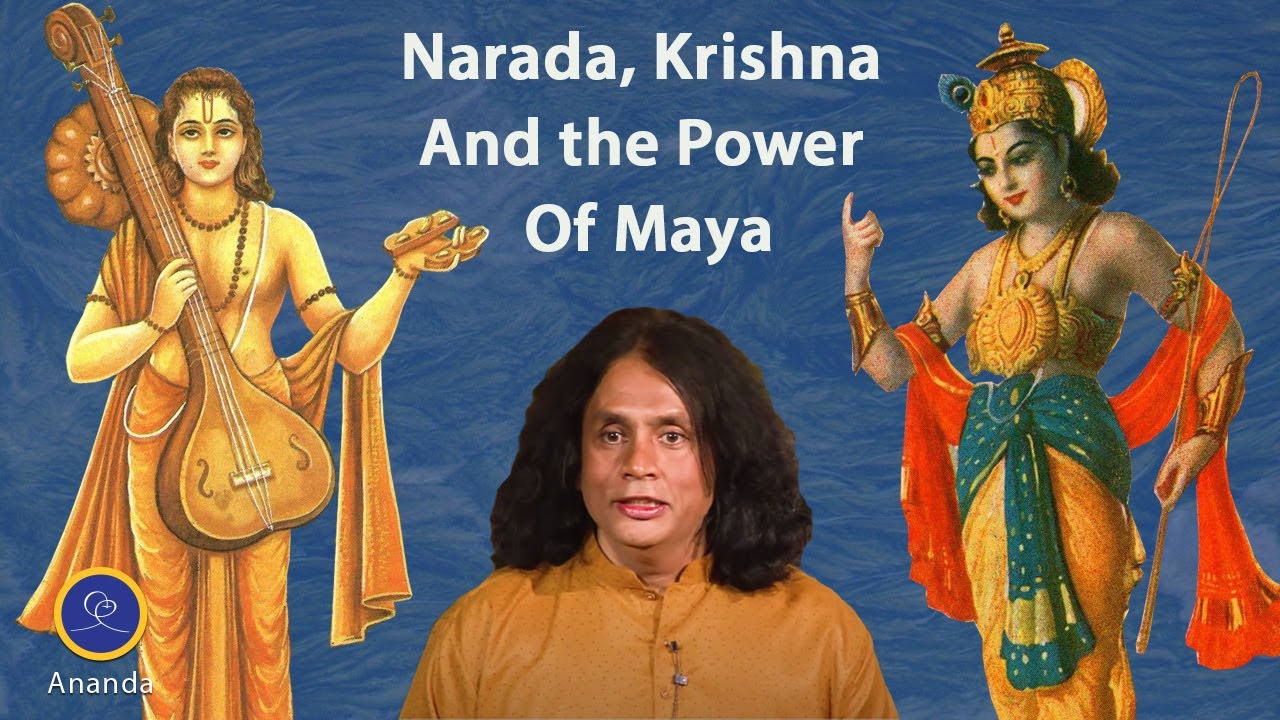
Narada, Krishna, and the Power of Maya
Listen to the inspiring and famous Indian story of the great sage Narada who wants to learn from Krishna about the power of maya. Told by Seattle-local, Bangalore storyteller extraordinaire Murali Venkatrao, who will carry you to ancient and sacred India.
This story follows Narada, an enlightened sage who feels left out because he has never experienced the delusion (maya) that other souls discuss. Seeking understanding, he approaches Krishna, who offers to show him the nature of maya.
Through a vivid dream-like sequence, Narada experiences love, attachment, loss, and immense suffering. As his world crumbles in a devastating flood, Krishna reveals it was all an illusion. Narada realizes the power of maya and the importance of staying connected to the divine. The story emphasizes the inevitability of spiritual awakening and the necessity of seeking the divine light within.
From his Sunday Service talk, January 16th 2022. You can watch the complete talk here.
Transcript
Narada’s Divine Dilemma
Murali Venkatrao:
I'll tell you the short, charming story of Narada. When he was born, he was enlightened. Because he was enlightened, there was no birth and rebirth for him. Since the beginning of creation, this guy Narada has always been there - always enlightened, always with God, always in a divine place.
But he's not happy about this. You might ask why. It's because when other Self-realized souls gather in the astral and causal plane, they always talk about how powerful the delusion or maya of God is and what they had to do to get over it. They talk about what a ride it was. Narada feels left out. He doesn't know what they are talking about. He's missing out - his "fear of missing out" - so he decides to do something about it.
He goes to God. Now God in those days had incarnated on Earth as Krishna, and he was walking among mortals. So he goes to earth and goes to Krishna's palace. Krishna warmly greets him and says, "Oh, Narada, so nice to see you!" Narada responds, "Lord, I'm not happy." Krishna, puzzled, says, "That doesn't make sense—you are in divine bliss. What do you mean you're not happy?"
Narada explains, "Lord, I'm not happy because I don't understand what maya is. Will you please explain it to me? I feel left out of all the conversations." Krishna responds, "I see what you mean, but it cannot be explained—you have to experience it. Come with me."
The Quest for Understanding Maya
So, Krishna and Narada start walking. They go beyond the palace precincts, beyond the city, and into the desert. The sun is very hot as they're walking. Narada is happy; he is walking with God. Suddenly, Krishna stops and says, "I can't walk anymore," his voice scratchy.
Narada asks, "Why, Lord?" Krishna responds, "Narada, I am very thirsty. Will you please fetch me some water?" "Of course, Lord, I can fetch you water," Narada agrees, and he goes off deeper into the desert.
He walks for who knows how many miles until he sees a village. "Ah, I have found water," he thinks, as he keeps hearing Krishna's voice: "Narada, I am thirsty, please fetch me water." He sees a well and says, "Ah, I got what I came for. I'll take the water and go back to my lord."
At the well, there's a beautiful young woman. Being thirsty himself, he asks, "Lady, will you please give me some water?" "Yes, of course," she replies, and pours from her pot as Narada receives the water. Narada looks at her and is dumbstruck by her beauty. In that moment, something comes over him and he thinks, "I have to spend the rest of my life with her."
After drinking the water, instead of taking it back to Krishna, he goes up to her father and says, "Sir, I have something to ask of you. Will you please give me your daughter's hand in marriage?" The man doesn't flinch. He thinks, "Hmm, he looks like a strapping young lad, seems decent enough. Why not?"
Then he says, "You can have my daughter's hand in marriage, but I have a condition. You must commit to staying here. You see, I am the headman of this village. Everything you see around belongs to me, and you must take care of it in my old age and after I am gone." Narada accepts, saying "Okay, I'll stay."
The Illusion of Worldly Attachment
He gets married and lives an idyllic life, with no moment of disharmony between him and his wife. He brings prosperity to the village - the crops are abundant every year. He goes from strength to strength, completely contented. Somewhere along the way, his father-in-law dies, and now Narada is the head of the household and the village. He is just so happy. They live a moderate life, helping other people.
But then one day, dark clouds come - so dark that even the sun is obscured. It feels like night in
the middle of the day. Rain begins to fall like an apocalyptic deluge. Within hours, all the farmland is inundated. The rice crop of this year is completely spoiled. A few hours after that, the rain is so great that the river begins to flood, and the village begins to get washed away. One by one, those little houses are swept away.
"My people!" Narada thinks, as one by one they die despite preparations. Soon the flood comes
to his own house, which was a little elevated so it took a while. His family is swept away too, as
is Narada. He had four children - the two elder children drown. His third child, his favorite, who is
only two years old, clings to him with her little arms. Out of nowhere, a big wave comes and pulls her away from him. His last memory is seeing his daughter's terrified eyes as she's swept away into the dark depths.
In the meantime, the mother is holding the youngest child, the little boy. She struggles mightily but she too loses the battle and drowns. In just a few hours, Narada - who came to this village to fetch water and started this great life of contentedness and happiness - sees the same water take it all away.
Narada is inconsolable. He is wailing, "How can I live without you?" As he thinks about his family, amidst the din of the rain, thunder, and lightning, and his wails, he hears a thin voice in his right ear: "Narada, I am thirsty. Will you fetch me water?"
The voice grows stronger, and Narada looks up to see Krishna standing before him, smiling. Narada falls at his feet, sobbing his heart out. "Lord, please, I cannot live without my family. I let down all the villagers. Bring them back to life - if not, kill me. I can never be happy again."
Breaking the Spell: Krishna’s Revelation
Krishna says, "Nonsense." He taps Narada on his forehead gently, and it's as if Narada wakes up from a dream. He startles and looks around. The water is gone - it's just the sand of the desert, and Krishna is standing there. All his pain and suffering are disappearing, just like when we wake up from a nightmare.
Krishna's eyebrows are dancing, his eyes are twinkling as he says, "Narada, what do you think of the power of my maya?" Narada says, "Lord, the depth and complexity of your maya is fathomless. Thank you for constantly calling out to me—otherwise, I would have never come out of it."
Lessons on Seeking the Light
Let's break this story down a little bit. When do you think Narada's pain and suffering started? When did it become inevitable? Was it when the rains came, when his family died? No, it started much before. It was that moment when he commits to his future father-in-law that he will turn away from God.
"I will turn away from Krishna, and I will stay here because getting married to your daughter and staying with her for the rest of my life - that is how I measure my happiness." It's that commitment away from God that is Maya and avidya. The more he said "my family, my village, my tribe," the less he understood, the less he comprehended what his reality was. "The light shineth in the darkness, but the darkness comprehended it not." That's what the gospel writer is saying.
Now, the beauty of this whole system is that both the light and the darkness are within us, within the astral spine - the Ida, Pingala, and the Sushumna. And in the Sushumna, there are these two poles. The Light of God that shineth is here, and the darkness that it shineth in is at the base of the spine. Our commitment to resolutely turn away from God, to seek separateness, is the power of Kundalini. It is an entrenched vitality, an irresistible vitality that exists. It pulls us down.
But the beauty of this system is that we are predisposed for the light to win over darkness. Eventually, it will, relentlessly. Krishna keeps calling: "Narada, I am thirsty, where is my water?" He keeps calling, and when we are completely frustrated with everything outside, when all we see is the flood waters of destruction, then all the outward sounds and sights become disgusting. The only thing that remains is Krishna's call: "Narada, where is my water?" We begin to hear the sound of God. This will eventually happen.
But the masters of our path and the masters of every path have said, "Don't wait for it." Hasten that process - what can we do to hasten it? We actively reach for the light on the entire spiritual path. For those of us who are Kriya yogis, the path of Kriya Yoga - the path of meditation in general - is a way of turning away from the senses and sitting there to see or wait for the light to appear.
When we meditate, when we do Seva (serving others), we share whatever light that we see and thereby make it bigger. We reach for it even more. Living harmoniously among people in communities or within family, the ego gets rubbed and dissolves just a little bit more, gets tempered a little bit, and we reach for the light a little bit more.
Murali's Personal Experience
About a month and a half ago, I was stuck in a rut of negativity. You know how that happens? It just comes out of nowhere and takes over your life. Even meditation, which was often my sanctuary, wasn't helping. The sessions weren't deep - I couldn't get away from my mind. After about a week of this, I got really sick of my mind. But where can you go to get away from your mind? Nowhere, because it's always there. The darn thing is always with you.
Then one day, I really asked Master, "Please make this better." It was a sincere request, simply because I was so frustrated - there was nothing I could do. That morning, as I was practicing Yoga, right in the midst of a fairly complicated yoga pose, I had this clear thought that landed from nowhere. It just landed in my mind, and therefore I know that I didn't think it. I wrote it down because it was clear enough. The strong thought said that my consciousness was stuck lower in my spine and I needed to raise it up. This was a very strong thought that just landed, and the bhav - the feeling behind the
thought - was one of urgency, meaning "do it right now."
So I did. There is a very inspiring talk by Swami Kriyananda that I listen to all the time - it's a talk on the path of devotion. I listened to it for a while, read a few verses from the Bhagavad Gita which were pertinent to raising the energy, and read from The Essence of Self-Realization - Master's sayings captured by Swami Kriyananda, one of my go-to books.
After about 45 minutes of this, the negativity, which was like a sick feeling in my stomach, began to ebb away. All the things that I saw, where people said the wrong thing, I put in perspective. I realized that it was just me reacting from a poor, unrefined consciousness. The fear went away, and it really was a night-and-day kind of difference.
What was very interesting about this was that it was very non-specific. It's not that I meditated on my problem, and it's not that I tried to find a reading that applied to what I was going through. It was just an act of reaching for the light - what clinicians call a non-specific intervention.
This is what Lahiri Mahasaya used to say very famously: no matter what problem the disciples came
to him with, he said, "Do more kriyas," meaning reach for the light, have God experience as a result of meditation.
I will end with this very inspiring saying from Yogananda: "Whatever comes, good or bad, all will
be turned to good if you see God and refuse to acknowledge the power of evil or trouble. Whatever comes, all will be turned to good if you see God and refuse to acknowledge the power of evil or trouble.
