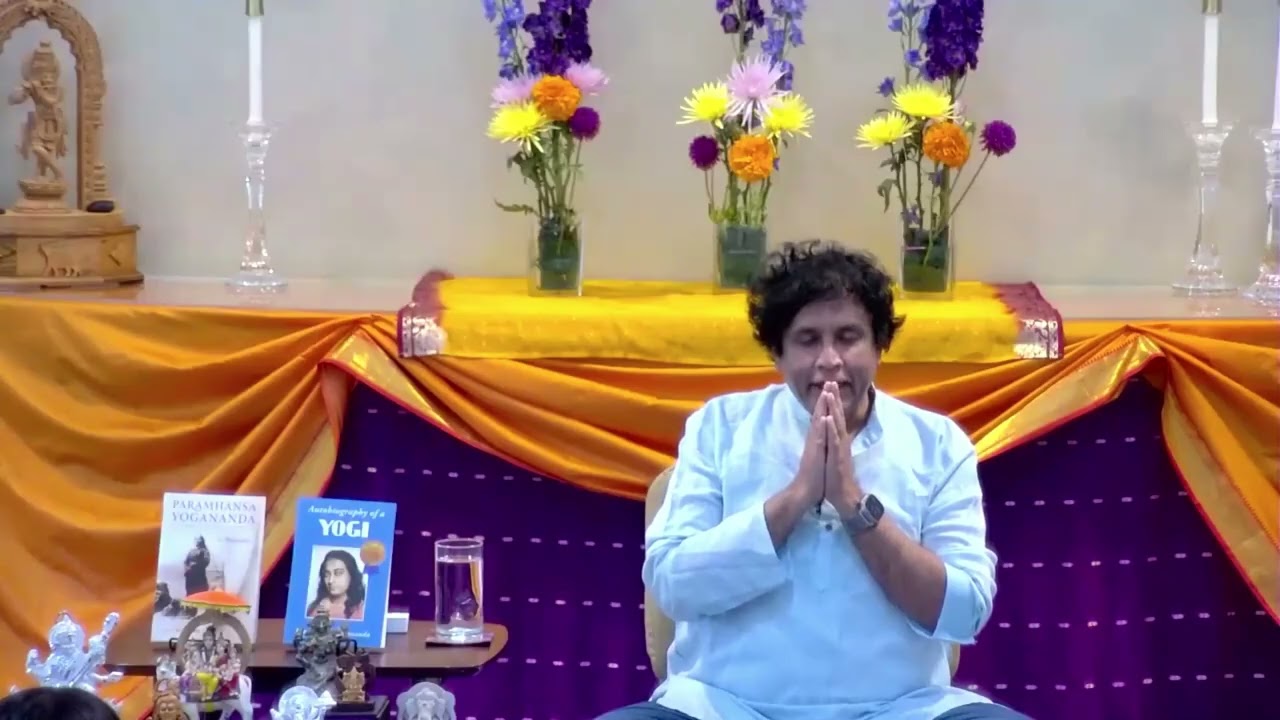
The Eternal Religion from Adi Shankara to Paramhansa Yogananda: Why It Matters (with Murali Venkatrao)
Since Adi Shankara, the great reformer of Hinduism, codified Advaita Vedanta, Sanatan Dharma has evolved in new expressions; it now comes to us through the new dispensation and lineage of Mahavatar Babaji into Dwapara Yuga. Adi Shankara was a great sage who revived Hinduism when it was in decline. Though he lived for only 32 years, he reformed Vedanta and founded monasteries and resurrected ancient temples. He showed how the worshippers of Shiva and Vishnu and Devi all longed for the same formless and omniscient God, which he named as Satchidananda – Ever Existing, Ever Conscious Bliss. He showed this thru an extraordinary canon of nuanced commentaries on the Upanishads and the Bhagavad Gita; and thru beautiful hymns, poetry, and transcendental methods of worship. He encouraged people to renounce worldly pursuits and seek this inner Bliss.
Paramhansa Yogananda lived at the dawn of a new age when the marvels of technology have obliterated space, and all parts of the world are connected. He brought the teachings of Vedanta to the West – but not to show its superiority; rather the commonality of the teachings of Krishna and Christ. For a world coming to grips with the extraordinary diversity of human cultures, he showed that all people were motivated by a longing for inner joy: Satchidananda – Ever Existing, Ever Conscious, Ever New Bliss. He said the Bliss is ever-new, and can be found exactly where one is – the real renunciation is inner, an attitude of the mind. He too wrote an extraordinary commentary on the Bhagavad Gita, and many beautiful hymns and poems. He brought to the West transcendental method of inner worship: Kriya Yoga.
Both Masters incarnated on Earth with a great mission. In this satsang, we will explore the life and teachings of Swami Shankara, and see how Paramhansa Yogananda made the teachings ever new by showing their universality.
