In this talk on Bhagavad Gita 2:55–57, the speaker explains that one established in wisdom is free from desire, unshaken by sorrow, and unmoved by pleasure. Such steadiness is not a final achievement only for saints but a state we can affirm at every stage of life. He outlines Patanjali’s eightfold path—not as a rigid system, but as progressive stages: … Read More
Video and Audio

The Most Important Attitude to Develop Is the Desire for God
(Download MP3)Swami Kriyananda, commenting on Bhagavad Gita 2:59–61, explains that merely abstaining from sense pleasures doesn’t remove their hold—the “taste” lingers until one experiences the Supreme Spirit, after which nothing but the Infinite satisfies. Even wise, self-controlled individuals can be swept away by latent desires (sanskaras) if senses remain untamed. True mastery requires withdrawing energy from the senses, as yoga teaches, … Read More

The Immortal Soul
(Download MP3)Swami Kriyananda explains Krishna’s teaching in Bhagavad Gita 2:11, where the wise grieve neither for the living nor the dead, as the soul is eternal. The spiritual path requires slaying delusion and lower tendencies—not destroying the self, but redirecting energy toward God. Even in worldly battles, just action taken with the right attitude carries no bad karma; harm arises only … Read More
How Our Mind Rationalizes Our Delusions
(Download MP3)This talk reflects on the first chapter of the Bhagavad Gita, where Arjuna hesitates to fight his own kinsmen—symbolizing our inner struggle against harmful tendencies that feel like part of ourselves. The speaker explains how the mind invents endless rationalizations to cling to delusions, excusing greed, anger, pride, or judgment by comparing faults or blaming others. True wisdom lies in … Read More
Don’t Identify with Your Mistakes
(Download MP3)Swami Kriyananda, reflecting on Bhagavad Gita 2:22, explains that the soul discards the body like worn-out clothing, taking on a new one when needed. True innocence comes in two forms: ignorance and wisdom, with the latter arising from transcending worldly illusions. The wise remain childlike at heart, free from self-importance. Aging or life stages should not define identity; one must … Read More
Our Level of Consciousness Determines Our Personal Reality
(Download MP3)Swami Kriyananda, reflecting on Bhagavad Gita 1:17, explains that the unchangeable Spirit is not only pervading all things—it is all things. God is the underlying reality, hidden behind appearances, much like smoke hides fire. Our personal realities often differ from cosmic reality, and suffering arises when our thoughts are misaligned with truth. Happiness and unhappiness are both transient states, but … Read More
You Can Only Find God with the Help of a Guru
(Download MP3)In this passage, the focus is on Krishna’s gentle rebuke of Arjuna’s despondency at the start of Chapter 2, reminding him that despair leads neither to heaven nor respect on earth. The speaker explains that leaving the spiritual path brings inner torment—once one has tasted divine peace, worldly pleasures cannot satisfy, and life becomes a kind of hell. True sin … Read More
Sexuality and Self-Control
(Download MP3)Chapter 1, Stanza 6 We have enormous power but may waste it. For mental clarity, health in body and mind, as the Bhagavad Gita recommends, learn to control the life force and sexual impulse. Swami says that just as the Native Americans have rites of passage for their young, all young people would best be taught the importance of using … Read More
Devotion Gives Us the Hunger to Want God
(Download MP3)In this passage, the speaker reflects on Bhagavad Gita 2:3, where Krishna urges Arjuna to reject weakness and rise with courage. “Unmanliness” here is not about gender but about imbalance—over-reliance on reason without feeling, or emotion without wisdom. True strength lies in being a whole human, combining will and devotion. Love, whether for truth, wisdom, or God, gives the courage … Read More
Love Is the Answer to Doubt
(Download MP3)This passage marks the transition from Bhagavad Gita’s first to second chapter, where Arjuna, lost in self-pity and grief, sets the stage for Krishna’s guidance. The speaker relates personally, recalling a period of intense inner struggle while serving his Guru. Though longing for peace and God, he simultaneously feared them, feeling torn between spiritual aspiration and subconscious resistance. This confusion, … Read More

Our True Home Is in God
(Download MP3)Swami Kriyananda, reflecting on Krishna’s words in the Bhagavad Gita, emphasizes the importance of living fully in the present. Past and future are hidden from our perception, yet they influence us—past actions shape current circumstances, and present choices create future outcomes. Dwelling on regrets or anxieties only burdens the mind and weakens effectiveness. Concentration, he explains, is the key to … Read More

Be Loyal to Your Experience, not Your Belief
(Download MP3)Swami Kriyananda, reflecting on Krishna’s counsel to Arjuna in the Bhagavad Gita, explains that the true battle is against one’s lower self, though outer battles for righteousness may also be necessary. He recounts standing up for his beliefs despite personal hurt, emphasizing loyalty to truth over institutions. Truth, he says, is an experience, not merely a belief, and God meets … Read More

Reason vs. Intuition
(Download MP3)Swami Kriyananda, reflecting on Bhagavad Gita verse 31, emphasizes the importance of unwavering commitment to one’s dharma, or rightful duty. Once the right course is recognized—whether in spiritual practice or breaking a harmful habit—hesitation and half-measures only weaken resolve. He warns against “playing with delusion,” noting that old subconscious tendencies can easily resurface if given even a small opening. Using … Read More
Patanjali’s Eight-Fold Path
(Download MP3)Chapter 1, Stanza 5 In this discourse, Swami Kriyananda reflects on stanza five of the Bhagavad Gita’s first chapter, explaining that each warrior mentioned represents a spiritual quality essential for inner growth. “Kashiraja” symbolizes upward-flowing discrimination, the ability to choose what raises one’s energy toward higher consciousness. This discernment is vital in spiritual life, guiding choices that align with upliftment … Read More
Finding Balance Between Our Masculine and Feminine Natures
(Download MP3)In Bhagavad Gita verses 38–39, Arjuna hesitates to fight after realizing the war would destroy his own family, eroding traditions and leading to moral decay. The speaker explains this as symbolic of a seeker’s struggle to relinquish attachments to identity, societal roles, and family approval in pursuit of spiritual truth. True progress requires readiness to sacrifice everything, even relationships, for … Read More
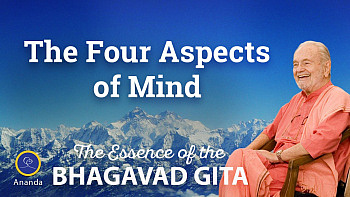
The Four Aspects of Mind
(Download MP3)The Bhagavad Gita shows us in allegorical form how man came from spirit and manifested from vibration into material form. The dialogue between Krishna (guru) and Arjuna (humble disciple) illustrates how we gamble away our happiness and peace of mind playing with the delusion and desires of this world. Warning: The dice are loaded. Swami talks about the aspects of … Read More
Self-Esteem Is Built on Sand – Know God
(Download MP3)Swami Kriyananda reflects on a verse from the Bhagavad Gita where Duryodhana instructs his warriors to protect Bhishma, symbolizing the ego. The ego, he explains, constantly needs reinforcement and validation, driven by fear of inadequacy and comparison. Kriyananda critiques the modern emphasis on self-esteem, suggesting it is unreliable when based on ego. Instead, he advocates for “God-esteem” — trust in … Read More

Sometimes We Need to Trick the Mind
(Download MP3)Chapter 1, Stanza 8 Swami Kriyananda explores the symbolic meanings behind various generals aligned with the negative side of human nature. Each represents a specific inner obstacle: Bhishma symbolizes ego, Karna reflects outward attachment, Kripa suggests personal delusion, and Ashwatthama represents deep-rooted habits or subconscious attraction. Kriyananda explains how attraction, though initially a force of delusion, eventually becomes a key … Read More
Why Fight Delusion?
(Download MP3)Swami Kriyananda, commenting on Bhagavad Gita stanza 32, explains that the true kshatriya—a warrior for righteousness—is anyone willing to sacrifice personal comfort or even life itself for truth, service, and spiritual growth. This role is not limited to literal soldiers but includes those who battle inner weaknesses with the “arms” of discrimination, devotion, wisdom, and nonattachment. Fighting for a just … Read More
Nishkam Karma – Desireless Action
(Download MP3)Swami Kriyananda explains Krishna’s counsel in Bhagavad Gita 2:47—act in this world, but without attachment to the fruits of action. Some mistakenly think liberation comes from complete inactivity, but Krishna teaches that right action, performed with the right consciousness, is essential. The appropriateness of any action depends on one’s stage of spiritual evolution; for example, physical work may benefit some … Read More

How the Mind Descends into Delusion
(Download MP3)Swami Kriyananda, reflecting on Bhagavad Gita 2:62–63, explains Krishna’s “ladder of downfall,” showing how the mind descends into delusion: dwelling on sense objects breeds attachment, which leads to craving; frustrated craving produces anger; anger clouds judgment, causing delusion; delusion erases memory of the true Self, leading to loss of discrimination and ultimately the ruin of right understanding. He notes that … Read More
A Saint Is a Sinner Who Never Gave Up
(Download MP3)Swami Kriyananda, drawing on Krishna’s counsel to Arjuna, teaches that everyone is on the spiritual path, whether they know it or not. Consciously abandoning one’s ideals brings inner contempt from one’s own higher qualities, which robs life of vitality and direction. Outer ridicule mirrors the inner disapproval that comes when we fail ourselves. Even enemies seldom respect those who forsake … Read More
The Purpose of Life Is to Know God
(Download MP3)In this talk on Bhagavad Gita 2:72, the state of Brahmi Sthiti is explained as perfect union with the Infinite—beyond delusion, beyond return to worldly bondage. Attaining this state, even at death, ensures eternal bliss. Death is described as life’s ultimate test, the final surrender of attachment. Preparing for that moment means living free from desires, ego, and personal claim … Read More
All Suffering Comes from Egoic Reactions
(Download MP3)Swami Kriyananda, commenting on Bhagavad Gita 2:64, explains that a person of perfect self-control acts in the world without being inwardly disturbed, free from attachment and aversion, anchored in unshakable calmness. True peace comes from releasing identification with the ego—no longer basing happiness on praise, success, or others’ opinions. Instead, one should do their best in all actions while offering … Read More
All Success Comes from Higher Consciousness
(Download MP3)Swami Kriyananda, reflecting on the Bhagavad Gita’s conclusion, stresses that beyond all techniques and principles, the essence of yoga is divine love. Quoting both Krishna and Jesus, he affirms that wholehearted love for God is a universal spiritual truth. Whatever you do—whether art, business, or spiritual practice—requires total engagement of heart and consciousness. Skill alone is insufficient; true mastery comes … Read More

Introspection
(Download MP3)Swami Kriyananda, reflecting on Bhagavad Gita 2:13, explains that the soul’s awareness continues unchanged through life stages and successive bodies. Sensations of pleasure and pain are temporary and should be endured with patience, remaining unattached to outer conditions. Early childhood often reveals past-life tendencies, talents, and flaws, offering clues for self-improvement. Negative traits, like moodiness, should not be met with … Read More
What Is the Source of All Suffering?
(Download MP3)Swami Kriyananda discusses many insights into the disciple-guru relationship. He highlights the transformative power of the Bhagavad Gita and shares stories from his personal journey with his guru, Paramhansa Yogananda. Kriyananda states emphatically that no one needs to have a guru. However, those who are desperate to know truth and want to find God do need one. Kriyananda explains that … Read More
The Yugas – Cycles of Time
(Download MP3)Swami Kriyananda explains that the Vedas contain both the highest truth—unity with the Infinite—and relative teachings such as rituals for worldly gains. Over time, as human consciousness declines through the yuga cycles, these rituals became the main focus, fostering dependence on deities for material desires. Buddha’s mission was to counter this trend, urging self-effort rather than reliance on gods. His strong … Read More
Find Peace Through Detachment
(Download MP3)Swami Kriyananda, reflecting on Bhagavad Gita stanza 33, explains that refusing one’s rightful duty—whether in worldly life or spiritual striving—leads to “sin,” which he defines as anything that takes the soul away from God and inner harmony. Sin and virtue, he stresses, are relative, not absolute; actions must be judged by whether they lead toward or away from spiritual freedom. … Read More
The Yamas and Niyamas
(Download MP3)Chapter 1, Stanza 5 Swami Kriyananda discusses the deeper meanings of the characters in the first chapter of the Bhagavad Gita, explaining that they represent inner spiritual qualities rather than literal warriors. He emphasizes the significance of the Yamas and Niyamas from Patanjali’s teachings as essential steps on any authentic spiritual path, regardless of religion. The Yamas involve self-restraint, such … Read More
Overcoming the Ego
(Download MP3)Swami Kriyananda reads the second stanza (sloka) of the Bhagavad Gita and discusses the power of habits. Habits of course can be constructive or negative but all too often habits are destructive forces that bind us to detrimental behaviors. Kriyananda shares a few stories that demonstrate how bad habits can be overcome through the power of strong affirmation and by … Read More
Act Without Attachment
(Download MP3)Swami Kriyananda, commenting on Bhagavad Gita 2:19, explains that the true Self neither kills nor can be killed, and this truth applies on many levels. In life, duties—sometimes even harsh ones like battle—must be fulfilled without hatred, recognizing their temporary nature. One may need to act a role, as Yogananda sometimes did, to convey a lesson effectively. Success on the … Read More
Through Meditation — Learn Contentment
(Download MP3)In this talk, Swami Kriyananda comments on stanza 19 of the Bhagavad Gita, using it as a springboard to discuss subtle spiritual experiences. He explains that the “mighty tumult” described is not a physical noise, but inner spiritual sounds heard in deep meditation—such as the sound of AUM. These inner vibrations begin to replace worldly attractions as one experiences increasing … Read More
Give Your Life to God and He Will Always Take Care of You
(Download MP3)Swami Kriyananda reflects on why the Vedas—lofty spiritual scriptures—include rituals for worldly aims like wealth, marriage, or victory. Paramhansa Yogananda explained that since people seek these things anyway, the Vedas channeled such pursuits toward divine sources, fostering gratitude to God rather than ego. Over time, however, as yugas declined, people used rituals as a crutch, expecting God to do everything … Read More
Samadhi
(Download MP3)Swami Kriyananda, reflecting on the Bhagavad Gita’s early chapters, explains that Arjuna’s reluctance to fight symbolizes the devotee’s struggle against lower tendencies. When one seeks God, the world often resists, trying to pull the seeker back into its delusions—sometimes fiercely. The wise approach depends on temperament: some keep their spiritual life private; others, like Kriyananda himself, feel compelled to share … Read More
The Need for a Guru, Part 2
(Download MP3)Swami Kriyananda reflects on Arjuna’s hesitation in the Bhagavad Gita, where he laments giving up long-cherished qualities and attachments, even if they hinder spiritual growth. People often cling to self-definitions—strength, intellect, talents—accumulated over lifetimes, resisting change. Arjuna questions whether it’s better to surrender than to fight those who symbolize his old nature. Kriyananda notes how the mind justifies avoiding necessary … Read More
Awakening the Kundalini
(Download MP3)Chapter 1, Stanza 3 How do we awaken the power (Kundalini) that is within each of us? It is possible to awaken this power by bringing energy upward through spiritual practice to the brain. We possess a tremendous power that can be harnessed when we learn to be lions of self-control. No matter the background or religion, it is a … Read More
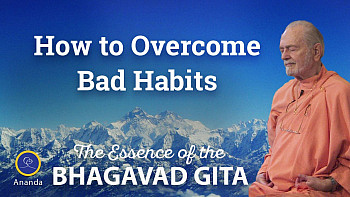
Overcoming Bad Habits
(Download MP3)Chapter 1, Stanza 2 Swami Kriyananda discusses the Bhagavad Gita, focusing on the symbolism of Duryodhana as representing material desires and Dronacharya as habit. He explains that our senses create the illusion of a real world, but it’s essentially a dream. The goal is to realize our true nature as Satchidananda (ever-existing, ever-conscious, ever-new bliss). We are born into a world where desires and … Read More

The Universal Truths of Yoga
(Download MP3)Swami Kriyananda, continuing his reflections on Krishna’s teachings in the Bhagavad Gita, explains that yoga is the practical application of universal spiritual principles, not bound by religious labels. Concentration at the point between the eyebrows, he says, is natural—saints across traditions instinctively focus there in ecstasy. This spot, linked to the brain’s frontal lobe, represents higher intellect, which must be … Read More
What Is Extreme Dispassion?
(Download MP3)In this talk, Swami Kriyananda reflects on stanza 18 of Chapter 1 of the Bhagavad Gita, where positive qualities are symbolized by warriors blowing their conches—representing inner vibrations and spiritual power. He explains that deep meditation can awaken sacred inner sounds within the chakras, which help focus the mind. The key themes discussed include extreme dispassion and self-mastery. Extreme dispassion … Read More

The Need for a Guru – The Bhagavad Gita
(Download MP3)Swami Kriyananda talks about the critical significance and blessings of finding and having a guru. The disciple/guru relationship he explains, is ultimately one of deep attunement that allows the individual to transcend limitation and delusion so that they can find their one true essence. Kriyananda explains that the ego (our bundle of self-definitions) is the one thing we ultimately need … Read More

Kriya Yoga and Pranayama
(Download MP3)Swami Kriyananda, explaining Krishna’s words on yoga in the Bhagavad Gita, emphasizes that mixing with uplifting people is vital, since all experiences are neutral and it’s our reactions that determine positivity or negativity. True equilibrium between pleasure and pain is not dullness but a dynamic center—symbolized by the spine and the *sushumna*, through which kundalini rises toward God. He illustrates … Read More
Go with Life’s Rhythms not Against Them
(Download MP3)This passage reflects on the conclusion of Bhagavad Gita’s first chapter, where Arjuna, overwhelmed by grief, lays down his bow—symbolizing abandoning his meditative focus. The lesson highlights how discouragement, like Arjuna’s slump, often clouds spiritual progress. Life’s difficulties, like crashing waves, are best met by flowing with them rather than resisting. A story of a man who overcame despair by … Read More
Modern Physics and Vedanta
(Download MP3)Swami Kriyananda, discussing Bhagavad Gita Chapter 2, explains that Krishna shifts from the Sankhya philosophy, which defines the need to transcend delusion and duality, to Yoga, which teaches the method to reach higher truth. The Gita integrates India’s ancient philosophical heritage, rooted in the Vedas, Upanishads, and centuries-old wisdom—not recent poetic speculation as some Western theories claim. Misinterpretations, such as … Read More
Being Twice-Born
(Download MP3)Chapter 1, Stanza 7 Swami Kriyananda reflects on stanza seven of the Bhagavad Gita’s first chapter, where Duryodhana addresses Dronacharya as “O flower of the twice-born.” Kriyananda explains that being “twice-born” refers to a spiritual rebirth—first through the body and then through the Spirit, as Jesus also described. This second birth involves awakening through divine contact, such as the inner … Read More
Don’t Worry About Your Faults — Love God
(Download MP3)Chapter 1, Stanzas 9-10 Swami Kriyananda highlights the spiritual symbolism behind the battle scene. Duryodhana represents material desire and lists the many qualities on his side—symbolizing the countless pathways into delusion. In contrast, the virtues on the Pandava side are few but powerful, showing how focused spiritual qualities like calmness, devotion, and self-control are more effective than scattered desires. Kriyananda … Read More
Overcoming Our Negative Tendencies
(Download MP3)In this talk, Swami Kriyananda discusses the pivotal moment in the Bhagavad Gita when Arjuna asks Krishna to drive his chariot between the two armies. This symbolizes the inner battle between the soul’s upward aspirations and the downward pull of worldly attachments. Kriyananda explains how Krishna’s silent role as charioteer reflects God’s quiet but constant guidance in our lives, especially … Read More
To Know Yourself Is to Know God
(Download MP3)Swami Kriyananda, reflecting on the Bhagavad Gita, explains that yoga neutralizes the reactive waves of pleasure and pain by centering consciousness in the spine, using breath to control energy and magnetize awareness inward. He distinguishes between ordinary dualities and the ultimate polarity of outward-moving maya versus inward-moving spirit, stressing that the seeker must cultivate a positive desire for God, leading … Read More
For Those Who Lack Peace, How Is Happiness Possible?
(Download MP3)In this talk on Bhagavad Gita 2:66–68, the speaker emphasizes that without inner stillness there can be no peace, and without peace, no true happiness. Restlessness—whether through constant stimulation like television or the pursuit of excitement—creates unhappiness, for worldly happiness quickly turns to its opposite. Life without inner control is like a boat tossed by gales, directionless and insecure, vulnerable … Read More
The Creation of the Universe
(Download MP3)Chapter 1, Stanza 14. In this talk, Swami Kriyananda reflects on a passage from the Bhagavad Gita in which Bhishma, symbolizing the ego, disrupts inner stillness by blowing his conch, which represents the breath. This disturbance stirs worldly distractions, but Krishna and Arjuna, representing the soul’s higher nature, respond with their own divine sounds, symbolizing the inward pull of meditation. … Read More
Subscribe to the Podcast