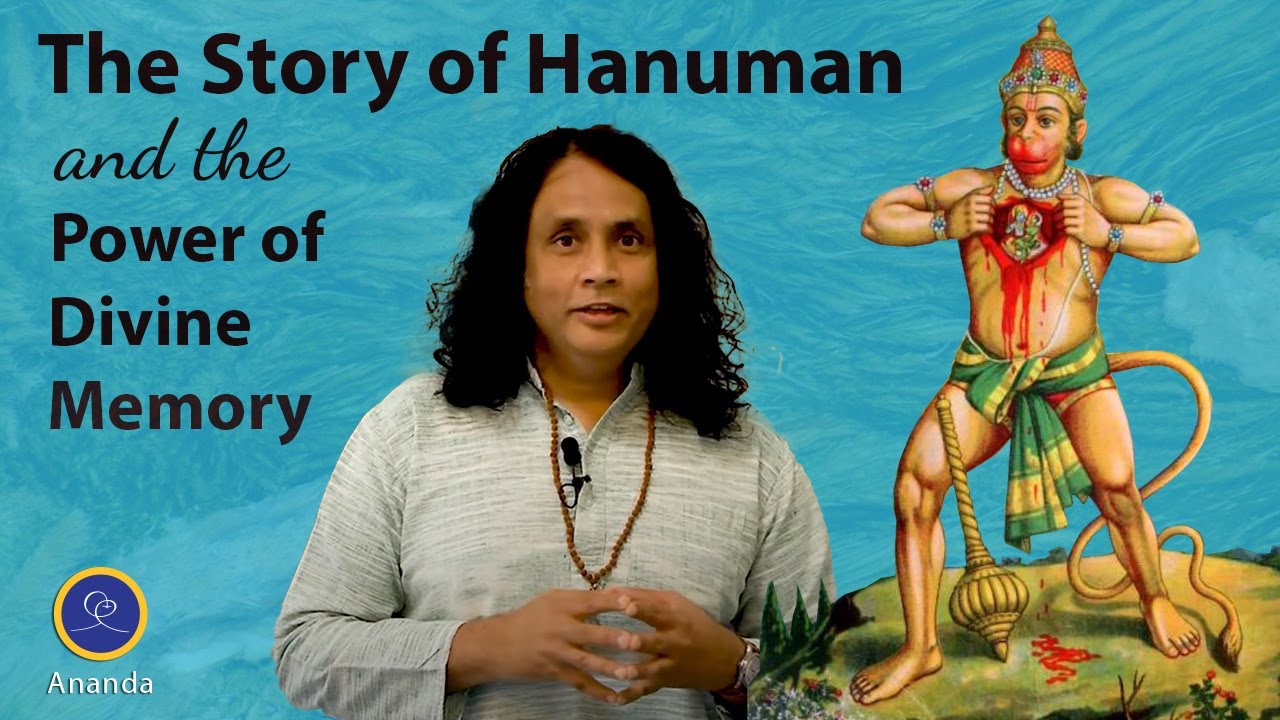
The Story of Hanuman and the Power of Divine Memory
Told by Seattle-local, Bangalore storyteller extraordinaire Murali Venkatrao, you will be carried to ancient and sacred India and gain knowledge of helpful principles of the spiritual path. You can find Murali's complete talk here.
This is the tale of Hanuman, the monkey god, whose immense power was evident even as a child. Mistaking the sun for a fruit, Hanuman leaps toward it, disrupting the cosmic order and angering the gods. Struck down by Indra, his mother’s rage prompts the gods to bless Hanuman with invulnerability. However, cursed by Brahma, he forgets his powers. Later, Hanuman meets Lord Rama, who reminds him of his true potential. This story serves as a metaphor for the soul’s forgotten divinity and highlights the importance of spiritual practice and the guidance of a guru in rediscovering it.
Watch additional inspiring stories told by Murali.
Transcript
Murali Venkatrao:
I'd like to tell you a little story. This is the story of Hanuman, the monkey god. If you all have heard of him. If you haven’t, that describes it all—the monkey god.
The Mischievous Power of Young Hanuman
When he's at peace, he's very well-known for his vitality and his discrimination as an adult. When he was young, he was so powerful, even as a baby. Even as a three-year-old—all three-year-olds have a lot of energy—but even in the august company of highly energetic three-year-olds, Hanuman was off the charts.
Hanuman's Leap to the Sun: A Cosmic Disturbance
One day, his mother, for various reasons—she’s a single mom and lives in a beautiful hut high in the mountains—puts Hanuman outside. It is sunrise, and he sees the sun rising. Hanuman, the three-year-old monkey, in his mind, understanding and misunderstanding, thinks it’s a delicious apple. He wants the apple, so he jumps at the sun. Such is his extraordinary power that when he jumps, he goes up 500 feet, 1,000 feet, into the upper atmosphere, into the vacuum of space, all the way to the disk of the sun. He is about to hold the sun, unaffected by it.
Now, this is a bad thing because the sun thinks, "Well, the job I signed up for is simply to sit on this chariot and make my way from east to west, take my rest, and come back the next day. I really have to keep up my time because people set their clocks by me. I cannot have some random monkey come and pull me off my orbit—this is against cosmic law." But the sun doesn’t know; it’s just sitting on a chariot, going from one place to the other.
The Gods' Anger and the Mother's Wrath
The king of gods, Indra, whose responsibility is all of these things, is very irritated by this monkey. A monkey in space, about to hold the sun—who's ever heard of this? He has an indomitable weapon called the vajra, which means diamond, and he takes that weapon and throws it at Hanuman. It hits Hanuman on his left jaw, and the baby is unconscious, plummeting down to the earth.
The mother is shocked. It’s like, "My baby isn’t there." She’s shocked as the baby is falling down, unconscious, with his left jaw now swollen. Soon, she realizes what happened, and she is angry. So angry. A mother’s anger cannot be trifled with because it comes from a pure place; there is no agenda there. "How dare you harm my baby?" Even the gods know this. They see the mother getting angry, and now they’re afraid because a mother’s anger can disturb the laws of the universe—nothing stands in its way. That’s God’s law.
Divine Blessings and Hanuman's Forgotten Powers
So, the gods come down and say, "Sorry, dear mother, we don’t know what we were thinking." The god of fire comes down and says, "I will bless your son," and touches his forehead. He says, "Hanuman is now impervious to fire. You will not be burned by fire." The god of water says, "You will not be drowned by water." The god of wind says, "You will not be disturbed by the wind." And on and on, Hanuman slowly transforms into an indefatigable, indomitable, invulnerable being—a three-year-old monkey.
Then Brahma, the creator, comes down. He’s sitting on the lotus padma and riding Hansa, the divine swan. He swoops down from the heavens, an impossibly ancient being with a big, long white beard and four faces, and says with the voice of creation itself, "Hanuman, you are invulnerable, but karma is karma. Whether you knew it or not, you jumped up and were about to disturb the cosmic order, and you have to pay for it. So, I curse you that even though you have all these powers, you will forget all of them. You’ll have no smriti, no memory of it.
Rama and the Awakening of Hanuman's True Nature
Hanuman grows up to be an adult, thinking he’s an ordinary monkey. He lives in a legion of monkeys in the forest, part of a great monkey kingdom. Then, one day, Rama, who is God incarnate—God walking in human form—comes into the forest. It’s a whole other story—he’s a banished prince because of palace shenanigans, and he’s been banished into the forest for 14 years with his wife and brother. His wife is abducted by the ten-headed evil king Ravana. Long story, but He is in search of his wife.
He comes into the monkey kingdom and sees Hanuman. The moment he sees him, he tells his brother, "Look at this monkey. This is no ordinary monkey. He thinks he’s ordinary. Look at the way he speaks." It’s a beautiful episode in the Ramayana. "Look at the way he walks." He sees great divinity in Hanuman in every action that he does.
Later on, at a critical time, when it’s time for Hanuman to jump the ocean to move into the demon's kingdom to see if Sita is alive, Rama tells him, "Do you not remember? Fire cannot burn you. Water cannot drown you. Wind cannot disturb you. No weapons can harm you. You jumped at the sun when you were three years old—you can jump this paltry 100 miles." Hanuman remembers, and he grows as tall as a mountain. He climbs another mountain to tolerate the power of his jump. Then he does so many wonderful things in his life.
The Metaphor of the Soul: Eternal and Unharmed
When Rama returns to the kingdom, other people say, "Why does the monkey get so much credit?" They’ve been hoping a monkey comes in, and Rama says, "He’s my right-hand man." Not even a man—it’s very disturbing to people. So, Hanuman says, "It’s very simple." He rips open his chest, and inside, instead of a beating heart, they see Rama and Sita sitting there. He says, "This is where all my power comes from."
This is a metaphor for the soul. The soul, as it says in the Bhagavad Gita, is a very famous verse. It says the soul cannot be harmed by weapons, cannot be burned by fire, cannot be wet by water, cannot be disturbed by wind, meaning it’s eternal. That infinitude is the quality of the soul, but we have the curse of the creator, banished from the Garden of Eden, that we have no memory of it.
We do have the memory of where we came from—that’s what inspiration is. You go to a talk, read a book, or have a deep meditative experience. We get inspired. That inspiration is not exogenous; it’s not something that comes to us from the outside. The memory of who we actually are is prodded, is awakened by the words that we read or hear, or in the calmness of deep meditation when the restlessness goes away, as it says in the Gita reading today; who we really are bubbles up.
We’re very inspired, and then we go back and say, "Okay, my entire life has changed. I dedicate myself to thee, Lord. How will you find us awake and ready?" Pretty soon, we go to sleep, neither awake nor ready. About a week later, the whole thing is forgotten. So we come back for another talk, the slate wiped clean. Awake and ready, we go back. This can go on for an entire lifetime or multiple lifetimes.
The Path of Spiritual Practice: Seva, Sadhana, and Satsanga
It’s not so much that we need to remember—the smriti, the memory, needs to be sustained, otherwise it disappears. That’s why, in all spiritual traditions, there is no exception to this: the three S’s are emphasized—Seva, which is service; by serving others, we recollect that we are all children of God. Sadhana, by inward practice—here, for us, disciples of Parmahansa Yogananda, it’s a part of yoga, and our practice is meditation. For those of us who are Kriyabans, we had this blessed, wonderful Kriya initiation weekend last Saturday.
Our path, our sadhana, is a path of meditation, which brings calmness to the mind. In that calmness, raga and vaisha, likes and dislikes, move to the side, and the memory of who we really are bubbles up endogenously, inwardly. Satsanga—the company of all of us with a similar purpose of seeking God—again reinforces the memory of who we really are. The three S’s of the spiritual path.
But, I told you—Seva, Sadhana, Satsanga—they move the dial, but they don’t transform. What transforms is the presence of the guru, the teacher. You see, that’s what Rama was for Hanuman. The moment he saw him, Rama knew that this soul was ready, and he says, "Do you not remember, Hanuman? What is beyond you?"
Yogananda, whose teachings we follow here, used to say, "If you could only see yourselves as I see you, you’re all beings of light." Seva is good, sadhana is good, satsanga is good—company of like-minded people—but they have to be charged by the consciousness of the guru. The guru’s grace performs miracles on our behalf. They’re not miracles—what the guru does, by the sheer presence and magnetism of his or her consciousness, is constantly awaken in us the memory of who we really are so that it’s not lost in the din of other memories.
In the presence of the guru, with Seva, service, Sadhana, practice, and Satsanga, company of like-minded people, we are ready to walk back and reach our home. The majestic promise of the scriptures is: by proud indifference, unaffected though eternally rejected, He remains our friend.
