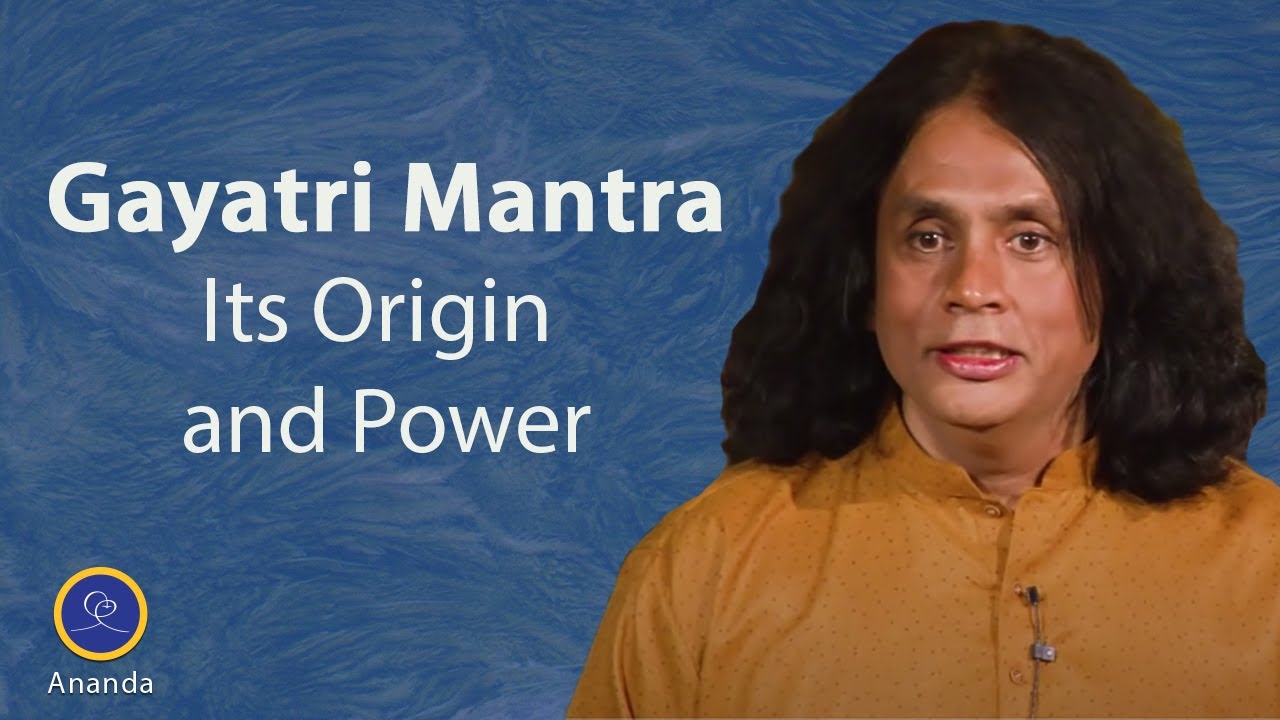
The Story of the Origin of the Gayatri Mantra of Enlightenment
Watch this beautiful and inspiring story, told masterfully by Murali Venkatrao.
Ananda Yoga Teacher Training — 4-month Yoga Alliance certified 200-hour yoga teacher training with Dr. Murali Venkatrao and a host of joyful Ananda Yoga teachers. Learn more here.
The Art and Science of Raja Yoga — 3-month course on Raja Yoga with Murali Venkatrao, PhD, offered online in January and September every year. Learn more here.
Transcript
Introduction
Nayaswami Gyandev:
From that slightly ridiculous to the sublime, for our last portion of the evening we have a very special guest storyteller Murali Venkatrao from Seattle, who is going to tell us about the origins of Gayatri Mantra. And we're very pleased to have Murali here with us.
Murali Venkatrao:
Thank you, Gyandev. Good evening, everybody. It's time to stop having fun now. The story I'm about to tell you is very famous in India, but it's hardly known outside of the country. A story so famous that it's influenced people's lifestyles across the centuries.
To give you an example, I was brought up in India in a semi-orthodox Brahmin family. Brahmins are the priestly caste. In my house, we were forbidden to eat eggplants on Thursdays. It's because of what happens in this story. So you can think of this as perhaps the most famous story you may have never heard.
A Note on Pronunciation
Before I go any further, I should say perhaps you have noticed that I have an accent. I'll try my best to speak slowly so you can understand me. If you still have trouble understanding me, not sure, just try harder. What else can I do? But I'll try my best.
The Essence of the Story
This is the story of a warrior who became a yogi. It's the story of what happens when human power confronts divine power. But most importantly, it's the story of a mantra.
You all know what mantras are. These are sacred incantations. They set up a resonance in the body, not merely resonance coming from sound - of course, it does that - but an astral resonance. The result of this is the veil of delusion, of Maya, is just a little thinner. It parts ever so slightly to help us perceive the Creator behind all of creation.
So mantras are known to be healing. In fact, that's what the word mantra means - that which heals. There are many, many mantras. A very simple, beautiful one is Rama, Rama, Rama, Rama, Rama. You keep chanting this; it takes us to a very uplifted state.
The beautiful chant that you heard coming into this amphitheater, Om Namah Shivaya, a mantra of six syllables - Om Na Mo Shi Va Ya - six syllables. This is known to destroy bad habits in us and grant us thereby great power.
The mantra of 12 syllables, Om Namo Bhagavate Vasudevaya, the sister mantra that takes our energy inward into the spine and redirects it upward towards God.
The mantra of 32 syllables, 'Mahamrityunjaya mantra', which is very central to our fire ceremonies—it's the mantra of liberation.
But the best of them, the easiest, the most exalted one, a mantra that is so powerful, so filled with benevolence and grace that anybody that chants it, no matter the cosmic burden they carry, will go towards enlightenment very quickly. This is, of course, the Gayatri mantra. It's a mantra of 24 syllables, and it's been chanted by millions of people over thousands of years. As to we chanted in our fire ceremonies and so forth.
The Origin of Mantras
You see, you just can't invent mantras. You just can't go home tonight and say, I'll invent a mantra for back pain. You'll come up with something; might increase your back pain. Doesn't work that way.
When a Self-realized master is in deep communion with God with a specific intention that's beneficial to everybody, God helps him or her by manifesting himself in this in a set of astral sounds. So these mantras are heard while in deep meditation by great masters.
The Story Begins
This is the story of the Gayatri mantra. Who was it given to? Why was it given? So all stories begin in the same way. All stories have the same beginning. It goes something like this: A long, long time ago. So does this story.
A long time ago—this was so long ago that it was in a higher age, Satya Yuga—it is said that in that age, Dharma - righteousness - stood on all four feet. It was firmly established. Men and women could hear the voice of God more easily than we do today.
In that age lived a king. His name is Vishwamitra. Vishwamitra means friend of the universe. He was a great king. Under his rule, his subjects were prosperous. They lived in harmony. They thought of God. They lived closer to nature.
He was a powerful King. He ruled with the perfect combination of justice, might, and love. He had a great army. He himself was a great warrior. Under his leadership, his armies, undefeated armies, had established dominion over much of this earth.
Now, if you're a king - I'm going to go out on a limb and guess that not many of you are kings or empresses in your life - so I'm going to tell you what you have to do in case you find yourself becoming ruler of a dominion. It's very important. Listen carefully.
You can't just hang out in your palace all the time giving parties or executing people. You do that - that's part of being a king. But every now and then, you have to go tour your kingdom. You have to visit the principalities, the municipalities, vassal states, and go look at what people are saying about you. You get some field intelligence, as they say, and make sure that everything's going well.
Vishwamitra's Journey
So Vishwamitra, the great king, the friend of the universe, he decides to do the same thing. His kingdom is vast, so he can't really go in the morning and come back the next day or something. So he takes a retinue. He takes a heap. He takes a bunch of soldiers with him, a thousand of his best soldiers, and he begins to tour the kingdom.
It's so vast that it takes almost an entire year for him to tour the kingdom. And the year is about to come to an end. He's very happy. Kingdom's going well. Nobody is about to rebel, and people are thinking good thoughts and so forth.
And before returning to palace where to his palace, he has one more stop to make. It's not to a vassal state or some other principality, but rather it's in a hermitage, an ashram deep within the forest. In this hermitage lives a Rishi.
Explanation of Rishi
Rishi is a title. It's a title given to a... it's a title given to a master of great spiritual achievement. You see, back in those days, the king was responsible for the material well-being of his citizens, but it was also recognized that the spiritual well-being was equally important. The spiritual well-being was the responsibility of the Rishi. He functioned as a guru of the king and as the spiritual protector of the kingdom.
Introduction to Vasishtha
So Vishwamitra is visiting the ashram of his guru, a great Rishi named Vasishtha. See, Sanskrit names have this quality to them. Vasishtha - those of you that know that already tells you you're not talking about a trivial guy. And indeed he wasn't. Those of you that do yoga, you know this asana - Vasisthasana. Guys, know that it's very poorly translated as side plank, but it's the asana of Vasishtha.
What's so great about him? Well, even among the Rishis, he was exalted. You see, his soul lived in constant communion with God, constantly, never away from God. And therefore, when Vasishtha spoke, God spoke through him. It was always true. Even if it wasn't true by when he started speaking it, it would become true by the time he ended speaking it because the universe rearranged itself to follow the will of God. His consciousness was a perfect mirror of divine consciousness.
Vasishtha's Special Title & Vishwamitra's Visit to Vasishtha
So he had a special title: Brahma Rishi. Not just a Rishi, but Brahma Rishi. Brahma means Supreme Spirit: Rishi in touch with supreme spirit all the time. And as a mark of his spiritual achievement, he carried around a wooden staff, not unlike what I am holding right now. This was the staff of God, the staff of Brahma, representing his communion with God.
So Vishwamitra, the friend of the universe, the Great King, visits his guru, Brahma Rishi Vasishtha, the man through whom God speaks. So Vishwamitra goes in. He's removed his footwear. He is dressed in regular clothes as a mark of respect.
And Vasishtha, he's a very emaciated-looking person with long matted locks and a flowing white beard, wide eyes filled with God's peace. His entire ashram reflects that peace. There are trees pregnant with fruits, there are fragrant flowers, deer, and other animals who are attracted by the peace. He has his acolytes, his disciples, other Yogis and apprentices in his ashram.
And Vasishtha receives Vishwamitra and asks him, “Oh King, are you doing well? Are the rains happening on time? Are there any floods or famine? Are people in harmony with God?” and so on. And Vishwamitra answers all of them, and then he asks the questions that are appropriate for him. He says, “Guru Deva, do you have everything you need? You have enough ghee for the fire ceremonies that you do? Enough rice? Are the cows bountiful in what they give you? You need more land?”
“Through your generosity, King, and through the grace of God, I have everything I need.” And then they talk this way for a few more minutes, and then Vasishtha says, “You've been traveling for an entire year. Let me make you a great big banquet for you and your army. You look very tired. Looks like you haven't had good food in a long time.”
The Miraculous Banquet
Vishwamitra says—I mean, how can you refuse your guru? But he's thinking, he looks around, it's a forest hermitage, it's about 10 or so huts. Where are the granaries? Where is the kitchen? What am I going to get? This is a little suspicious at this point, but what to do? It's your guru. So you got to please, say, okay, in a year of starvation rations, what's one more... one more lunch with bad food? “Yes, sir. We are happy to.”
And Vasishtha, the man who always speaks God's truth, looks at the meadow. There are a few cows in there. One of them is especially eye-catching. You can tell that there is something special about her. Vasishtha looks at the cow, and the cow is so attuned to her master that she senses the look and turns and saunters over. And she nestles his hand and looks at him with big brown eyes filled with love, as if asking, “Master, what do you want?”
And Vasishtha looks at the cow and says, “My child, as you can see, we have a lot of guests. He points his staff of Brahma at her forehead, touches it, and says, Will you not prepare a great banquet for us?” What he's spoken, the words of God, what he says has to be true. And the cow shakes herself just a little bit, just a teeny shake, and makes a sound, you know, the sound that cows make. The mooing sound, it's filled with love.
Then one interesting thing happens. From the belly of this wish-fulfilling heavenly cow begin to emerge great heaps of food. Mounts of warm rice infused with ghee and saffron, rivers of milk and honey and curds, mangoes, melons, guavas, jackfruits, savories, all kinds of breads, not unlike the meal we had — began to emerge in silver platters, golden dishes, crystal goblets. Magically, mountains of food, tables appear in the forest clearing, and soon the mother of all buffets is set up, a banquet like nobody has ever seen before.
The Feast
The soldiers, they have been eating such bad food for an entire year. They are ready to pounce on it. And Vasishtha says, “Stop!” He gathers his disciples, holds up the staff, and blesses the food: “Receive, Lord, in delight thy food we eat, for it is thine. Infuse it with thy love, thy energy, thy life divine.” The food is now twice blessed.
And then the soldiers begin to eat. Poor things, they give a new meaning to the term all-you-can-eat buffet. Pile their plates with food, but the food keeps appearing. They eat for an entire hour. They eat themselves into senseless stupor. That's how hungry they were.
Vishwamitra's Desire
All the while, Vishwamitra is thinking, “It feels like I should have this cow. Imagine the kind of parties I can throw in my palace. What's this cow doing here?” So he goes up to Vasishtha. “Gurudeva, I have a question for you.”
“Yes, my son.”
“If you had a great big shiny diamond, and if it's in the forest, don't you think it's a waste?”
“Of course it's a waste, my son. What do forest dwellers... what use do they have of a shiny diamond?”
“Lord, this cow is exactly like that. It's a shiny diamond. It belongs in my palace. If it was with me, I could banish hunger in my kingdom. I will give you ten thousand cows. Would you let me have this divine wish-fulfilling cow?”
Vasishtha looks at him and says, “This cow was given to me by the Creator Himself. Its destiny, its karma, Dharma is to satisfy the meager needs of my ashram. It cannot be in the palace. You shall not have the cow.”
Now Vishwamitra gets into full negotiation mode. He's a king after all. He says, without thinking what he says, he says, “I will give you 14,000 war elephants.”
War elephants for a forest monk? Vasishtha laughs at him. “What will I do with a single elephant, let alone a war elephant, let alone 14,000 of them? You shall not have the cow.”
“I will give you 11,000 of the best horses in my kingdom.”
“No, my son. You shall not have the cow.”
He ups the ante. He says, “I'll give you 800 chariots. Before you say no, each chariot will be filled with the choicest and the rarest of gemstones.”
Vasishtha looks at him and in a tone that's both disdainful and firm, he says, “You can give me a million cows. You can give me the wealth in all of your kingdom, but you shall not have the cow. It does not belong to you. It's not your Dharma.”
The Conflict Escalates
Vishwamitra is a great warrior. He's a king. He's not used to disobedience. He's now angry. “Take caution in your tone. Remember to whom you're speaking. The land that you stand on is the land that I own. You have it because I gave it to you. Everything that's on this land belongs to me. I could have taken the cow at any time. It would still be dharmic. But out of respect for you, I offered you great wealth.”
He snaps his fingers, and the general of the army comes. “What is your bidding, my lord?”
He says, “Get a squad together. Capture the cow. Let's take it back with us.”
And the squad of men rushes towards this beautiful wish-fulfilling satvik cow in the meadow. And the cow looks at Vasishtha as if beseeching him, asking, “Are you going to let them harm me, my lord?”
And Vasishtha looks at the cow. “You have within you the power to stop them. Protect yourself. God has spoken.”
The cow shakes herself a bit, much more vigorously this time, and makes a sound, a mooing sound, but nothing like how she made it before. It was like as if a lion just roared. And then she goes still.
What happens next is stunning. From her belly begin to emerge hundreds of soldiers. Not ordinary soldiers - expert charioteers from Greece, horsemen from the steps of Mongolia, swordsmen from Cambodia, and archers from India. They come out of the cow, wish-fulfilling heavenly cow, in droves.
Now, Vishwamitras army is no slouch either. They have dominated the entire earth, indefatigable. So they arrange themselves into battle formation. But what chance does a human army have against this divine host? Very soon, as if within minutes, the entire army is decimated, defeated, eviscerated. All the soldiers of Vishwamitra dead or they lay dying.
Vishwamitra's Defeat and Response
Vishwamitra, the friend of the entire universe, is stunned. What happened? All my life I believed in human power. All my life I trained to be a warrior, equipped the best army, and conquered the entire earth. And here, a forest monk with a wooden staff and a cow my army was defeated.
Filled with anger, cheeks burning in humiliation, he is a great warrior, he's not one to give up. He has indomitable will. He looks at Vasishtha, says, "I don't know what you just did, but this is not over." He turns his heel without looking back. He strides away from the ashram and goes where? Where do all such people go? We just saw it in the skit. Of course, they go to the Himalayas.
Amidst the snowy peaks of the Himalayas, Vishwamitra, the friend of the universe, begins to meditate to the great god Shiva, the god of destruction, the patron saint of all weapons. How does he meditate? What austerities does he perform? He stands on one leg. He lifts his arms and stands there. As a king, he is used to three meals a day. He stops. He reduces that to two and then to one, and then eventually he begins to eat only the dried leaves and the grass that's available to him on the ground near him.
When winter comes, he stands in an icy river lifted up. When summer comes, he stands on an exposed ledge. He begins to meditate. A year passes. Om Namah Shivaya, the great six-syllable mantra—he continues to chant that and meditate. “Om Namah Shivaya, Om Namah Shivaya.” Keeps going. The year passes, and then ten years, 50 years, 200 years. “Om Namah Shivaya.” Such is the power of his anger and the nature of his will. “Om Namah Shivaya.” Continues to meditate.
A thousand years later, a thousand years later, Shiva appears in front of him. Dark-skinned, dark blue is his skin, smeared in ashes, matted locks as big as mountains that surround him, crescent moon on his head, with a great Trident. And Shiva says, with the voice that fills the mountains and the valleys around him, and he says, “My son Vishwamitra, I'm very happy with you. What boon do you seek?”
Here comes trouble. It is said Shiva is the greatest friend of devotees. You know why? Because all he wants is the devotee's love, and he's willing to give anything. And so it was that the Shiva was a friend of the devotees. The lord of destruction has asked the question. He's popped the question. Now there's no turning back.
And Vishwamitra says, “My lord, you're the god of destruction, the patron saint of all weapons - physical, astral, celestial. Will you not give me mastery over all of those weapons? I would like to have mastery over the power of the wind and fire and water. I would like to have the poison of all snakes within me at my beck and call, and the ferocity of all wild animals.”
Tathastu Shiva says, “Be it so.” Vishwamitra fills, fills his body, filled with this great power. Can you imagine? Then one instant you feel the sacred mantras coming into your mind that allows you to control fire, earth, water, air, and you feel the great ferocity of all wild animals, indomitable, indefatigable.
So his body fills with power, his mind fills with power. He begins to walk. All the anger repressed for a thousand years comes back unabated, perhaps amplified, seeking vengeance. He doesn't need to walk anymore. He's the master of the wind, so he flies to Vasishtha's ashram—Brahma Rishi Vasishtha, the man through whom God speaks, and he descends into the ashram.
Vishwamitra's Revenge
And he sees there, the meadow where he was humiliated, those little pitiful little huts. His anger bubbles up uncontrolled. He chants the hymn to Agni, the god of fire, lifts his hands, and through his hands shoot out fountains and fountains of flame. It is not mere flame. It is the elemental force of fire itself. It arches high up into air and descends down into the poor mud huts which have the acolytes and the disciples and the Yogis, women and children. These poor humble huts, it incinerates all of them in an instant.
The meadow is burned. The trees pregnant with fruits are gone. The fragrant flowers, the deer, all animals, they are gone. Moments ago, it was filled with the fragrance of flowers and the song of birds. Now there is the smell of charred flesh and the crackle of bone about to break. An eerie silence descends over the ashram.
And the silence is broken by a resonant voice: “What have you done, you evil King?” It is the voice of Vasishtha. He comes before Vishwamitra, his staff in hand. “I fed you. I invited your armies into this hermitage and gave you a great banquet. Is this how you repay me? What a sin you have committed!” His great big eyes still filled with divine peace but also filled with bottomless sorrow, tinged with bottomless sorrow. And Vasishtha says in a voice that is both true and frightening, “Be prepared to pay the price of your sin.”
Vishwamitra just laughs at him. “You know, last time, Vasishtha, I don't know what you did. There was a magical cow, and somehow it killed my armies. It's not like that now. I have the power of Shiva within me. There is no weapon that's not under my control. You cannot summon some cow and kill me now. Be prepared to face my wrath.”
And saying so, once again he lifts his arms, and the power of fire comes out of him and begins to arc up in the air. Vasishtha holds his staff, an emaciated monk, hardly built, there he was very emaciated, skin and bones, holding a poor wooden staff. He holds it in front of him, and this fire, instead of going up and spreading out like it did before, seems to be attracted into a single laser beam, comes to the center of the staff and gets absorbed by it. In one moment, the power of fire is gone, nullified.
The staff pulses just a little bit with the great energy that it had just absorbed. And still, Vasishtha is not even using his other hand. Just one hand, that's good enough for you.
Vishwamitra is beside himself in anger. He invokes the power of water. A wall of water, a tsunami forms in front of him, gathers strength, and roars towards Vasishtha. Holds the staff, one hand, a frail monk standing there, a man of God realization. The wooden staff absorbs all the water just like that. The water of all the seas and all the oceans in the world is absorbed in one moment by a thin wooden staff held by an emaciated monk.
Vishwamitra continues to power the explosive power of air, of Earth. He rains down mountains, boulders, uproots trees. Everything absorbed by the staff. Not knowing what else to do, he takes the nuclear option. Ready to push the red button.
The Ultimate Weapon
What is the nuclear option? Well, the greatest force in the universe. What is the greatest force in the universe? It's the force that created the universe, of course. The creative potential of universe itself. It's called Brahma's weapon, Brahmastra. With a chant, with a mantra that's unknown to all but very few, he begins to suck the power out of the entire creation. The earth spasms in uncontrolled earthquakes. The heavens are disturbed, and all the power gets sucked in. It becomes a strange astral beam coming out of Vishwamitra's forehead.
Such is the power of this beam that even Vasishtha feels his skin darken, and there are sparks coming out of the hair on his hands. And even he is disturbed a little bit, and he holds the staff with stronger hands this time, using both hands. The power of the entire creation is absorbed into the staff of the Creator. Nothing like this has ever been tried or seen before. The staff vibrates a little bit with the power and then dissipates it to all of creation. Harmony is restored.
Vishwamitra's Epiphany
In this moment of ultimate defeat, the nuclear option, the button's been pressed, nothing's happened. Now Vishwamitra realizes what happens when human power, even great human power, confronts the infinite power of God. Of course, it's absorbed.
A moment of Epiphany. He sees the sin that he has committed. He looks at his hands and says, “These are the hands that were about to kill my Gurudeva. What have I done?” He's mortified with his sin. But then he's a Kshatriya, he's a warrior. Such is his will that he doesn't dwell on what went wrong. There, right in that instant, he decides, “The only way I can atone for my sin is to become a Brahma Rishi myself. When I'm in constant communion with God, then I will know how to atone for my sin. It's too great otherwise.”
Now this time he says the same thing, what he said before, that “This is not over. I will be back.” But now it is said with an entirely different tone. “I will be back. Please forgive me. I will be a Brahma Rishi.” Goes back to the Himalayas, Devabhoomi, the land of gods. He goes back there and begins to meditate.
And what austerity it was! He doesn't eat anything. He doesn't drink anything. It is said that it's easy to fast. It's not that hard. It's even easy to forego water for a few days. But what's not easy is to forego sleep. With indomitable will, Vishwamitra gains mastery over sleep, begins to focus on God and prays to the God and says, “Give me God contact, oh Lord. I wish to atone for my sin.” And he begins to meditate.
The year passes, ten years, 50 years. You know where I'm going with this. 200. Keeps meditating. The power of his austerity is so great that smoke begins to come out of his body. But he continues.
A thousand years later, Brahma the Creator appears. He experiences his great stillness, and in that moment of stillness, Brahma the Creator appears. He says, “Vishwamitra, my son, I am very pleased with your great will and your single-minded contemplation of me.” And with the thrill of God contact, Vishwamitra looks up to the Creator, to Brahma. And Brahma says, “You are now a Rajarshi. Rajarshi means you're a king among Rishis and a Rishi among kings.” And Brahma vanishes.
Of course, the thrill of contact, the awe of God contact is great. It's amazing, life-changing. But that's not enough for Vishwamitra. He wants to be a Brahma Rishi. The will of the Kshatriya, the will of man, is very great. So he begins. He begins to contemplate, “Where did I go wrong?” Swadhyaya, self-study. “Where did I go wrong?”
Vishwamitra's Self-Reflection
Then he realizes somewhere in t100-year meditation, there was one day when he was meditating, is really getting to a good place, and then there was a very melodious song of a songbird which disturbs his meditation. He wakes up with great anger. He curses the bird, who makes bad things happen to it. And he says, “That's where I went wrong. God may have touched my heart, but anger still remains in me. Why do I have anger?” He meditates on it. “Ah, I have anger because I still have desire. I desire to be a Brahma Rishi. Why do I have desire?”
This is a hard one. ”I have desire because I have attachments.” He's getting close to the essence of the problem. “Why do I have attachments?” This is really hard. He thinks, “Why do I have attachments? I have given up my family. My kingdom is long gone. I don't even know what happened to my descendants. I wear the robes of a simple monk. Why do I have attachment?”
Why does he have attachment? Another moment of Epiphany. What a realization it was. “I have attachments simply because, simply because I dwell on things. I dwell on the beauty of a tree. I'm attached to that tree. I dwell on the fragrance of a flower. I'm attached to that flower. I dwell on the beauty of a woman. I'm attached to that woman.” He says, “Then what is the solution? I cannot think about creation. I can only think about the Creator. That is the transformation.”
Vishwamitra's Final Realization
How he says, “How shall I seek the Lord my God?” And the answer comes, “Seek Me through service.” “How shall I serve the Lord my God? “And the answer comes, “Seek, serve Me by loving Me.” That's all God wants.
"'How shall I love the Lord, my God? With every breath I take.' With body, mind, and soul, I seek only Thee."
And now Vishwamitra enters into meditation. Vishwamitra, the friend of the universe. Rajarshi, enters into meditation. Now he doesn't want anything. He doesn't want to be a Brahma Rishi. He doesn't want any attainments. He just sits in meditation, and his breath — he lived only on breath now. Even his breath stopped. Such is his stillness.
The great fountain of energy begins to rise from the base of his spine, rising up through the central channel, washing away lifetimes of vrittis, of karmic worries. His heart opens completely to the presence of God, and he stays in divine ecstasy for who knows how long. Perhaps a year, 50 years, 200 years, maybe 1000 years. We don't know. There is no time. He stays in divine ecstasy.
And then finally, the Supreme Spirit himself takes human form as god Vishnu, resplendent in golden robes, arms lifted in benediction. He appears in front of Vishwamitra. "Vishwamitra, friend of the universe, you shall always be with me from now on. I shall never leave your presence. You will always be in infinite bliss. Hold out your right hand."
Vishwamitra holds out the right hand, and in the right hand appears the simple wooden staff. “You are a Brahma Rishi now. When you speak, you speak my will.” Tears are flowing down Vishwamitra's cheeks. When he has it, he no longer wants it. Why? He has God already. What does a wooden staff mean? What is the title mean? Isn't that the nature of all our aspirations, even the greatest ones? That's why it's called as lila. It's a game that God plays.
Nonetheless, Brahma Rishi Vishwamitra, what does he say? “Lord, the hand in which you placed Your staff, which is meant to hold your power, has sinned gravely. It was once about to strike my Gurudeva. How can I atone for that sin, my Lord?”
And Vishnu says, “The dark ages are coming, my son. You had the willpower to find me through pure human willpower alone. In the dark ages, this is not possible. Will you not find, find, find a trick, find something that everybody can use that in the depths of the dark ages they can just deploy that little tool, that little trick, and they too can be enlightened like you are?”
Then Vishwamitra says, “Thy will be done, Lord.”
The Origin of the Gayatri Mantra
Goes back into meditation. For a yogi of Self-realization, for a Brahma Rishi, what is time? Has no meaning. So in using his yogic power, he travels forward in time to the dark ages. Descends in astral form, perhaps has walked among us in this earth, and begins to feel the human pain and suffering in the dark ages brought along by lust, desire, possessiveness, and all the endless cycles of births and deaths that we are part of.
For a man of Self-realization, the man who has seen infinite bliss, what suffering is this? His heart cannot tolerate it. It's rent asunder by this incredible pain and suffering of humanity. He meditates fervently, feverishly. “Help me get rid of the pain of humanity, Lord. Please show me something.” He continues to meditate. And I won't go through how long he meditated. You all know this. Let's say a long time later, his heart is still torn with pain as he continues to meditate.
And suddenly he begins to hear a small sound in his right ear. And he realizes that when he focuses on that sound, the pain, the pain of humanity that he feels in his heart, is reduced just a little bit. He focuses even more, and the indistinct sound becomes a little more distinct. Focuses even more, and the syllables begin to separate themselves from this sound. And they arrange themselves in here behind the spiritual eye, golden syllables, 24 syllables, eight syllables per line. It arranges themselves in itself in three lines.
And he looks at those and begins to chant it loudly. Then he realized, and as soon as he does that, the pain that he feels is in his heart melts away. Now he knows the will of God has been done. “Through God's grace, I have found a mantra, a mantra that is so great that in the darkest depths of human suffering, just listening to it heals my heart. I shall call thee the Gayatri mantra,” he says. And he begins to chant.
The Revelation of the Gayatri Mantra
And then he hears the chant even outside of his physical form. It's as if many people are chanting with him. He opens his hands, hand automatically going to Brahma Danda, the staff of God, and he sees in front of him who else but Brahma Rishi Vasishtha. He's standing there, great smile on his face, eyes filled with love and compassion.
He comes to Vishwamitra and says, “Vishwamitra, friend of the universe, Brahma Rishi, the one through whom God speaks his will. God used your anger to serve a purpose. You have given such a great gift to mankind, the Gayatri mantra, which is so powerful that it is capable of granting enlightenment no matter who chants it.”
Gods and angels are surrounding Vasishtha, and they all say, “Glory be to Vishwamitra. Blessed be Vishwamitra, the great saint, the great Brahma Rishi. Let his name stand for as long as the sun and the moon stands.”
And so it was that through the efforts of Vishwamitra, the friend of the universe, the Gayatri mantra was given to us as a gift by God himself. No matter what our cosmic burden might be, chanting this mantra with devotion is capable of parting the veil of maya just a little bit so that we can perceive the eternal bliss of the creator in our hearts.
So will you join me now in chanting this mantra as millions of people have done over thousands of years? We'll play a recording of Swami chanting this, and then we'll chant along with him.
Chanting of the Gayatri Mantra
[The speaker then leads the audience in chanting the Gayatri mantra, accompanied by a recording. The mantra is repeated several times:]
Om bhur bhuva swaha
Om Tat savitur varenyam
Bhargo devasya dhimahi
Dhiyo yo nah prachodayat
Om bhur bhuva swaha
Om Tat savitur varenyam
Bhargo devasya dhimahi
Dhiyo yo nah prachodayat
Conclusion
Nayawami Gyandev:
I'd like to thank Murali for this beautiful, beautiful telling of the story of Gayatri mantra. Thank you, Murali.
[Applause]
Thank you Murali, thank you to our dancers, our chanters, and our other stars are probably somewhere trying to scrub off all the makeup. But also many thanks to Melody and Cara, Dossett, Sam, and thank you all.
[Applause]
