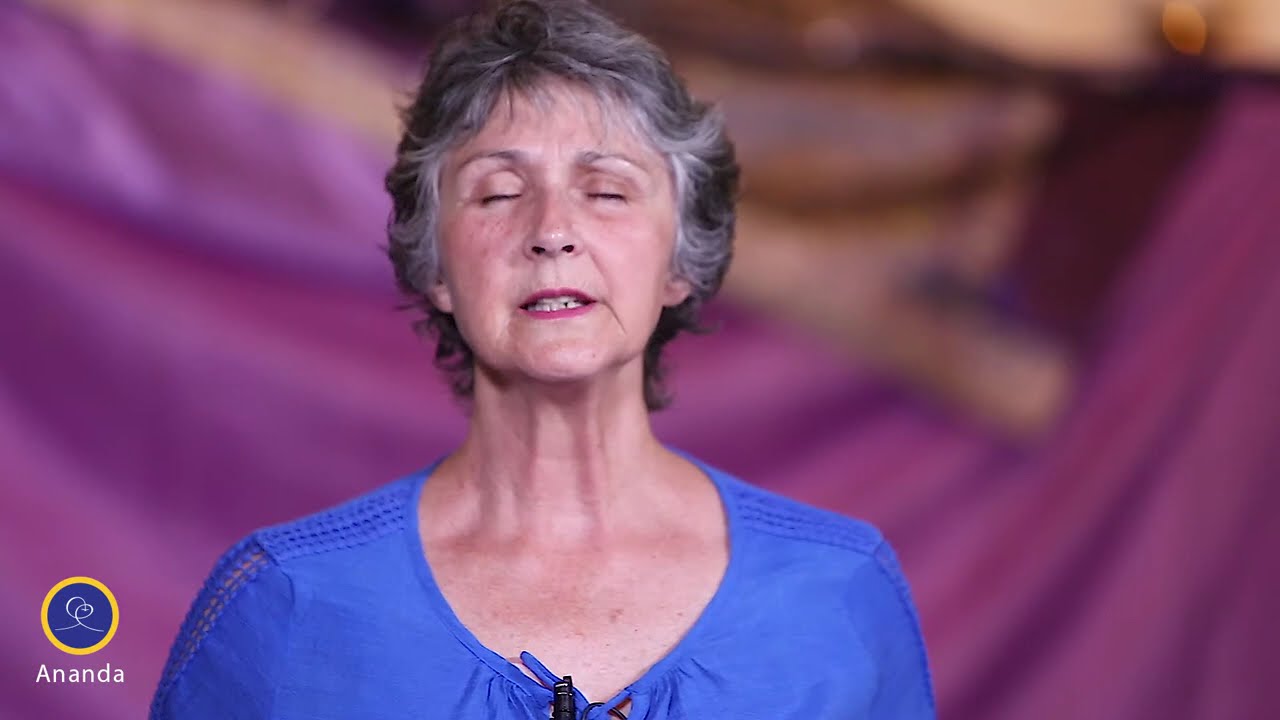
Guided Meditation on Calmness
Nayaswami Sahaja leads you in a 20-minute guided meditation on developing and experiencing calmness within yourself. She is a longtime meditator and lives at Ananda Village, California.
Join our guided meditation on calmness, designed to help you find inner peace and serenity. Through prayer, chanting, and focused breathing techniques, you will learn to calm your mind and uplift your consciousness. The meditation includes even-count breathing and a calming mantra to deepen your relaxation.
Experience the divine quality of calmness, and become more responsive to life's challenges. End with an affirmation to reinforce your newfound serenity. This meditation offers a pathway to cultivate a calm and centered approach to daily life.
Transcript
Nayaswami Sahaja:
Hi, my name is Sahaja, and I'll be leading us today in a guided meditation on calmness.
The Quality of Calmness
If you want to affect change in this world, it needs to begin within yourself. Calmness is a divine quality, and we can experience it in meditation. So with practice, eventually, you become more responsive to your challenges and less reactive. I know meditation has helped me a great deal with this, and I know that it can help you as well.
I'd like to begin our meditation with a prayer, and then we'll do a chant together [chanting is omitted in this recording]. After that, I'll guide us into meditation.
An Opening Prayer
Heavenly Father, Divine Mother, Friend, Beloved God, Great Masters of all religions, we bow before you. Lead our way. Help us to take this time to go deep into our center and feel the calmness that is in our hearts. OM
A Reading on Calmness
And now before we go into meditation, I'd like to read something to you from this book How to Have Courage, Calmness, and Confidence by Paramhansa Yogananda.
A yogi, whose mind is like a rippled lake, free from the waves of temporary mental elation, sadness, or emotional disturbances due to loss or gain, victory or failure, finds within himself the unruffled, clear reflection of the spirit.
Introduction to Meditation
So now, if you're new to meditation, you might find that it's just easier to start by sitting in a chair because we want to really feel the body relaxed. If you can sit with your back away from the back of the chair, this is very helpful. We want to keep the spine elongated.
If you bring your hands to the juncture of hip and thigh and relax your shoulders backward, it opens the heart. We want to keep the chin parallel to the floor.
And then, we're going to lift our gaze to this point between the eyebrows, the spiritual eye. And a way to kind of realize where that is is [to] hold your thumb in front of you and then just close your eyes and lift your eyes as if you're looking at it, or you might imagine looking at a distant mountain peak. Try to keep your gaze uplifted throughout the meditation experience.
So first, we'll want to begin with an exercise to relax the body. And we'll do that with a short and a long inhalation through the nose and then a short and a long exhalation through the mouth. It's kind of like sniff, sniff, ha, ha. And we're going to tense the entire body as we inhale and relax it completely as we exhale. [Models breathing twice]
And now, take a nice deep breath, a nice long inhalation and fully expel the breath.
Even-Count Breathing
And now, I'm going to guide us through even-count breathing. And just as we've relaxed the body, now we will use this technique to relax the mind.
We'll inhale, hold the breath, and exhale to the same count. We'll use the count of six, and I will snap my fingers as we do it for the first three rounds. And then I'd like you to practice on your own for three rounds.
Inhale, hold, exhale.
Inhale, hold, exhale.
Now, three more times on your own.
Meditation Starts
And when you finish your last round, just let the breath come in naturally. No more control. Become the observer. First, just try to feel your breath wherever you can, in your belly, in your chest. Just begin to watch it.
And as the breath becomes calmer, I'd like you to see if you can feel the breath. As it enters the nostrils, it is cool, and as it exits the body, it is warm. So very sensitively, try to feel the breath in the nostrils.
And now, I'd like you to watch the breath as it enters, moves up the septum, up to the point between the eyebrows. And as you exhale, watch it move back down again. As you practice this, you can begin to feel that the breath is fanning the spiritual eye, that point between the eyebrows.
Mantra Introduction
And now, we'll begin a mantra, and we'll practice this mantra for about 5 minutes. And during the process, I will call you back to the mantra. Don't be discouraged if your mind wanders.
The mantra we'll use today is 'I am calmness.' 'I am' on the inhalation, 'calmness' on the exhalation. There's no control of the breath, just let it flow naturally. 'I am' as you inhale, 'calmness' as you exhale.
You might find it helpful to draw your right forefinger towards you as you inhale and let it move away from you as you exhale. 'I am calmness.'
Internal Mantra Chanting
Let's practice now together. [Period of silence]
Gently now, back to the process. 'I am calmness.' With every exhalation, feel that you're going deeper
And now, you can let go of the mantra. Keeping your gaze lifted, try to feel that stillness, that deep calmness that lives at your center.
Just sit in this experience for as long as you can. [Period of silence]
Closing with Affirmation
And now, I'd like to end our meditation with an affirmation on calmness. 'At the center of life's storms, I stand serene. At the center of life's storms, I stand serene. I am calm. I am poised. I am calm. I am poised.’
Namaste.
