Downward-Facing Dog is hard for most beginners no matter what their size. Because of having greater weight, the fat student may prefer a wider stance in both hands and feet for better balance.
The dolphin variation, where the forearms, not the hands, bear weight, can be used if the person is not yet strong enough to hold his/her weight in this position.
Half-Spinal Twist is a nightmare for fat people! It’s usually the knee that’s pulled up to the chest that’s the problem. The fat student usually can’t even find out how supple they are in this asana, because the belly gets in the way.
Difficulty breathing, and a tendency to lean back (to unconsciously accommodate the belly) are the usual result. I seldom teach this asana in my class, substituting supine twists. However, I do sometimes use it to teach alignment. (It’s a good one for demonstrating keeping the head aligned with the torso.)
I usually recommend that the fat student raise the knee to a comfortable level only, and that s/he not cross the raised leg over the other knee. This, of course, lessens the stretch in the lower back and buttocks. On the other hand, it permits the fat student to breathe. I know which one I’d go with.
 Ugh! Just where is the fat in my tummy, chest and thighs supposed to go in this asana?! Let alone the air from an inhalation? Child’s Pose is often taught as a “reprieve” from a difficult asana — a real “milk and cookies pose.”
For the fat person, it is anything but that. Because bringing the knees and the chest together compresses the abdomen and chest, in order to breathe, the fat person usually ends up with his/her buttocks in the air, which is humiliating if s/he is the only one doing that. And it is even more so if the thinner people are heaving sighs of relief at how easy and comfortable the asana is.
One trick that Lin Turner teaches everyone for Vajrasana may help somewhat: “roll” muscle and fat from the calves laterally before sitting down fully into Vajrasana. I think that doing the same for the thighs relieves compression of the medial thighs and makes it easier to hold the legs closer together, and to get the buttocks closer to the heels.
It does, however, introduce a slight pressure toward internally rotating the femurs, which may not feel comfortable for some knees. At any rate, this may prove helpful also in Balasana by making the lower body more compact. I usually teach the frog variation, wherein the knees are spread before one lays the torso down. (See photo above.)
This helps, but usually there is still some difficulty. One of the problems to watch for is an increased tendency not to round the back enough, due to the weight of the tummy increasing the lumbar spine’s lordotic curve, so that there is strain on the lumbar area. (In the photo, you can see how a heavy tummy is beginning to cause this strain.) All the weight is shifted forward, which also places additional strain on the neck.
I solve this by encouraging the student to pay extra attention to rounding the back appropriately, keeping the bulk of the weight over the hips, not thrown forward, and placing cushions or soft blocks under the forehead.
Of course, this can overly restrict the breathing, and the student may not be able to remain seated on the heels, so cushions under the buttocks may be needed as well. Nevertheless some fat students will be able to find a reasonable amount of comfort this way in Balasana. Not complete relaxation, perhaps, but at least a reasonable amount of comfort.
Also, bear in mind that all this arranging takes time and focuses a lot of attention on the student. It’s good training for adapting an asana to one’s individual needs, but it could be embarrassing, especially for more sensitive people. You have to know your students and watch for their non-verbal cues.
This asana is usually not harder for fat people than for anyone else. However, there are a couple of items to keep in mind.
One, usually the hardest part of the asana is lying prone with the head on the ground. It’s hard for a fat person to breathe that way, since some abdominal and chest fat is compressed upward. Once one enters the asana, it stops being a problem. Two, it is very difficult for a fat person to keep the legs together.
The normal difficulty with this is exacerbated by the need to tighten the buttocks and press the pubis and thighs into the floor. This “squishes” the thighs, and once again, the fat has to go somewhere, and it ends up on the sides.
I haven’t found that spreading the legs slightly creates any problem as long as the buttocks are tight and the pubis is pressed to the floor to protect the lower back. However, one may use a strap to help keep the knees from separating too far, if necessary.
The only real problem here for some fat people is the need to keep the legs together. I don’t think the student risks injury if s/he has a slightly wider stance, but it does tend to decrease the feeling of the body being in a smooth, compact crescent-moon arc — an important part of the “energy” of the asana.
I don’t have a solution to this, but I do think that if keeping the legs together causes pain or creates added balance problems, then widening the stance is justified.
Anyone, fat or thin, may have a swayback, and it’s important to protect the lumbar area by tucking the pelvis. For a fat person with a very large belly, the lumbar area may be vulnerable even without a clinical lordosis, and in my experience it is safest to teach this asana assuming the need for extra lumbar protection for most fat people.
Also, the additional weight in a fat person’s arms may make it difficult to hold the pose very long.
The only caveat here is that when fat people place their arms at their sides, their arms are not hanging down perpendicular to the floor. Consequently, when a fat person supports him/herself in this asana, the angle of the arms makes them less efficient in strength for the task.
This may make the asana difficult even if the student otherwise has enough upper body strength to lift his/her body. Of course, the arms don’t lift the body clear of the floor in this asana, so it’s not as serious a problem, but it could still present difficulties.
As for any student, sitting on a cushion will facilitate a straighter spine, just as the arms would have if not for the angle. In addition, if the student has a very large belly, s/he may need to spread the legs.
The difficulty for fat people with this asana is the tendency for the legs to splay open when bringing the feet to the buttocks — another case of “the fat has to go somewhere.”
Holding a strap around the feet, and fastening another one around the lower thighs (don’t suggest this last unless you’re sure the strap will be long enough for the person) can help with this problem.
However, I still allow a few extra inches even with the straps. It’s critical that the student be able to protect the lower back by tightening the buttocks and pressing the pubis to the floor, since the wider apart the legs are, the less protection there is for the lower back.
Because of extra flesh in the upper arms and thighs, it’s hard for a fat person to wrap one limb around the other.
If the student has good balance and is otherwise fairly flexible, I have him/her place the foot of the raised leg on the lateral part of the knee, rather than the back of the calf. This allows more room for the thighs, although admittedly it sacrifices some of the twist. It does provide the same ankle strengthening and balance practice that the full posture does, though.
For the arms, I simply allow whatever approximation the student can perform while stressing that the forearms and hands should be (close to) vertical even if the full wrap-around is not possible. This prevents the upper body from losing proper alignment.
You will likely need to use a strap to “unite” the arms; that will also help with balance. Remind those who use straps to keep a loose grip with the hands.
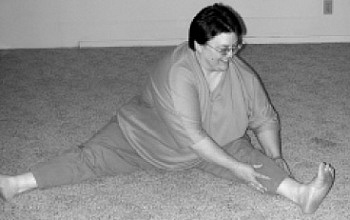 Here’s another asana in which the abdomen gets in the way. A partial solution is to practice the variation with legs wide apart. One still has to turn the torso before bending over the knee, so some compression is inevitable. It’s easier than the standard, legforward version, however.
A word of warning: if the student is very large, the displaced abdomen could pull the back out of alignment, so that a slight turn of the back (seen as the outside shoulder dropping) occurs. This can be solved by making sure that the student turns the torso while still fully upright, and that the student adjusts his/her belly until it is squarely on top of the thigh over which the bend is to occur (see me above).
One simply has to be vigilant to make sure the student stays in alignment and backs off if needed.
As with pregnant women, fat people need to accommodate the belly via less bend in the leg that crosses over. The difficult bend is at the hip joint, not so much in the knee joint.
Holding the knee of the crossover leg may not be possible. I personally practice this twist with straight legs (not locked) and holding a strap around the foot that’s crossing over. One must make sure the student isn’t tugging at the strap and putting extra strain on the knee, though.
The difficult aspect of this asana for a fat person is the position of the arms. Ideally, the elbows are shoulder-width apart, but a fat student may have too much bulk in the upper arms and back to accomplish this. Adding to the difficulty is the fact that s/he may have a mild contracture of the deltoid, lateral biceps and lateral triceps. Thus it can be harder both to get leverage to lift the torso and to have the strength to support it (and “it” is heavier, to boot).
To work on this, one can bind the elbows with a strap, then have the student simply do the asana as well as possible. Be aware that s/he must have done some serious shoulder and arm warmups before attempting this asana. Also, s/he will need to be “spotted” to help with the strap.
I always place my hand under the lumbar back to ascertain the amount of curvature, since it’s more difficult to eyeball it than with a thinner student.
Lastly, as in many asanas, holding the legs straight and together may be difficult. A second strap may be used for the legs, but I don’t find it necessary unless the legs spread so wide that the student is unable to adequately use the buttock and thigh muscles to protect the lower back. Still, form is often improved with the strap.
A fat student will not be able to bend forward as far as a comparatively flexible thinner person, again due to the size of the belly. Bending the knees aggravates this problem, so be on the lookout for locked knees in your fat students.
Another related problem is difficulty breathing. Taking a deep, belly breath may move a fat student’s torso up a few inches, and then it will move down again with the exhale. This produces a slow undulation that I think is not harmful as long as it is not a bounce that would stress spinal discs or knees. Besides, it’s proof that your fat student is breathing correctly!
The fat person will be tempted to open the legs to accommodate the belly. This provides a legitimate stretch in itself, but not the same as Padahastasana. I therefore encourage my fat students to keep the legs at the width with which they perform Tadasana, and to think of lengthening the spine rather than bending over as far as possible.
However, I often have them perform the asana with legs wide apart afterward, to demonstrate both how the belly gets in the way in the proper asana and how well they can usually do the asana without belly problems. Obviously, this strategy could backfire if the student has difficulty with forward bends in general. Otherwise, it’s a fine morale booster.
Most fat people find it difficlut to draw the legs into a close cross-legged position, although many can do a loose version.
Almost all fat people will need cushions under the knees, and it is unlikely that any will attempt anything more than Sukhasana (the simple cross-legged position) unless they’ve been practicing for a long time. In time the hip joints will open, but fat in the thighs and calves prevent close folding of the legs.
Also, the habitual contracture of fat students’ external hip rotators means that all cross-legged sitting postures will be more challenging for them, on average. You may also notice fat students surreptitiously “adjusting” their belly out of the way of their legs.
When I demonstrate, I call attention to the fact that I need to do this, but it’s probably better for the average-sized teacher to reassure the fat student individually that this is an important thing to do. The only other caveat in this asana is that fat arms weigh more, and therefore the fat person is working harder than the thinner one.
This asana presents the same difficulties for the fat person as Padahastasana. I usually teach it using a strap around the feet and held in both hands like reins, including with the same slight looseness one would use with a horse.
Then I instruct the student to move the chest forward, keeping the back straight and the chest open. I don’t even encourage them to bend forward, because in the fat person with a belly, this inevitably rounds the back. In addition, the more the fat student bends over, even with a straight back, the less efficiently s/he will be able to breathe.
For the surrender phase, I have my students bow the head slightly, make sure there is no tension in the arms or shoulders, and breathe deeply. As with Padahastasana, the fat student may “bob” slightly, but as long as it’s gentle and with the breath, this is okay. One last comment with this asana is that, again as with Padahastasana, I practice the wide-legged version after.
Keeping the arms close to the body and the legs together are the challenges here for the fat person. I generally let my students put their arms in an abducted position like airplane wings. The legs can be strapped together — not too close; allow a few inches — or the fat student can simply do the asana with spread legs.
The danger here occurs when the legs are so wide it affects the thigh and buttock muscles protecting the lower back. I have found that most fat students prefer to do the “cross-extension” version of this asana, lifting the left hand and right leg, then vice versa. This is safer for the lower back and is easier to perform.
I don’t teach this asana for the same reason as I don’t teach Halasana. However, the primary difficulty for a fat person in this asana comes in placing the hands on the back and the elbows close enough to the body to provide proper leverage. The strap-around- the-elbows strategy mentioned for Halasana may be helpful.
Other than that, the difficulties for the novice fat student would be similar to those of a thinner one, and therefore practicing with a chair or against a wall might be appropriate. As in Halasana, the caveat about large-breasted women having difficulty breathing also holds true here, as does the note on using blankets.
This asana usually makes fat people laugh and make jokes about “Maybe in my next lifetime…”
There is simply too much tummy and thigh and possibly chest on most fat people to roll into a ball. I don’t teach this asana per se, although I do sometimes start with the “frog” variation of Balasana and invite my students to lift the buttocks and tuck the head for a gentle upper back/neck stretch. The weight stays on the arms or hands, not on the head, as described in the Ananda Yoga Teacher Training manual under variations for Sasamgasana.
Entering this asana may require some extra “arranging” for the fat person. The arms and legs may need to be wider than with a thinner person. Mostly, though, fat is somewhat mobile (the jiggle effect that we so love in Jello, but for some reason hate in people… go figger), and the fat student may have to squirm a bit until it is distributed evenly underneath and laterally.
The feeling is similar to sitting on a cushion, but missing slightly, so that you are off-kilter. You need to rearrange the cushion to be seated squarely on it. With some experience, I’ve found that I know how to sit, lie down, or whatever in a way that minimizes the need for adjusting, but for a fat person just getting used to tuning into his/her body, there might be a fair amount of restless movement to get things “just right.”
In addition, a person with very large buttocks may need a cushion under the knees even in the absence of lower back problems, simply because the extra fat adds curvature to the lumbar spine. Some fat students may prefer to rest the legs on a chair seat.
Finally, because a fat student’s neck will tend toward the jackknife position (due to the fat pad on the back), a cushion under the head may be in order. Also, a neck roll may prove valuable in keeping the neck in a comfortable, supported, neutral position.
The difficult part of this asana for the fat student is the position of the arms and putting the hands together under the back. I simply have the student hold a strap taut between the hands, and otherwise perform the asana as usual. Breathing may be difficult, especially for large-breasted women.
As in Savasana, a cushion under the head may be in order.
Most likely the fat person will prefer Ardha Siddhasana, in which one foot is placed in front of the other rather than on top of it. As with any cross-legged position, the fat person may not be able to fold the legs as snugly (i.e., get as much knee flexion) as a thinner person.
Some very large people may not be able to cross the legs at all. I have these students place their legs in as near to a cross as possible, and support the knees with cushions. This posture makes it tempting to round the back, so I make sure they are sitting well forward on a blanket or cushion so that the pelvis is tilted forward.
I don’t think this asana has any problems exclusive to fat people — except that they have to hold up even more weight in the arms, so it’s hard to hold the pose for very long.
Except for position 3, Padahastasana, there are no positions in this sequence that are much harder for the fat beginner than for the thinner one, in and of themselves.
However, the transition between postures may be very difficult for fat people. For example, lowering the hands to the ground between Banarasana and Plank Pose may be hard to do because of the belly. Almost inevitably the front knee will drop to the side to accommodate the abdomen, and the person’s balance will be thrown off, especially since s/he must move the now out-of-alignment leg back for the next asana.
Likewise, moving from Adho Mukha Shvanasana back into Banarasana is also difficult since it requires the student to lift and bring the leg forward between the hands, again running into the belly. Most fat students will lift their leg out to the side, then forward, placing the foot beside the hands rather than between them. Both alignment and balance suffer with this move. The same problem occurs in the movement from Banarasana back into Padahastasana.
I don’t know a way for a fat person not to run into this difficulty if s/he does the transitions the traditional way. Here’s what I do personally:
To move from Banarasana to Plank Pose, I first lessen the intensity of the lunge by pressing down with my front foot and moving my torso back (making sure to remain upright, not to bend forward). Then I bring my front leg back to match the back one, so that I am kneeling. Next I place my hands on the ground, much as in “Mad Cat / Old Cow” (on all-fours), as far forward as I can, then lift my body into Plank Pose. The hardest part of this is getting my front leg back to match the back one. The transition is easier if the knee drops to the side, but it is at least possible to do the move without doing that. Thus my body stays in alignment, I keep my balance, and my transition is reasonably smooth.
For moving from Adho Mukha Shvanasana to Banarasana, I leave Downward Facing Dog by re-entering an all-fours position, then I straighten up my torso by pushing my hands into the floor. From here, I step one leg forward (the very large person may have to lean back or move the leg outward slightly, and I honestly don’t know a way around that), then move into Banarasana.
Lastly, for the transition from Banarasana to Padahastasana, I again move my torso back, place my hands on my front thigh, and step the back leg forward as I’m pushing myself up with my hands, and enter the forward fold (as much as the old tum-tum will allow) smoothly, without ever having stood up completely. I’m not sure I like this last maneuver, especially it puts pressure on the front knee when I push myself up. It may be safer for someone with knee problems not to attempt this.
Actually, I’m a bit uneasy about all my adaptations in this sequence. Unlike my reaction to adapting a single asana, I feel a bit like I’m cheating, since the transitions are such a large part of the Surya Namaskar. However, it is the only way I’ve found that allows me to stay in alignment, keep my balance, and maintain the necessary flow of movement. I’d be curious to learn what other fat yogi/yoginis have come up with for this sequence. But so far, these adaptations work for me. I have not yet tried them in class, because the Sun Salutation is a bit advanced for my crowd.
The only difference for a fat person in this asana is that s/he may prefer the legs to be a bit wider for better grounding, balance, and comfort.
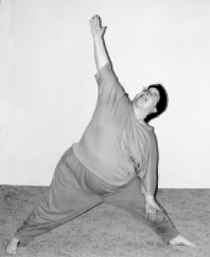 I don’t think this asana should be done any differently by fat people. Fat students need to pay special attention to not collapsing the underside of the rib cage because just the bending alone will restrict breathing somewhat.
Also, since the torso of the fat person weighs more, s/he may be tempted to rest a lot of weight on the hand touching the forward leg. This is a no-no for everyone, but especially if s/he has problem knees, it’s easy to make things worse by doing this. Also, if the fat student’s weight is primarily in the tummy, you should watch for swayback.
[Note from Gyandev McCord : Some Ananda Yoga Teacher Training students have heard me speak of a very heavy — okay, fat (whew, that was hard to say!) — student whose video workshop asana was Trikonasana. You also saw me demonstrate the way she did it — rather narrow stance, very little sideways bend — and say “But her spine was straight, her pelvis, torso, and shoulders were opening, her breath was full and even, and she was vibrant, joyful. There was no doubt: it was a real Trikonasana!”]
[Well, that student was Kay. In the picture above, you can see how nicely her pose has evolved. Can’t you almost feel the energy and joy flooding Kay’s body cells?]
In this asana, the fat student may have difficulty snagging the heels behind him/her without twisting and leaning back, which is clearly potentially hazardous for the lower back. The modification wherein the student places his/her hands on the upper back rim of the pelvis, then performs the backward bend, is usually easier.
For those who sure of the strength in their lower backs, holding a strap with both hands behind the body while doing the backbend is another alternative.
Unless there are knee problems, most fat people are comfortable with the first phase of this asana. The second phase is harder for everyone, of course. The fat person performing this asana must be sure of his/her leg strength and knee health, since s/he must carry more weight. The most troublesome part is keeping the knees pointed forward as s/he completes the squat, due yet again to abdominal and thigh fat. I have found that I and other fat people unconsciously lean back in order to breathe better, which places stress on the lower back as well as hinders an already precarious balance. I teach fat students to go down as far as possible, maintaining alignment, then to come out of the asana.
Alternatively, they can start the asana from a slightly duckfooted and externally rotated leg position. We’re talking a couple of inches, no more. This allows the necessary room for the thighs and belly as they squat. This changes the lower back stretch and which aspect of the quadriceps is working the hardest, but I believe that as long as the legs are opened from the hips, and the knees stay in alignment with the feet, there is no extra danger.
As with any student, if it’s too hard to come straight up out of the second phase of Utkatasana, a fat student can bring his or her hands forward onto the floor, resulting in an all-fours position. Then s/he can simply straighten up to “standing” on the knees and step up to Tadasana.
As with Balasana, the thigh fat just doesn’t know where to go in this asana! Therefore, the fat student may not be able to sit on the heels at all. For some, however, especially midsized people, the trick I described for Balasana — rolling the muscle and fat on the calves and thighs laterally — may help. Usually, though, sitting on a cushion is required, and the legs will simply be as close together as the fat permits.
Another potential problem in this asana for the fat person concerns the feet. The heels bear more weight with a fat person, and the extreme plantar flexion that results may cause painful cramps. In addition, if the student (fat or thin) has plantar fasciitis (chronic inflammation of the connective tissue in the soles of the feet), this asana can aggravate the condition.
To solve the problem, I use a large enough towel roll under the fronts of the ankles to make the angle of the ankle between 90 and 120 degrees, rather than the more usual 150 degrees or more.
This is another asana that my neck protests, so I myself don’t practice it. The main problem(s) for the fat person would probably be once again getting the elbows in enough to provide the necessary leverage, plus the sheer amount of weight that must be supported by the arms/wrists, which is a difficulty even for many thinner students.
When I was first learning this asana, I would lift my torso, then blithely sway, putting weight on first one shoulder, then another, in order to move the elbows in. It made the asana possible for me, but I was doing heinous things to my neck in the process. I have seen other strong fat people attempt the same maneuver, and I’ve had to rush to stop them. It’s frustrating for the fat student who is otherwise ready to try the asana.
A way around the difficulty is to practice against the wall or with a chair. With the buttocks and feet resting against the wall, legs bent, it is possible to support some of the weight via the legs instead of the hands, just enough to shift the elbows in without torquing the neck. However, it could place a little extra flexion strain on the neck, so one must use caution.
The notes about blankets mentioned for Halasana also apply here.
Fat people generally make excellent warriors! This asana requires strength, but extra fat doesn’t get in the way of anything here. The extra weight does make an already challenging pose a bit more challenging, but that will be a problem only if the fat student has no prior physical conditioning.
Watch for swayback in those who weight is primarily in the tummy.
Except for the advanced half-lotus version of this asana, wherein thigh fat would interfere with placement of the raised leg, this asana is usually no more problematic for fat people than for thin, unless the fat person is very out of shape.
Sometimes, though, a fat person has less of a sense of his/her own balance than a thinner person, so it may take a little while to find it. Watch for swayback among those who weight is primarily in the tummy.
