When I sit for meditation for 10 minutes or so, I feel discomfort near my neck area. Please give me some suggestions.
—Kiran, USA
Dear Kiran,
Neck pain while meditating, or in any other seated position, can arise from chronic conditions as well as your posture.
Assuming for the moment that you don’t have any specific medical conditions with your neck, you can probably improve your comfort by checking and adjusting your meditation position. If you have discomfort only when meditating, then it’s very likely your posture, although there are other possible contributing factors.
Let’s look first at posture. Overall, because the neck is the top portion of the spine, neck pain can actually originate anywhere along the spine. For example, your body might try to compensate for a strain in the lumbar region by tensing in such a way that it creates a strain in the thoracic or cervical area.
Your posture for meditation, with whatever seat you use, should be upright, balanced, and relaxed preserving the natural curves of your spine in the lumbar, thoracic and cervical area. Imagine having a string dropping down through the center of your body from the center of the top of your head with all the body parts relaxed and balanced to keep that string centered. Avoid having the spine rounded so that you are slumped forward with shoulders rounded, collapsed chest, head in front of the shoulders or sit so that you are leaning backward and off center.
You can refer to the article, How to Sit Comfortably in Meditation for details on different sitting in a chair, on a meditation bench, and on the floor with a suitable cushion.
Meditating benches that have a little forward tilt, as you can see in the photo above, are a good way to sit with a relaxed, upright spine. If you’re a new meditator, especially, a meditation bench helps your body become accustomed to that posture. The downside of a meditation bench is that the position puts pressure on your lower legs and knees, which may not work as well for longer periods of meditation.
When sitting in a chair, it helps to tip your pelvis gently tipped forward by sitting on an angled cushion or the edge of a blanket or pillow. Be very mindful of this, because every chair has its own tilt. Some chairs are flat, some tilt a little forward, and others tilt a little backwards.
When sitting on the floor, find a suitable cushion that also provides the pelvic tilt. The exact shape, height, and firmness of the cushion is a very individual matter. Some people to well with just a flat blanket; others like a round cushion (a “zafu”); still others like a crescent-shaped cushion. All in all, it takes some experimenting.
Moving up the spine, once you have the pelvis in a comfortable position with a little forward tilt, check the upper chest. People sometimes have a habit of keeping the shoulders tense and shrugged upward. Lift and roll your shoulders up and back, then drop them so they rest in a centered, not rolled forward position. Draw the shoulder blades gently together and uplift the sternum, the center of the upper chest, feel the heart area open, your breath relaxed with good expansion in the lower rib and diaphragm area as you breathe.
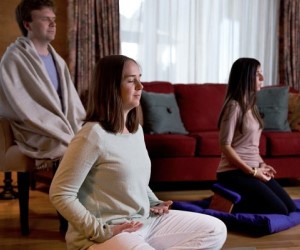
Try also placing your hands upright at the junction of the thighs and abdomen and drawing your elbows back, as you see in the photo here. This position of the hands helps to keep the check open. If you prefer to place your hands elsewhere, first lift and open the upper chest, then find a position of your hands, rather than allowing the position of the hands to dictate the position of the chest.
With the head and neck, now, check to be sure the head is centered on the spine (not jutting forward or leaning back) and your chin is parallel to the floor. (Your adjustments lower down the spine will help with head position). The neck muscles should be relaxed because the head is centered and the neck muscles are not working to hold your head up.
Also keep the muscles of the jaw and face relaxed as tense muscles there can contribute to neck tension. Your eyes, too, should be relaxed. Ananda recommends lifting your gaze slightly as if looking to a distant mountain peak. Alternately, hold your thumb upright with your arm outstretched and slightly raised. Feel the position of your eyes as you look at your thumb, then try to hold your eyes in that position, keeping them relaxed. Sometimes, when new meditators are instructed to concentrate at the spiritual eye (the point between the eyebrows), they go crossed-eyed, which can strain the eyes as well as the neck.
It can be really helpful to have a friend take a look at your meditation position with these guidelines in mind. They may be able to see something that you don’t notice yourself. Have them take photos of you as well so you can look closely at your posture. Then try making adjustment and see if they help you stay comfortable.
Furthermore, have the friend watch as you meditate for a time, or have them perhaps set up your phone to record a video. Your posture may be changing as you progress in your meditation. That is, as you interiorize, your body may be relaxing away from its initial position, most likely assuming more habitual positions that may not be suitable for meditation. By increasing your awareness of those habits, you can make adjustments and gradually train your body to hold a better position.
What may also be happening is that when the rest of your body relaxes in meditation, that specific areas of chronic tension announce themselves. Be sure, then, that you’re getting regular exercise and doing some stretching. Practicing the Energization Exercises is very helpful.
Beyond your posture while meditating, also be aware of your posture during the day. Do you work a desk job with a computer? Take a careful look at the ergonomics of your workstation. For example, working directly on a laptop forces you to tilt your head downwards, which can strain the neck over time. It’s much better to have a separate monitor that’s positioned so that your eyes are level with the upper quarter of the monitor.
If you spend a lot of time on your smartphone, be mindful of how you’re holding the phone in relation to your head and neck. The default posture, which I’m sure you’ve seen with many other people, is to hold the phone close to your belly, which forces you to tilt your head downwards, stretching your neck. For a better posture, hold the phone up closer to the level of your face, thereby keeping your head upright and your neck straight and relaxed.
If you spend a lot of time in your car, also check the support of your seat. The same goes for other chairs and sofas in your home: if they don’t support you properly, you may be creating tensions in the body that manifest when you sit to meditate and your body tries to relax. Your bed, too, is a factor: does it have the proper support? How about your pillows?
Do you have neck pain at other times of the day? If so, try to observe if there’s anything in common with your posture then and your posture while meditating.
Let me return briefly to potential chronic conditions. If you’ve had any trauma like a neck injury or whiplash, then it’s important to correct any residual effects. Such injuries may be giving rise to chronic posture problems that just happen to manifest while meditating. A chiropractor or physical therapist will be able to assess the health of your neck joints and can also evaluate your meditation posture. Don’t be afraid to ask!
And is your neck pain possibly seasonal? If so, then allergies may be involved. Of course, in such a circumstance you’re likely feeling the pain at other times than when you meditate, but it’s a possibility.
Many blessings,
Nayaswami Mukti
(Revised and expanded May 2024 by Satyaki)
Ananda Course in Meditation
A 10-week online course with in-depth instruction in scientific meditation techniques that bring more peace, deeper relaxation, and focused concentration to every area of your life.
Learn more